Successful Start to NASA’s SpaceX Crew-5 mission

Image (Credit): October 5, 2022 departure of a SpaceX Falcon 9 rocket from the Kennedy Space Center in Florida carrying NASA’s SpaceX Crew-5 mission to the ISS. (NASA/Joel Kowsky)

Earlier today, SpaceX Crew-5 successfully departed from NASA’s Kennedy Space Center in Florida on their way to the International Space Station (ISS). The four members on this flight are NASA astronauts Nicole Mann and Josh Cassada, Japan Aerospace Exploration Agency astronaut Koichi Wakata, and Roscosmos cosmonaut Anna Kikina. The population of the ISS will increase to 11 until 3 astronauts return to Earth a few days later.

Here is NASA’s bio on the new crew members:

  • As commander, Mann is responsible for all phases of flight, from launch to re-entry, and will serve as an Expedition 68 flight engineer. This will be her first spaceflight since becoming an astronaut in 2013. Mann was born in Petaluma, California, and will be the first indigenous woman from NASA in space. She is a colonel in the U.S. Marine Corps, and she served as a test pilot in the F/A-18 Hornet and Super Hornet.
  • Cassada is the spacecraft pilot and second in command for the mission. He is responsible for spacecraft systems and performance. Aboard the station, he will serve as an Expedition 68 flight engineer. This will be his first flight since his selection as an astronaut in 2013. Cassada grew up in White Bear Lake, Minnesota, and is a physicist and U.S. Navy test pilot.
  • Wakata will be making his fifth trip to space and as a mission specialist he will work closely with the commander and pilot to monitor the spacecraft during the dynamic launch and re-entry phases of flight. Once aboard the station, he will serve as a flight engineer for Expedition 68. With Crew-5’s launch, Dragon will be the third different type of spacecraft Wakata has flown to space.
  • Kikina will be making her first trip to space, and will serve as a mission specialist, working to monitor the spacecraft during the dynamic launch and re-entry phases of flight. She will be a flight engineer for Expedition 68.

NASA News: An Eye on Hurricane Ian

Image (Credit): Images from the ISS’s instruments monitoring Hurricane Ian as the storm neared Cuba. (NASA/JPL-Caltech)

It may have been a bad week for NASA regarding the delayed launch of the Artemis I mission from Florida, but it has been a good week for NASA as it illustrates the benefits of monitoring Hurricane Ian as it crosses the Caribbean and heads towards Florida.

Two NASA instruments on the International Space Station (ISS) in particular are helping with this monitoring:

  • Compact Ocean Wind Vector Radiometer (COWVR) to measure the amount of rain in the atmosphere; and
  • Temporal Experiment for Storms and Tropical Systems (TEMPEST) to track the volume of ice particles pushed into the upper atmosphere by the storm.

Together these instruments give us a much better understanding of the storm hitting the eastern coast of the United States. In this type of situation, any additional details can assist civic leaders and potentially save lives.

We are all fascinated by NASA’s images showing dust storms sweeping across Mars or highlighting the Great Red Spot on Jupiter, which represents a violent storm that has marked the planet’s surface for hundreds of years. Enormous storms mark and transform the face of our Earth as well. Monitoring our own planetary storm systems is another worthwhile goal for our NASA scientists.

RIP: Cosmonaut Valery Vladimirovich Polyakov

Image (Credit): Cosmonaut Valery Polyakov. (NASA)

Last week cosmonaut Valery Polyakov passed away at the age of 80 (1942 to 2022). He still holds the record for the longest single spaceflight in history when he was aboard the Mir space station for 437 days and 18 hours during one stay between 1994 and 1995. By the time he retired later in 1995, he had spent 678 days in space.

Russians have a history of long tours in space, including four cosmonauts from the last century who spent at least one year in a single tour:

  • Valery Polyakov – 437 days aboard Mir (1994-95)
  • Sergei Avdeyev – 379 days aboard Mir (1998-99)
  • Vladimir Titov – 365 days aboard Mir (1987-88)
  • Musa Manaro – 365 days aboard Mir (1987-88)

When U.S. astronaut Astronaut Scott Kelly returned to Earth with cosmonaut Mikhail Kornienko from the International Space Station in 2016 after 340 days in space, the Russians were not so impressed according to a story in arsTECHNICA. The story notes cosmonaut Talgat Musabayev, serving as the head of the Kazakh space agency, stated, “Congratulations on your record. Of course it was already done 28 years ago.” 

Image (Credit): The Soviet Mir space station. (Encyclopaedia Britannica)

Soyuz Launch to Space Station a Success

Image (Credit): The Soyuz MS-22 rocket launch from earlier today. (NASA/Bill Ingalls)

Earlier today, the Russian Soyuz MS-22 rocket launched from Kazakhstan and successfully placed three new inhabitants on the International Space Station (ISS): NASA astronaut Frank Rubio and Russian cosmonauts Sergey Prokopyev and Dmitri Petelin. The three will stay on the ISS for the next six month, while three cosmonauts will be returning to Earth next week after completing their own six month tours.

Even with all of the Russian posturing back on the surface, it is great to see the ISS team is remaining above the fray. That is, if you ignore the flag-waving antics of the three returning cosmonauts. Sorry, I could not leave it alone.

More Space Travel Offers from China and NASA

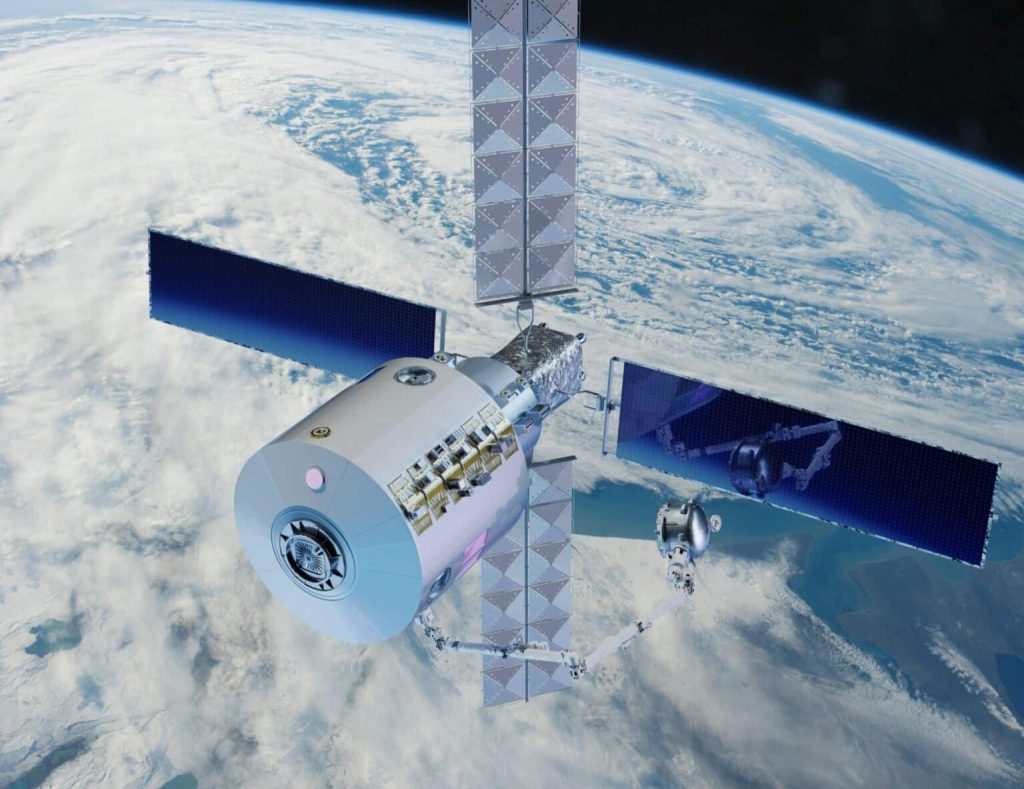
Image (Credit): Artist’s impression of the Chinese Space Station. (China Manned Space Program)

The China Global Television Network recently reported that China is looking into offering space rides to commercial passengers by 2025, including suborbital flights, cargo flights, and trips to Chinese Space Station. For instance, suborbital flights are expected to be priced at 2 and 3 million yuan (or $287,200 to $430,800).

Given the growing U.S. space industry with its own range of space flight options, it was only a matter of time that China would enter this commercial space race. Russia has been in the game the longest, having sold seats to U.S. astronauts hoping to reach the International Space Station (ISS) following the demise of the space shuttle.

Not to be outdone, NASA has also announced plans to take commercial passengers to the ISS at $55 million per seat. According to Tech Times, NASA is seeking commercial partners for two such flights per year starting as early as 2023. We have already discussed the Axiom Mission 1 (or AX-1 mission) to the ISS earlier this year at about the same price, so this is not a new idea. I guess the Axiom Mission 1 went well enough for NASA to see this as a regular operation.

A variety of space travel options from a variety of countries and commercial suppliers shows that playing in space can be both fun and profitable. Just ask Captain Kirk.

That is fine, as long as the tourists do not get in the way of the real work that is being conducted. With the taxpayers still footing most of the space-faring bill, we do not want space travel to be seen as only a luxury for the wealthy (similar to electric vehicles in the U.S., up to now). Space and related space travel should be seen as something belonging to everyone.