Image (Credit): The Expedition 74 crew members launched towards the space station earlier today aboard a Soyuz rocket from Baikonur Cosmodrome in Kazakhstan. (NASA/Bill Ingots)
This week’s image shows a Soyuz rocket sending a crew to the International Space Station (ISS) on Thanksgiving Day. One NASA astronaut and two Russian cosmonauts are thankful today that they are safe and sound on the ISS. NASA astronaut Chris Williams joined Roscosmos cosmonauts Sergey Kud-Sverchkov and Sergei Mikaev aboard a Soyuz rocket launched from Russia earlier today.
The three crew members of Expedition 74 join the Expedition 73 crew members already on the station, increasing the crew count to 10 members for the next few weeks. Expedition 74 is scheduled to begin on Monday, December 8th, once three members depart the ISS.
These crews change like clockwork, regardless of holidays, government shutdowns, or even hot wars back on the surface. This dedication to duty is something we can all be thankful for.
Image (Credit): NASA Expedition crew members (clockwise from the left) Zena Cardman, Mike Fincke, Jonny Kim, and JAXA astronaut Kimiya Yui recording their holiday message. (NASA)
The NASA Expedition 73 crew on the International Space Station (ISS) has recorded a Thanksgiving greeting for all of us down here looking up.
So what can the astronauts expect to eat for Thanksgiving? Astronaut Mike Fincke mentioned turkey and cranberry sauce, while astronaut Zena Cardman added mashed potatoes, crab meat, salmon, lobster, and more.
In a Florida Todaynews story, Steve Siceloff, a NASA public affairs officer, stated:
The crews’ holiday meals, including Thanksgiving, were flown up on NG-23 [on September 14]. On board the spacecraft was a special Holiday Bulk Overwrapped Bag (BOB) filled with festive foods like clams, oysters, crab meat, quail, and smoked salmon, along with shelf-stable treats such as candies, icing, almond butter, and hummus,
Happy Thanksgiving wishes to the ISS crew as well as everyone back here on Earth.
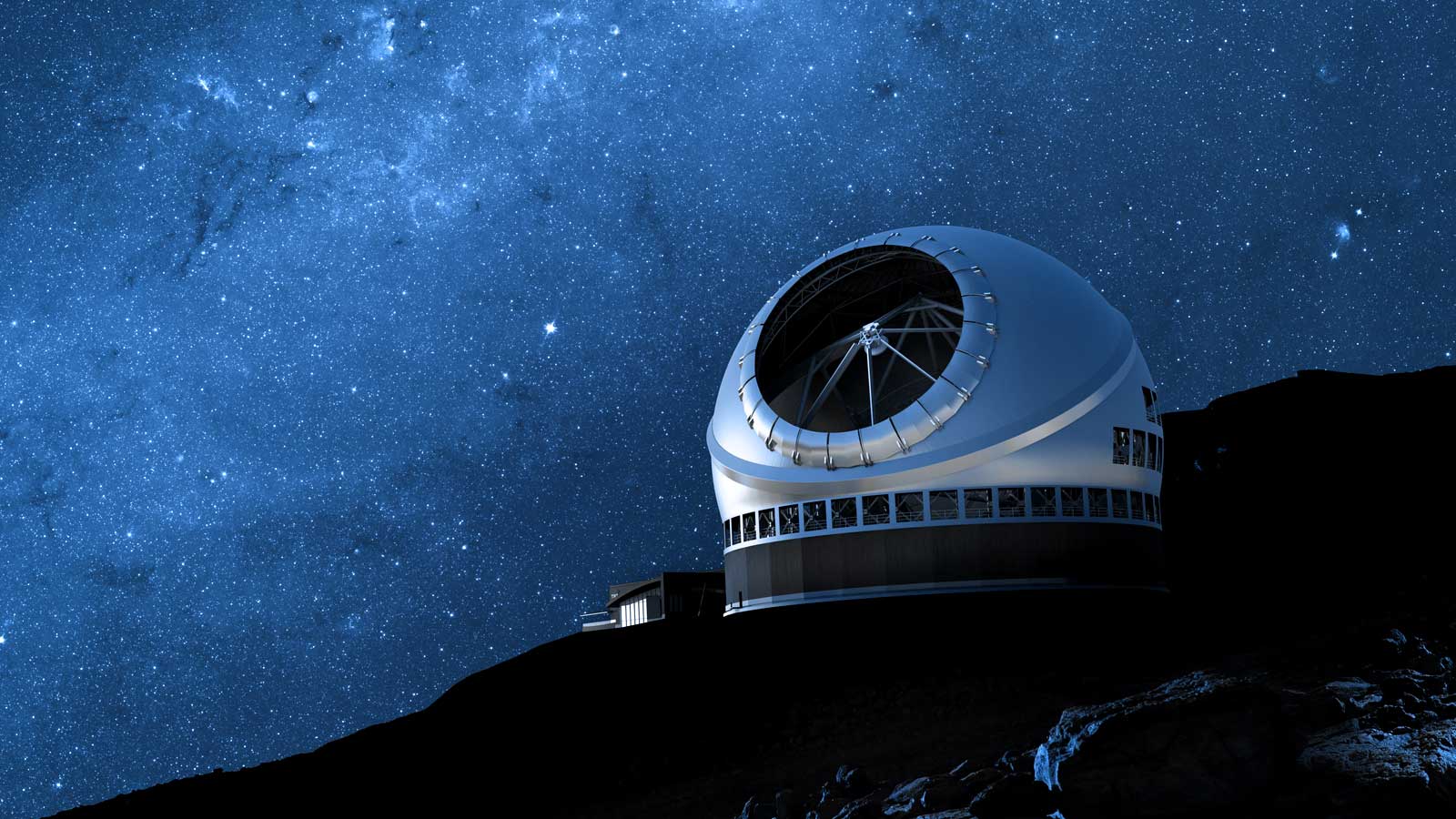
The Thirty Meter Telescope (TMT) was conceived more than two decades ago as the largest and most advanced telescope in the Northern Hemisphere. However, the telescope has encountered significant roadblocks, from funding uncertainties — now heightened by President Trump’s proposed budget cuts — to local resistance to building the telescope on Mauna Kea, a volcanic mountain in Hawai‘i that’s sacred to native communities. Now, the telescope might find a new home in La Palma on the Canary Islands of Spain. In July, the Spanish government offered to host the telescope, with an investment of up to €400 million ($460 million) to help cover some of the costs. In a brief statement posted on November 11th, the TMT announced that it is officially considering the move to La Palma.
In its latest shakeup to the Commercial Crew Program, NASA announced on Monday it has reduced the number of missions Boeing is required to fly to the International Space Station and changing the next flight from a crew mission to a cargo mission. The original contract NASA awarded to Boeing and SpaceX called for each to fly an uncrewed demonstration flight to the ISS, followed by a crewed demo mission and then conduct six regular crew rotation missions.
In the airless, radiation-saturated void outside of the International Space Station, researchers tested whether a common moss species known as Physcomitrium patens could survive at all, and if it could, for how long. The answers are yes and probably forever if it wants...Tomomichi Fujita, the study’s lead author, thinks moss could last up to 15 years in space, knowledge that could help build future extraterrestrial farms or entire ecosystems on the Moon or Mars.
The recent film The Astronaut did not stay in theaters very long, but then again very few films do these days. Even so, if you are looking for something inspiring, such as a space adventure that takes us away from Earth, you will be disappointed. This astronaut is from the International Space Station, not Mars, so we do not even make it to the Moon.
If the trailer is not clear enough, here is the main story from Deadline:
When astronaut Sam Walker (Mara) returns from her first space mission, she’s found miraculously alive in a punctured capsule floating deep off the coast of the Atlantic Ocean. General William Harris (Fishburne) arranges for her to be placed under intense NASA surveillance in a high security house for rehabilitation and medical testing. However, when disturbing occurrences begin happening around the property, she fears that something extraterrestrial has followed her back to Earth.
Without giving away the whole plot, just think of it as a gruesome ET: The Extraterrestrial. Critics were not impressed, with the Tomatometer showing only 42 percent approval. In general, a rating between 40 and 59 percent is considered mixed or mediocre, with the average film achieving something in the low 70s.
Matt Donato from Collider did not have high praise for writer/director Jess Varley’s first film:
The Astronaut has sky-high ambitions that go up in flames during the home stretch. Everything’s chugging along fine, then the tone implodes, and Varley’s command over scenes disintegrates...I haven’t seen a movie shoot itself in the foot like this in a wee bit, and that’s a shame.
The selection of films of this genre are slim, so you may have a desire to see it anyway. That’s fine, but you have been warned.
No trip to space can be counted a success unless you make it safely back to Earth…And it’s a lesson that was learned anew this week by the taikonauts—Chinese astronauts—Chen Dong, Chen Zhongrui, and Wang Jie. The trio arrived at China’s Tiangong Space Station aboard their Shenzhou-20 spacecraft on April 24, and were set to come home on Nov. 5, handing the keys to the station over to the three-person crew of Shenzhou-21, who arrived on Oct. 31.But that was not to be. Not long before Shenzhou-20 was set to carry the three home it was struck by a piece of space debris, leaving cracks in one of its windows. That can be deadly in a spacecraft that is supposed to remain airtight both in the vacuum of space and in the steadily thickening atmosphere as it returns to Earth.
A powerful geomagnetic storm that dazzled skywatchers across the Northern Hemisphere earlier this month also affected life aboard the International Space Station (ISS). During the Nov. 11-12 solar storm, Russian cosmonauts temporarily relocated their sleeping quarters as a precaution against increased radiation exposure, NASA confirmed.
Sierra Space has completed key testing milestones for its Dream Chaser vehicle as the company explores both civil and national security missions for the spaceplane. The company announced Nov. 13 that the first Dream Chaser vehicle, Tenacity, completed electromagnetic interference and compatibility testing at NASA’s Kennedy Space Center...While Sierra Space is emphasizing national security uses, the company is keeping open the option of using Dream Chaser to support the ISS or future commercial space stations, known as commercial low Earth orbit destinations, or CLDs.




 Our Awesome Universe