White House: U.S. Anti-Satellite Testing to End

Image (Credit): The White House. (Whitehouse.gov)

Earlier this week, Vice President Harris announced that the United States will no longer conduct anti-satellite missile testing in space. In her statement, she highlighted the dangers caused by the related satellite debris.

From Vandenberg Air Force Base in California, she stated:

I am pleased to announce that as of today, the United States commits not to conduct destructive direct-ascent anti-satellite missile testing.

Simply put: These tests are dangerous, and we will not conduct them.

We are the first nation to make such a commitment.  And today, on behalf of the United States of America, I call on all nations to join us.

Whether a nation is spacefaring or not, we believe this will benefit everyone, just as space benefits everyone.

In the days and months ahead, we will work with other nations to establish this as a new international norm for responsible behavior in space.  And there is a direct connection between such a norm and the daily life of the American people. 

If a satellite was taken out by debris, it could affect the daily weather forecast, GPS driving directions, and even your favorite TV station.

Critical infrastructure, like wind turbines that power our homes, well, they rely on satellites for connectivity.

Satellites help us track the climate crisis.  They enable our commercial activities.  And they help us protect our troops and our people.

All of this is threatened by the debris created by these reckless tests.

These tests also threaten the lives of astronauts in the International Space Station.

In fact, I spoke earlier this month with Mark Vande Hei who just returned from 355 days in space on the Space Station.  An American record.

While he was in space, Russia conducted its anti-satellite missile test.  He had to shelter in an escape capsule in case the Space Station was hit by debris.

Russia’s action was a threat not just to his life, but also to those of Russian cosmonauts.

Let’s hope other nations are quick to follow. Further discussions and decisions on limiting the number of satellites in low-Earth orbit would also be helpful. That said, it’s a start.

A Day in Astronomy: The Launch of Salyut 1

Image (Credit): Artist’s drawing of the Soviet Union’s Salyut 1 with a Soyuz spacecraft (upper left) approaching it. (NASA)

On this day in 1971, the Soviet Union launched Salyut 1, mankind’s first space station. The station was visited only once by a Soyuz 11 crew for 24 days, who had to cut their mission short do to technical problems, including an electrical fire. The crew died of asphyxia on the trip back to Earth.

While an earlier Soyuz 10 crew had attempted to dock with the Salyut 1, they were unsuccessful. This unsuccessful docking, followed by the death of the Soyuz 11 crew, led to a redesign of the Soyuz spacecraft. Unfortunately, the new spacecraft could not be launched in time to save the Salyut 1. The station burned up in the Earth’s atmosphere in October 1971.

The Salyut 1 was followed by the successful launch of five more stations, the last one being the Zvezda Service Module, launched in 2000. This module is still in orbit and part of the International Space Station.

Even with all of the issues, it was a great accomplishment for the Soviet Union. The United States did not have its own space station in orbit until the launch of Skylab 1 on May 14, 1973.

No one said space missions were easy or safe, as NASA has also learned over the years.

You can read more about the Soviet and Russian space stations at this NASA site.

Space Quote: Space Cowboys or Space Tourists?

Image (Credit): SpaceX AX-1 mission to the International Space Station. (SpaceX)

“We are not space tourists.”

– Statement by Michael López-Alegría who traveled as a private citizen (and former NASA astronaut) to the International Space Station (ISS) on Friday as part of SpaceX’s AX-1 mission.

Why does this remind me of the statement “I am not a crook”? Mr. López-Alegría leads the mission carrying three wealthy passengers who spent about $55 million apiece to stay on the ISS for eight days and basically get in the way of working astronauts. I thought Bigelow was working on inflatable space hotels. Wouldn’t that be more appropriate? And maybe that $55 million could go towards STEM classes for students who want to go to space as a career rather than a joyride. Just an idea.

Image (Credit): Artist’s rendering of a Bigelow inflatable space station. (Bigelow Space Ops)

Space Quote: Good Feelings in Orbit

Image (Credit): NASA Astronaut Mark Vande Hei aboard the International Space Station. (NASA)

“They were, are and will continue to be very dear friends of mine. We support each other throughout everything. And I never had any concerns about my ability to continue working with them – very good professionals and technically competent and wonderful human beings.”

-NASA astronaut Mark Vande Hei, who returned to Earth from the International Space Station (ISS) last week, regarding his US and Russian crew mates, as quoted in the Washington Post. As a result of his latest ISS mission, Mr. Vande Hei has now spent more time in space on a single mission than any other US astronaut.

Where is the International Space Station?

Image (Credit): The International Space Station. (NASA)

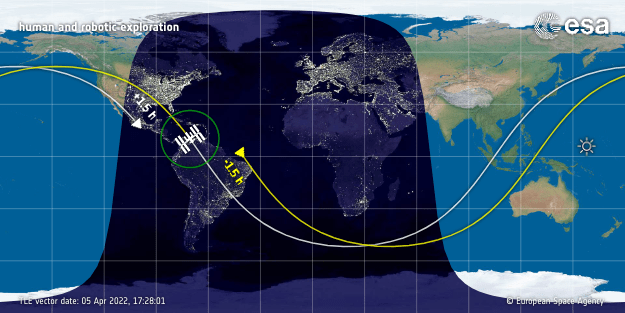
If you are standing outside in your yard looking for the International Space Station (ISS) at dawn or dusk (which is necessary to see the sun’s reflection on the station), this NASA site called Spot the Station may help. The site provides a global tracking map created by the European Space Agency (ESA) showing the current location of the ISS as well as its spot 90 minutes ago and 90 into the future.

NASA notes that the ISS circles the Earth every 90 minutes, traveling at about 17,500 miles per hour. While you experience one sunrise per day, an astronaut on the ISS will experience 16 sunrises each day.

You can find more ISS facts and figures here.

Image (Credit): ISS global tracking map. (ESA)