
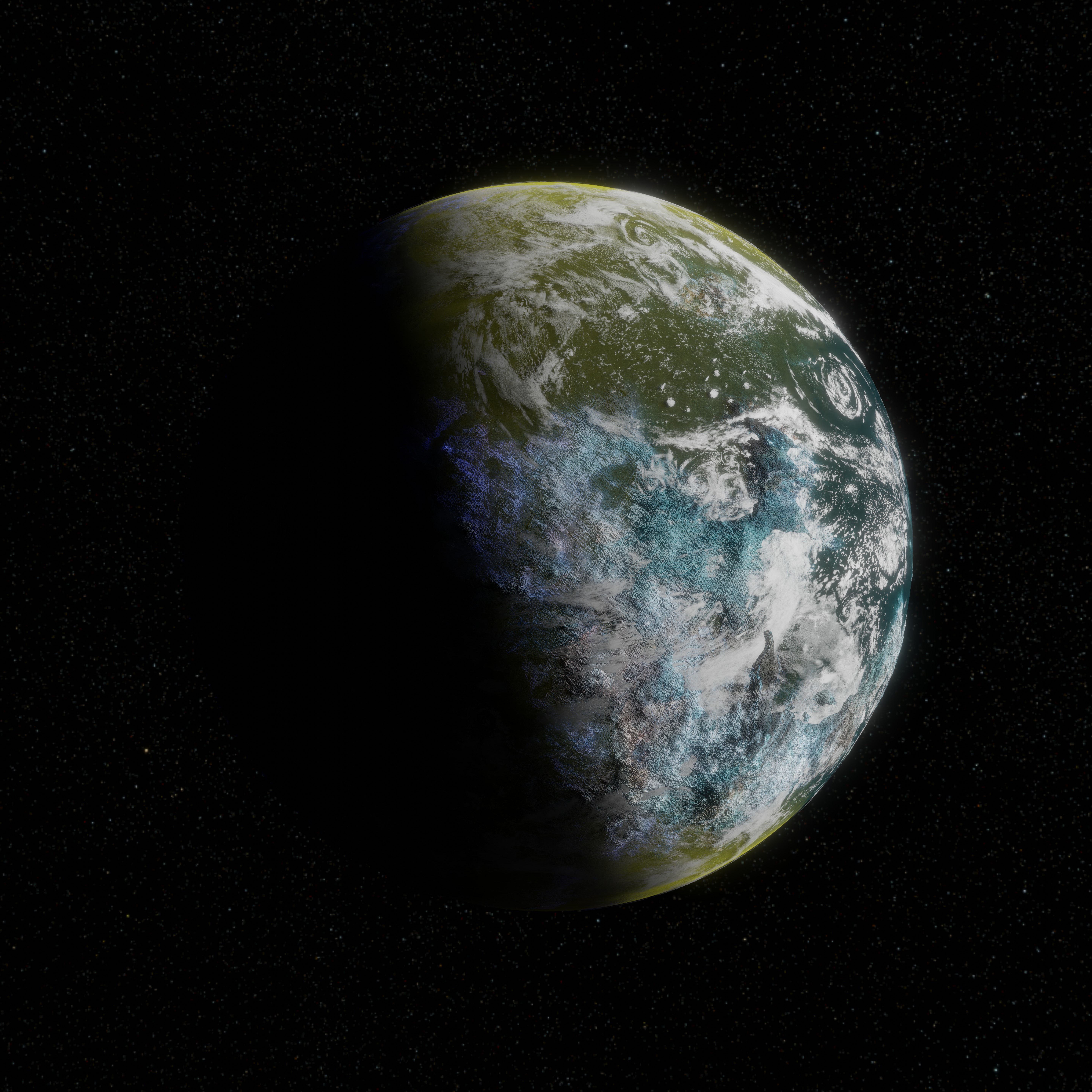
Here are some recent space-related stories of interest related to exoplanets.
—Wired: “Astronomers Confirm Discovery of the Youngest Known Exoplanet Ever”
Newly formed exoplanets are often buried within disks of gas and dust, the leftover building blocks from a planet’s formation, also known as a protoplanetary disk. The difficulty of just locating such a new celestial body is part of what makes the discovery of the exoplanet Elias 2-24b—now the youngest ever confirmed—so exciting…Elias 2-24b is located approximately 450 light-years from Earth. It orbits its star at a distance of approximately 55 astronomical units (one astronomical unit being the average distance between Earth and the sun). Its mass is estimated to be at most 1.9 to 4.0 times that of Jupiter, though researchers believe its volume is likely to be much smaller than our local gas giant. Since its host star is less than 1 million years old, Elias 2-24b is estimated to be similarly young.
—CNN: “First-ever Evidence of a Second-generation Planet Detected Around Dead Star“
In a cosmic first, scientists say they have detected a planet that may have formed from the burned remains of its dead host star. The planet is likely a gas giant orbiting a white dwarf called HS 0209+0832 located about 270 light-years from Earth, according to the authors of a study published Monday in the journal Nature Astronomy. After analyzing observations from NASA’s Hubble Space Telescope and other instruments, the team found chemical evidence that suggests the planet could have condensed from material expelled by the star as it fizzled out of energy and collapsed into a white dwarf.
—Space.com: “Astronomers Discover a Cold Lava Planet That May Resemble Early Earth“
Scientists have discovered a new planet that defies all expectations. It’s a lava world, but it’s also cold. In fact, it’s the coldest lava world we’ve ever seen with an atmosphere. Researchers spotted HD 3167 b, a rocky super-Earth covered in lava, orbiting a star 154 light-years away. This planet orbits so closely to its star that a “year” on the world (one revolution around its star) takes only one Earth day. But it’s not just a lava-covered rock — it’s the smallest lava world researchers have ever found. And yet, it has managed to hang onto its atmosphere.
Note: Here is the podcast version of this post.

