Image (Credit): Supernova Remnant Cassiopeia A. (NASA, ESA, CSA, STScI; D. Milisavljevic (Purdue University), T. Temim (Princeton University), I. De Looze (University of Gent))
This week’s image captured by the James Webb Space Telescope is both violent yet beautiful. It is also NASA’s Astronomy Picture of the Day for today.
Here are some details about the image from NASA:
Massive stars in our Milky Way Galaxy live spectacular lives. Collapsing from vast cosmic clouds, their nuclear furnaces ignite and create heavy elements in their cores. After only a few million years for the most massive stars, the enriched material is blasted back into interstellar space where star formation can begin anew. The expanding debris cloud known as Cassiopeia A is an example of this final phase of the stellar life cycle. Light from the supernova explosion that created this remnant would have been first seen in planet Earth’s sky about 350 years ago, although it took that light 11,000 years to reach us. This sharp NIRCam image from the James Webb Space Telescope shows the still hot filaments and knots in the supernova remnant. The whitish, smoke-like outer shell of the expanding blast wave is about 20 light-years across. Light echoes from the massive star’s cataclysmic explosion are also identified in Webb’s detailed image of supernova remnant Cassiopeia A.
Planets with radii between that of the Earth and Neptune (hereafter referred to as ‘sub-Neptunes’) are found in close-in orbits around more than half of all Sun-like stars. However, their composition, formation and evolution remain poorly understood. The study of multiplanetary systems offers an opportunity to investigate the outcomes of planet formation and evolution while controlling for initial conditions and environment. Those in resonance (with their orbital periods related by a ratio of small integers) are particularly valuable because they imply a system architecture practically unchanged since its birth. Here we present the observations of six transiting planets around the bright nearby star HD 110067. We find that the planets follow a chain of resonant orbits. A dynamical study of the innermost planet triplet allowed the prediction and later confirmation of the orbits of the rest of the planets in the system. The six planets are found to be sub-Neptunes with radii ranging from 1.94R⊕ to 2.85R⊕. Three of the planets have measured masses, yielding low bulk densities that suggest the presence of large hydrogen-dominated atmospheres.
Citation: Luque, R., Osborn, H.P., Leleu, A. et al. A resonant sextuplet of sub-Neptunes transiting the bright star HD 110067. Nature 623, 932–937 (2023). https://doi.org/10.1038/s41586-023-06692-3
Image (Credit): JWST’s view of the Milky Way. (NASA)
With the Thanksgiving holiday almost over, you may be thinking of Christmas lights after seeing the image above. Think larger, such as the size of a galaxy. You are looking at approximately 500,000 stars at the center of the Milky Way galaxy as seen by the James Webb Space Telescope (JWST), and it is pretty amazing.
The Webb telescope site has this to say about the image (and even more to say at the linked site):
A bright field of gas sweeps around the edge of a dark, dense cloud where young stars are bursting out to take their place in the universe. They join an estimated 500,000 other stars in the scene, of various ages, sizes, and colors. It’s the hub of our Milky Way galaxy, a city center at rush hour, making our solar system’s calm corner a frontier outpost by comparison. Discover the new features – and mysteries – NASA’s James Webb Space Telescope has revealed with its unprecedented infrared-light view of the chaotic region, and what it means for astronomy.
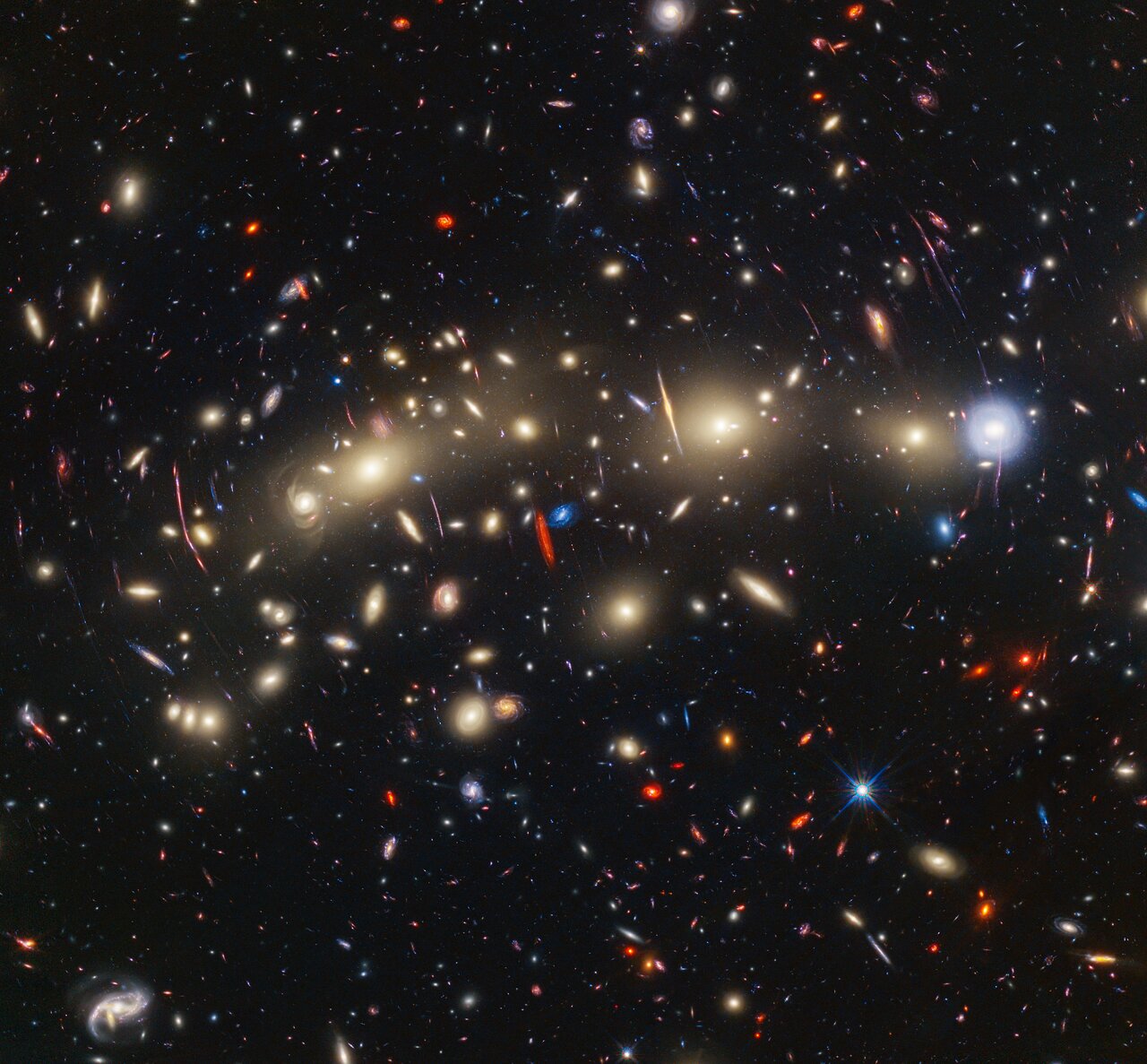
Image (Credit): Galaxy cluster MACS0416. (NASA, ESA, CSA, STScI, J. Diego (Instituto de Física de Cantabria, Spain), J. D’Silva (U. Western Australia), A. Koekemoer (STScI), J. Summers & R. Windhorst (ASU), and H. Yan (U. Missouri))
This week’s image combines the talents of the Hubble Space Telescope and the James Webb Space Telescope to create a dazzling show of light. The galaxy cluster, known as MACS0416, is about 4.3 billion light-years from Earth.
The image reveals a wealth of details that are only possible by combining the power of both space telescopes. It includes a bounty of galaxies outside the cluster and a sprinkling of sources that vary over time, likely due to gravitational lensing — the distortion and amplification of light from distant background sources.
This cluster was the first of a set of unprecedented, super-deep views of the Universe from an ambitious, collaborative Hubble programme called the Frontier Fields, inaugurated in 2014. Hubble pioneered the search for some of the intrinsically faintest and youngest galaxies ever detected. Webb’s infrared view significantly bolsters this deep look by going even farther into the early Universe with its infrared vision.
To make the image, in general the shortest wavelengths of light were colour-coded blue, the longest wavelengths red, and intermediate wavelengths green. The broad range of wavelengths, from 0.4 to 5 microns, yields a particularly vivid landscape of galaxies.
Those colours give clues to galaxy distances: the bluest galaxies are relatively nearby and often show intense star formation, as best detected by Hubble, while the redder galaxies tend to be more distant and are best detected by Webb. Some galaxies also appear very red because they contain copious amounts of cosmic dust that tends to absorb bluer colours of starlight.
While the new Webb observations contribute to this aesthetic view, they were taken for a specific scientific purpose. The research team combined their three epochs of observations, each taken weeks apart, with a fourth epoch from the CANUCS (CAnadian NIRISS Unbiased Cluster Survey) research team. The goal was to search for objects varying in observed brightness over time, known as transients.
They identified 14 such transients across the field of view. Twelve of them were located in three galaxies that are highly magnified by gravitational lensing, and they are likely to be individual stars or multiple-star systems that are briefly very highly magnified. The remaining two transients are within more moderately magnified background galaxies and are likely to be supernovae.
The finding of so many transients with observations spanning a relatively short timeframe suggests that astronomers could find many more transients in this cluster and others like it through regular monitoring with Webb.
Among the transients the team identified, one stood out in particular. Located in a galaxy that existed about 3 billion years after the Big Bang, it is magnified by a factor of at least 4000. The team nicknamed the star system Mothra in a nod to its ‘monster nature’, being both extremely bright and extremely magnified. It joins another lensed star that the researchers previously identified and that they nicknamed Godzilla. Both Godzilla and Mothra are giant monsters known as kaiju in Japanese cinema.
Interestingly, Mothra is also visible in the Hubble observations that were taken nine years earlier. This is unusual, because a very specific alignment between the foreground galaxy cluster and the background star is needed to magnify a star so greatly. The mutual motions of the star and the cluster should have eventually eliminated that alignment.
The most likely explanation is that there is an additional object within the foreground cluster that is adding more magnification. The team was able to constrain its mass to be between 10 000 and 1 million times the mass of our Sun. The exact nature of this ‘milli-lens’, however, remains unknown. It is possible that the object is a globular star cluster that’s too faint for Webb to observe directly.
If you are trying to learn more about the space programs at NASA, you can download the recently updated NASA+ app, which has a variety of videos and astronomy series to please anyone’s curiosity. For instance, check out the videos under “Scientific Wonders” to learn more about the James Webb Space Telescope, the New Horizons mission to Pluto, the Hubble Space Telescope, the Kepler Space Telescope, the OSIRIS-REx asteroid sample return, and much more.
This free app can bring you up to speed on the earlier space programs as well as provide updates on the latest missions. For example, you can watch the video showing yesterday’s docking of the SpaceX CRS-29 Cargo Dragon Resupply Craft with the International Space Program.
You cannot go wrong with this free app. You can read more about the updated NASA+ app here.




 Our Awesome Universe