Pic of the Week: Eyeing the Ring Nebula

Image (Credit): The Ring Nebula as captured by the JWST. (ESA/Webb, NASA, CSA, M. Barlow (University College London), N. Cox (ACRI-ST), R. Wesson (Cardiff University))

This week’s image comes from the Jame Webb Space Telescope’s (JWST) Near-Infrared Camera (NIRCam). It shows the Ring Nebula, which is approximately 2,500 light-years away. It looks like a heavenly eyeball. with an Earth-colored iris.

Here is more on the image from NASA:

The NASA/ESA/CSA James Webb Space Telescope has observed the well-known Ring Nebula with unprecedented detail. Formed by a star throwing off its outer layers as it runs out of fuel, the Ring Nebula is an archetypal planetary nebula. Also known as M57 and NGC 6720, it is both relatively close to Earth at roughly 2,500 light-years away. This new image provides unprecedented spatial resolution and spectral sensitivity. For example, the intricate details of the filament structure of the inner ring are particularly visible in this dataset. There are some 20,000 dense globules in the nebula, which are rich in molecular hydrogen. In contrast, the inner region shows very hot gas. The main shell contains a thin ring of enhanced emission fromcarbon-based molecules known as polycyclic aromatic hydrocarbons (PAHs). Roughly ten concentric arcs are located just beyond the outer edge of the main ring. The arcs are thought to originate from the interaction of the central star with a low-mass companion orbiting at a distance comparable to that between the Earth and the dwarf planet Pluto. In this way, nebulae like the Ring Nebula reveal a kind of astronomical archaeology, as astronomers study the nebula to learn about the star that created it.

Space Quote: Astronomers Have a New Term – JuMBOs

Image (Credit): Image of Jupiter taken by the Hubble Space Telescope. (Amy A. Simon/NASA/European Space Agency)

“We find them down as small as one Jupiter mass, even half a Jupiter mass, floating freely, not attached to a star…Physics says you can’t even make objects that small. We wanted to see, can we break physics? And I think we have, which is good.”

Statement by Mark McCaughrean, a senior adviser for science and exploration at the European Space Agency, regarding Jupiter Mass Binary Objects (JuMBO). These objects were spotted by the James Webb Space Telescope in the Orion Nebula. They may be a new astronomical body as they do not fit into the normal star or planet category.

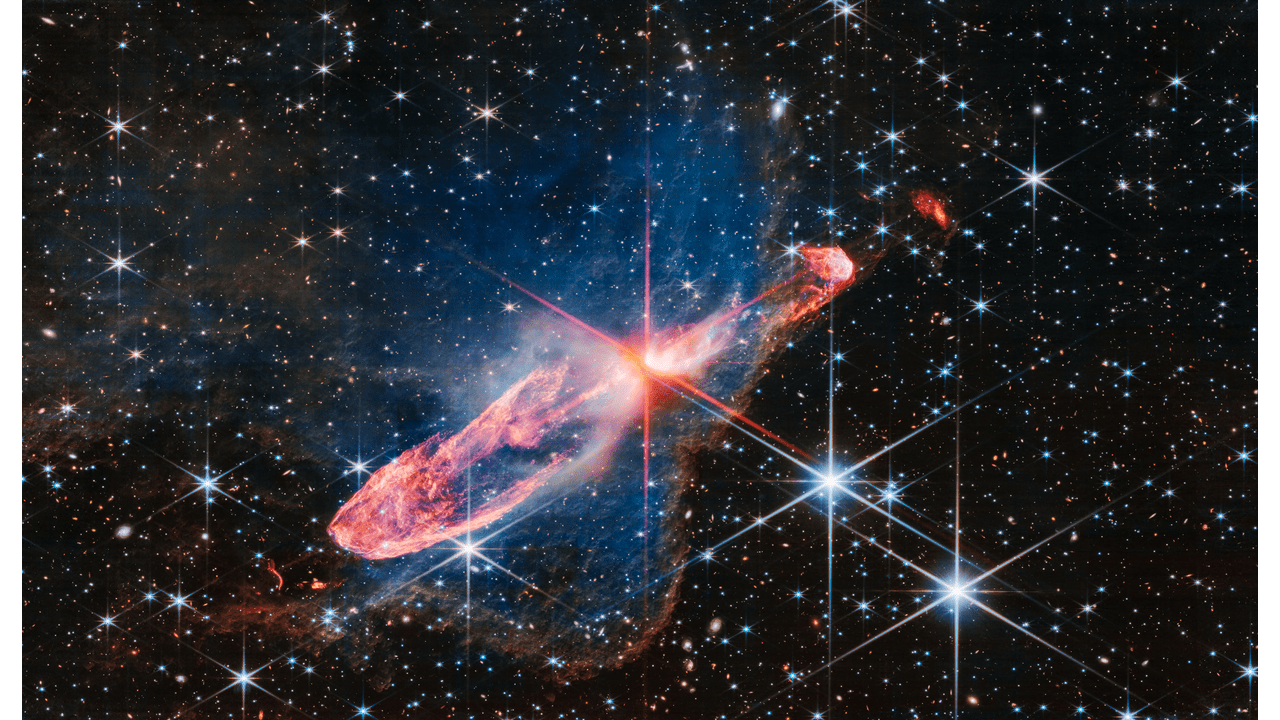
Pic of the Week: Herbig-Haro 211

Image (Credit): Herbig-Haro 211 as captured by the JWST.

This week’s image is from the James Webb Space Telescope (JWST). It shows a colorful and expansive Herbig-Haro 211, with a Herbig-Haro (HH) being “…luminous regions surrounding newborn stars, formed when stellar winds or jets of gas spewing from these newborn stars form shock waves colliding with nearby gas and dust at high speeds.”

NASA explains what we are seeing:

This image of HH 211 from NASA’s James Webb Space Telescope reveals an outflow from a Class 0 protostar, an infantile analog of our Sun when it was no more than a few tens of thousands of years old and with a mass only 8% of the present-day Sun (it will eventually grow into a star like the Sun).

Infrared imaging is powerful in studying newborn stars and their outflows, because such stars are invariably still embedded within the gas from the molecular cloud in which they formed. The infrared emission of the star’s outflows penetrates the obscuring gas and dust, making a Herbig-Haro object like HH 211 ideal for observation with Webb’s sensitive infrared instruments. Molecules excited by the turbulent conditions, including molecular hydrogen, carbon monoxide, and silicon monoxide, emit infrared light that Webb can collect to map out the structure of the outflows.

The image showcases a series of bow shocks to the southeast (lower-left) and northwest (upper-right) as well as the narrow bipolar jet that powers them. Webb reveals this scene in unprecedented detail — roughly 5 to 10 times higher spatial resolution than any previous images of HH 211. The inner jet is seen to “wiggle” with mirror symmetry on either side of the central protostar. This is in agreement with observations on smaller scales and suggests that the protostar may in fact be an unresolved binary star.

Space Stories: Remembering the Solar System Delivery System, Many More Milky Ways, and AI Investigates Alien Life

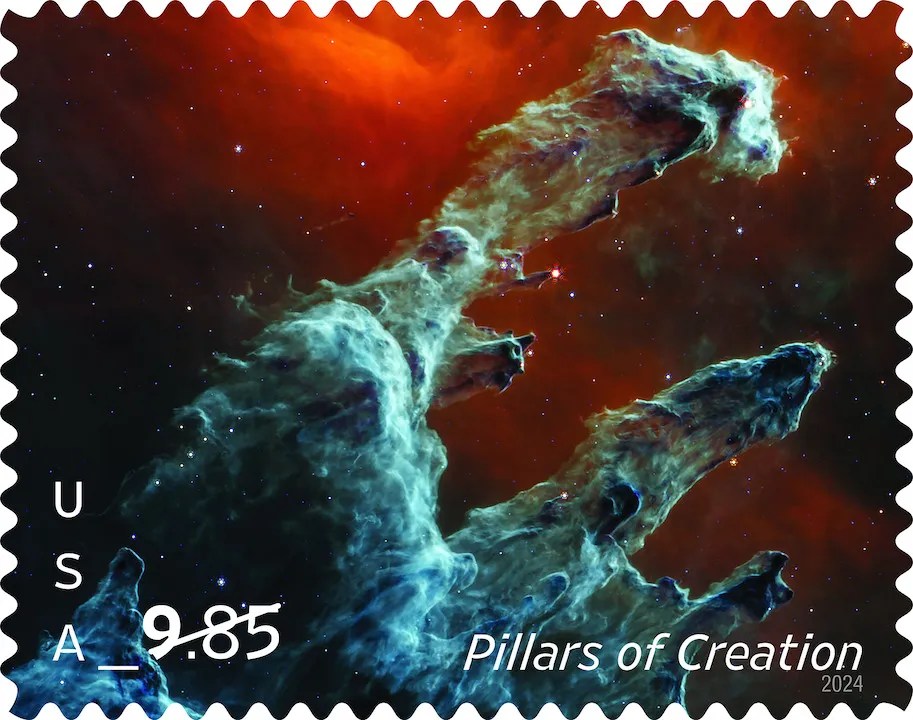
Credit: USPS

Here are some recent stories of interest.

NASA:New US Postage Stamp Commemorates NASA’s Asteroid Sample Delivery

On Sept. 24, NASA’s OSIRIS-REx (Origins, Spectral Interpretation, Resource Identification and Security – Regolith Explorer) spacecraft will speed past Earth and – at precisely the right moment – jettison its sample capsule containing material from asteroid Bennu…To help celebrate this engineering and scientific achievement, the U.S. Postal Service issued a commemorative stamp featuring an artist’s impression of the sample capsule as it parachutes to Earth over its landing site on the Department of Defense’s Utah Test and Training Range…Although OSIRIS-REx has already had many scientific accomplishments, at its heart, the mission’s research goals circle around the sample delivery from Bennu. That influenced the Postal Service’s decision to select the capsule’s descent as the subject of the new stamp.

LiveScience.com:James Webb Telescope Spots Thousands of Milky Way Lookalikes That ‘Shouldn’t Exist’ Swarming Across the Early Universe

The James Webb Space Telescope (JWST) has found more than 1,000 galaxies mysteriously resembling our own Milky Way hiding out in the early universe. Shaped like warped vinyls and sporting delicate spiral arms, the Milky Way doppelgangers were found by JWST more than 10 billion years into the universe’s past — during a period when violent galactic mergers were thought to have made an abundance of such fragile galaxies impossible. Yet the disk galaxies are 10 times more common in the early universe than astronomers previously thought, new research reveals.

Astronomy.com:Can AI Find Life in the Universe?

Scientists could soon use common lab technology along with sophisticated algorithms to answer one of the biggest questions in all of astronomy — are we alone in the universe? In new research published today in Proceedings of the National Academy of Sciences (PNAS), a team of scientists announced a novel technique that can take a sample of a material, feed it through a machine-learning algorithm, and find out if the material did — or didn’t — come from a living organism with 90 percent accuracy.

JWST Spots a Promising Exoplanet

Image (Credit): Artist’s concept showing exoplanet K2-18 b. (Illustration: NASA, CSA, ESA, J. Olmsted (STScI), Science: N. Madhusudhan (Cambridge University))

The exoplanet, some 120 light-years away, has caught the attention scientists using the James Webb Space Telescope (JWST). K2-18 b, about 8.6 times as massive as Earth, has carbon-bearing molecules in its atmosphere, including methane and carbon dioxide. This could mean the exoplanet has a hydrogen-rich atmosphere and a water ocean-covered surface (called a Hycean exoplanet).

Exoplanets of this size, between the size of Earth and Neptune, are called “sub-Neptune” exoplanets. These are the most most common type of exoplanet found to date in our galaxy.

Nikku Madhusudhan, an astronomer at the University of Cambridge and lead author of the paper announcing these results, stated:

Our findings underscore the importance of considering diverse habitable environments in the search for life elsewhere…Traditionally, the search for life on exoplanets has focused primarily on smaller rocky planets, but the larger Hycean worlds are significantly more conducive to atmospheric observations.

You can read more about this discovery at the NASA site.