Space Stories: Remembering the Solar System Delivery System, Many More Milky Ways, and AI Investigates Alien Life

Credit: USPS

Here are some recent stories of interest.

NASA:New US Postage Stamp Commemorates NASA’s Asteroid Sample Delivery

On Sept. 24, NASA’s OSIRIS-REx (Origins, Spectral Interpretation, Resource Identification and Security – Regolith Explorer) spacecraft will speed past Earth and – at precisely the right moment – jettison its sample capsule containing material from asteroid Bennu…To help celebrate this engineering and scientific achievement, the U.S. Postal Service issued a commemorative stamp featuring an artist’s impression of the sample capsule as it parachutes to Earth over its landing site on the Department of Defense’s Utah Test and Training Range…Although OSIRIS-REx has already had many scientific accomplishments, at its heart, the mission’s research goals circle around the sample delivery from Bennu. That influenced the Postal Service’s decision to select the capsule’s descent as the subject of the new stamp.

LiveScience.com:James Webb Telescope Spots Thousands of Milky Way Lookalikes That ‘Shouldn’t Exist’ Swarming Across the Early Universe

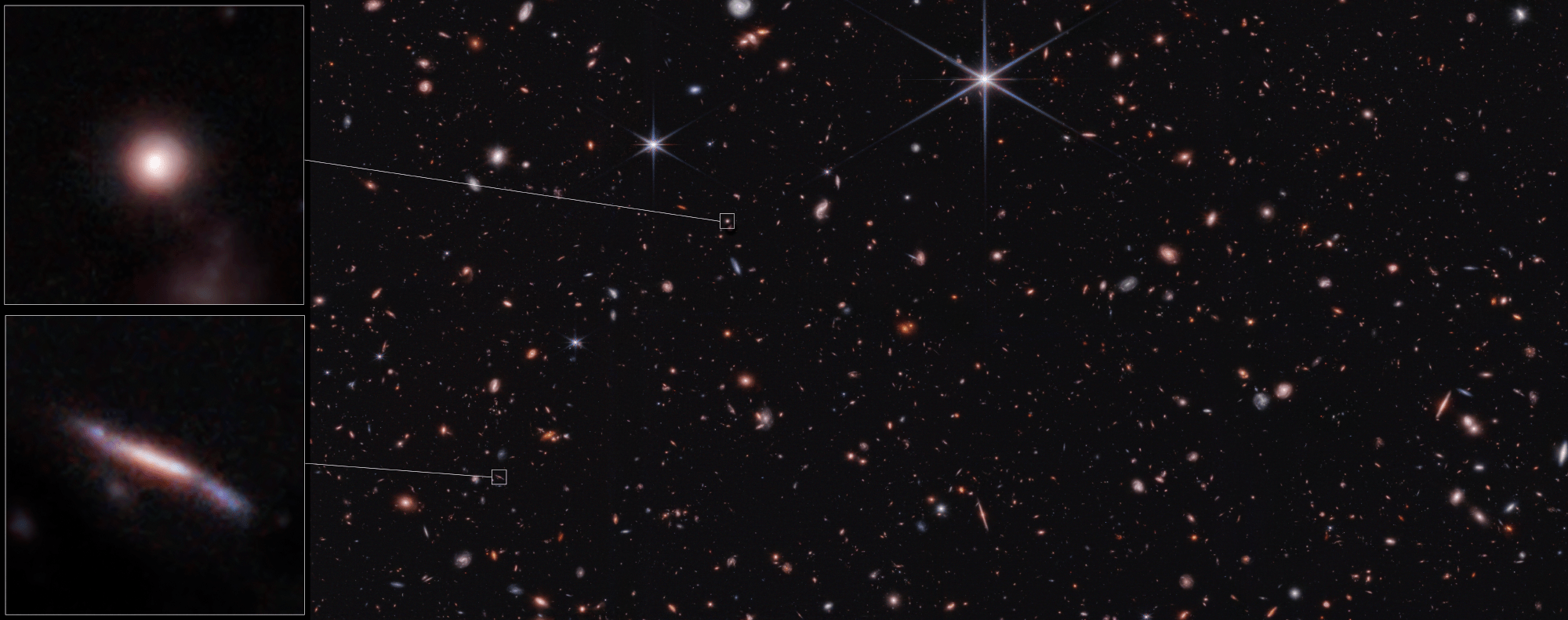
The James Webb Space Telescope (JWST) has found more than 1,000 galaxies mysteriously resembling our own Milky Way hiding out in the early universe. Shaped like warped vinyls and sporting delicate spiral arms, the Milky Way doppelgangers were found by JWST more than 10 billion years into the universe’s past — during a period when violent galactic mergers were thought to have made an abundance of such fragile galaxies impossible. Yet the disk galaxies are 10 times more common in the early universe than astronomers previously thought, new research reveals.

Astronomy.com:Can AI Find Life in the Universe?

Scientists could soon use common lab technology along with sophisticated algorithms to answer one of the biggest questions in all of astronomy — are we alone in the universe? In new research published today in Proceedings of the National Academy of Sciences (PNAS), a team of scientists announced a novel technique that can take a sample of a material, feed it through a machine-learning algorithm, and find out if the material did — or didn’t — come from a living organism with 90 percent accuracy.

JWST Spots a Promising Exoplanet

Image (Credit): Artist’s concept showing exoplanet K2-18 b. (Illustration: NASA, CSA, ESA, J. Olmsted (STScI), Science: N. Madhusudhan (Cambridge University))

The exoplanet, some 120 light-years away, has caught the attention scientists using the James Webb Space Telescope (JWST). K2-18 b, about 8.6 times as massive as Earth, has carbon-bearing molecules in its atmosphere, including methane and carbon dioxide. This could mean the exoplanet has a hydrogen-rich atmosphere and a water ocean-covered surface (called a Hycean exoplanet).

Exoplanets of this size, between the size of Earth and Neptune, are called “sub-Neptune” exoplanets. These are the most most common type of exoplanet found to date in our galaxy.

Nikku Madhusudhan, an astronomer at the University of Cambridge and lead author of the paper announcing these results, stated:

Our findings underscore the importance of considering diverse habitable environments in the search for life elsewhere…Traditionally, the search for life on exoplanets has focused primarily on smaller rocky planets, but the larger Hycean worlds are significantly more conducive to atmospheric observations.

You can read more about this discovery at the NASA site.

Space Quote: Has the JWST Changed Astronomy Forever?

Image (Credit): On June 25, 2023, NASA’s James Webb Space Telescope conducted its first near-infrared observations of Saturn using its Near-Infrared Camera. (NASA, ESA, CSA, Matthew Tiscareno (SETI Institute), Matthew Hedman (University of Idaho), Maryame El Moutamid (Cornell University), Mark Showalter (SETI Institute), Leigh Fletcher (University of Leicester), Heidi Hammel (AURA))

“Physicists and astronomers are starting to get the sense that something may be really wrong. It’s not just that some of us believe we might have to rethink the standard model of cosmology; we might also have to change the way we think about some of the most basic features of our universe — a conceptual revolution that would have implications far beyond the world of science.”

-Statement by guess essayists Adam Frank and Marcelo Gleiser in a New York Times article about the James Webb Space Telescope titled “The Story of Our Universe May Be Starting to Unravel.” Dr. Frank is an astrophysicist at the University of Rochester. Dr. Gleiser is a theoretical physicist at Dartmouth College.

Video: More on the Importance of Exomoons

Image (Credit): Artist’s rendering of an exomoon. (Cool Worlds Lab)

If you watched my earlier post on Cool Worlds Lab’s missed opportunity on an exomoon proposal with the James Webb Space Telescope, then you will enjoy this updated video where Assistant Professor of Astronomy David Kipping provides five reasons that the study of exomoons is so important.

I do not want to give too much away, but one of the reasons is that the search for life on exoplanets needs to consider not only the chemical composition of the exoplanet, but the orbiting exmoon as well. If we assume everything we are seeing in the light from the observed exoplanet comes from only the exoplanet, we may experience a number of false positives because the life-affirming chemicals may not be combined in one object but instead come from two dead objects that only appear as one.

This makes sense, but it also throws a wrench into things. If we are struggling to build telescopes large enough to truly understand an exoplanet’s composition, we are now much farther away from a useful telescope because of the impact of exomoons. Of course, this is not the fault of the exomoons, but rather a reality that must be added to the equation.

Check out the video as Dr. Kipping makes his argument. It is pretty convincing.

What Will the JWST Peer At Next?

If you are wondering where the James Webb Space Telescope (JWST) will be looking in the future, some of that is known and some has yet to be determined. The approved targets of the space telescope can be found at the Programmatic Categories of JWST Science Observations site.

The site breaks the approved targets into these six categories:

  • General Observer (GO) Programs: Observations and archival research proposed by the community and selected by peer review.
  • Guaranteed Time Observations (GTO) Programs: Observations defined by members of the instrument and telescope science teams, as well as a number of interdisciplinary scientists.
  • Director’s Discretionary Time (DDT): Time-critical observations that cannot be scheduled for a regular proposal cycle.
  • Director’s Discretionary Early Release Science (DD-ERS) Programs: Observations to be executed within the first five months of science operations and immediately released to the community.
  • Calibration Programs: Observations used to calibrate the science instruments in support of all the other science programs.
  • First Image Observations: The first observations following commissioning to demonstrate the observatory’s capabilities.

The GO Programs have been decided through Cycle 2. Earlier this month, the Space Telescope Science Institute put out a call for Cycle 3 Call for Proposals for the GO Programs. Proposals are due by October 25, 2023 and selected proposals will be announced in February 2024.

Take a look at the existing list and you will find plenty of interesting areas of study. For instance, under the Cycle 3 GTO Programs you have areas such as:

  • Titan Surface and Atmosphere;
  • Exoplanet search around Altair; and
  • Search for Varuna’s Satellite.