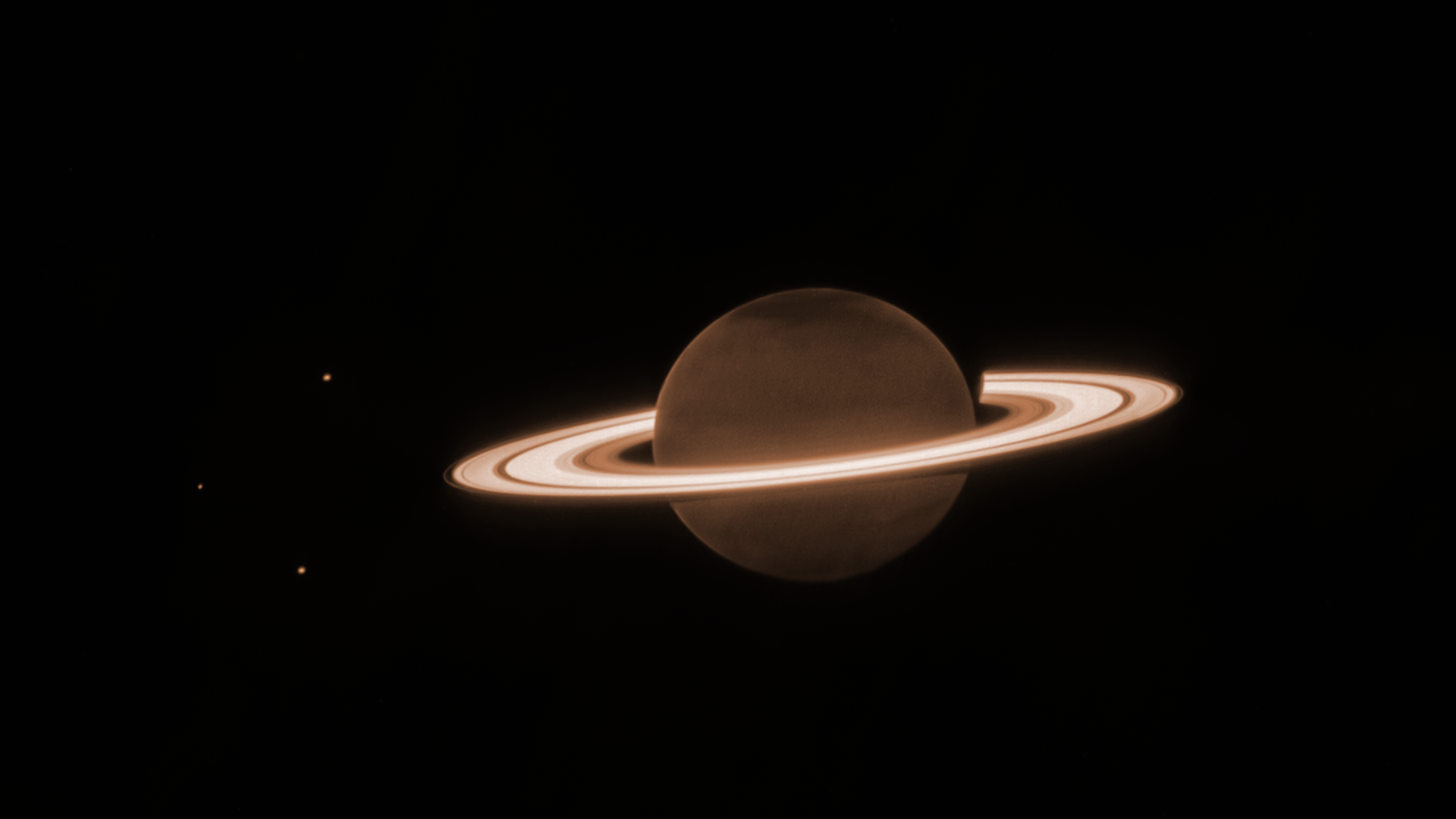
Image (Credit): On June 25, 2023, NASA’s James Webb Space Telescope conducted its first near-infrared observations of Saturn using its Near-Infrared Camera. (NASA, ESA, CSA, Matthew Tiscareno (SETI Institute), Matthew Hedman (University of Idaho), Maryame El Moutamid (Cornell University), Mark Showalter (SETI Institute), Leigh Fletcher (University of Leicester), Heidi Hammel (AURA))
“Physicists and astronomers are starting to get the sense that something may be really wrong. It’s not just that some of us believe we might have to rethink the standard model of cosmology; we might also have to change the way we think about some of the most basic features of our universe — a conceptual revolution that would have implications far beyond the world of science.”
-Statement by guess essayists Adam Frank and Marcelo Gleiser in a New York Times article about the James Webb Space Telescope titled “The Story of Our Universe May Be Starting to Unravel.” Dr. Frank is an astrophysicist at the University of Rochester. Dr. Gleiser is a theoretical physicist at Dartmouth College.
Image (Credit): Artist’s rendering of an exomoon. (Cool Worlds Lab)
If you watched my earlier post on Cool Worlds Lab’s missed opportunity on an exomoon proposal with the James Webb Space Telescope, then you will enjoy this updated video where Assistant Professor of Astronomy David Kipping provides five reasons that the study of exomoons is so important.
I do not want to give too much away, but one of the reasons is that the search for life on exoplanets needs to consider not only the chemical composition of the exoplanet, but the orbiting exmoon as well. If we assume everything we are seeing in the light from the observed exoplanet comes from only the exoplanet, we may experience a number of false positives because the life-affirming chemicals may not be combined in one object but instead come from two dead objects that only appear as one.
This makes sense, but it also throws a wrench into things. If we are struggling to build telescopes large enough to truly understand an exoplanet’s composition, we are now much farther away from a useful telescope because of the impact of exomoons. Of course, this is not the fault of the exomoons, but rather a reality that must be added to the equation.
Check out the video as Dr. Kipping makes his argument. It is pretty convincing.
If you are wondering where the James Webb Space Telescope (JWST) will be looking in the future, some of that is known and some has yet to be determined. The approved targets of the space telescope can be found at the Programmatic Categories of JWST Science Observations site.
The site breaks the approved targets into these six categories:
General Observer (GO) Programs: Observations and archival research proposed by the community and selected by peer review.
Guaranteed Time Observations (GTO) Programs: Observations defined by members of the instrument and telescope science teams, as well as a number of interdisciplinary scientists.
Director’s Discretionary Time (DDT): Time-critical observations that cannot be scheduled for a regular proposal cycle.
Director’s Discretionary Early Release Science (DD-ERS) Programs: Observations to be executed within the first five months of science operations and immediately released to the community.
Calibration Programs: Observations used to calibrate the science instruments in support of all the other science programs.
First Image Observations: The first observations following commissioning to demonstrate the observatory’s capabilities.
The GO Programs have been decided through Cycle 2. Earlier this month, the Space Telescope Science Institute put out a call for Cycle 3 Call for Proposals for the GO Programs. Proposals are due by October 25, 2023 and selected proposals will be announced in February 2024.
Take a look at the existing list and you will find plenty of interesting areas of study. For instance, under the Cycle 3 GTO Programs you have areas such as:
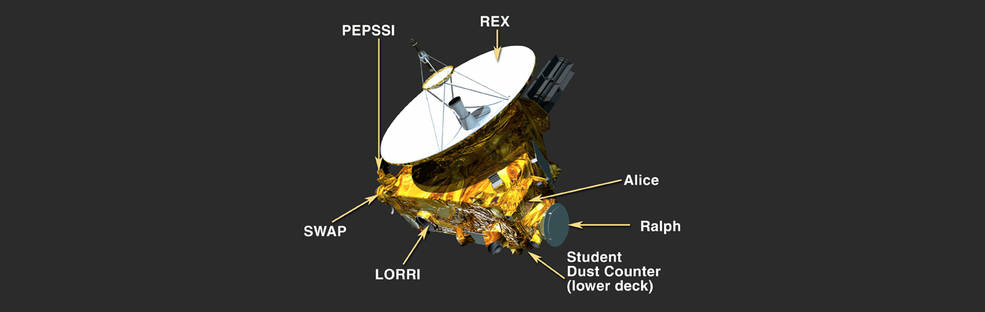
With its budget being trimmed for 2024, NASA is making some weighty decisions… and one includes drastically trimming New Horizons funds by replacing the current science staff with a new team in an effort to save about $3 million—a rounding error in terms of the planetary science budget...As it stands, New Horizons will exit the Kuiper Belt around 2028 and should continue operating until 2050.
Using ESO’s Very Large Telescope (VLT), astronomers have observed a large dark spot in Neptune’s atmosphere, with an unexpected smaller bright spot adjacent to it. This is the first time a dark spot on the planet has ever been observed with a telescope on Earth. These occasional features in the blue background of Neptune’s atmosphere are a mystery to astronomers, and the new results provide further clues as to their nature and origin.
We will soon have more than 10,000 worlds where life might be able to survive. It’s an amazing idea, but with so many exoplanets we don’t have the resources to search for life on all of them. So how do we prioritize our search? That’s the focus of a recent paper on the pre-print server arxiv. In it, the team strives to identify the “best in class” candidates for exoplanets that could be further studied by the spectroscopic cameras of the James Webb Space Telescope (JWST). Their list could not only help astronomers find evidence of life but also help us understand the range of atmospheres exoplanets have.
Image (Credit): Aerial view of the damaged Arecibo Observatory after one of the main cables holding the receiver broke in Arecibo, Puerto Rico, on December 1, 2020. (Photo by Ricardo ARDUENGO / AFP)
After weathering hurricanes, earthquakes, budget cuts and a pandemic-induced shutdown, the iconic Arecibo Observatory in Puerto Rico closed its doors on 14 August. After its main instrument collapsed two years ago, the site was supposed to shift from carrying out astronomy and other research to being a science education centre. But concrete plans for that have yet to materialize — and funding for current operations has run out.Scientists were disappointed that research would formally halt at the site, but they had hoped to keep some instruments running, both for the students who might use the educational centre and to continue the site’s astronomy legacy. Doubts now swirl, as equipment is taken offline and dismantled, that Arecibo will ever again study the sky.
In recent months, a torrent of observations of the cosmic smudges has delighted and confounded astronomers…The most straightforward explanation for the tornado-hearted galaxies is that large black holes weighing millions of suns are whipping the gas clouds into a frenzy. That finding is both expected and perplexing. It is expected because JWST was built, in part, to find the ancient objects. They are the ancestors of billion-sun behemoth black holes that seem to appear in the cosmic record inexplicably early. By studying these precursor black holes, such as three record-setting youngsters discovered this year, scientists hope to learn where the first humongous black holes came from and perhaps identify which of two competing theories better describes their formation: Did they grow extremely rapidly, or were they simply born big?
A team of astrophysicists from the University of Bordeaux and Observatoire Astronomique de l’Université de Genève is suggesting that some exoplanets may not have been too hot during their formative years to harbor life today. In their paper published in the journal Nature, the group suggests that due to factors not considered in the past, some exoplanets may not have grown so hot that they lost the water in their atmospheres to evaporation into space.




 Our Awesome Universe