In Case You Missed It/Video: Missed Opportunity on Exomoons

Image (Credit): Assistant Professor of Astronomy David Kipping sharing his story of rejection. By the way, the image behind him is the exomoon Pandora from the movie Avatar. (Cool Worlds Lab)

A few months back, Assistant Professor of Astronomy David Kipping shared a short video regarding his organization’s failure to secure James Webb Space Telescope (JWST) time to search for exomoons that he knows are there. His organization, Cool Worlds Lab, has done some amazing work studying and publicizing issues related to astronomy. You should visit his site for some challenging topics.

What is unique about his video is that it was recorded only one hour after he learned that his organization would not be able to use JWST for his exomoon search and he wanted to share what rejection felt like “in real time.” He goes on to say that such rejection is part of science, as brutal as it may feel at the moment, noting that for every seven JWST proposals, only one will be approved.

Fortunately, we have scientists out there with very thick skin sharing new ideas and proposals. And Dr. Kipping will not be giving up on his exomoon push anytime soon. That is good news for all of us.

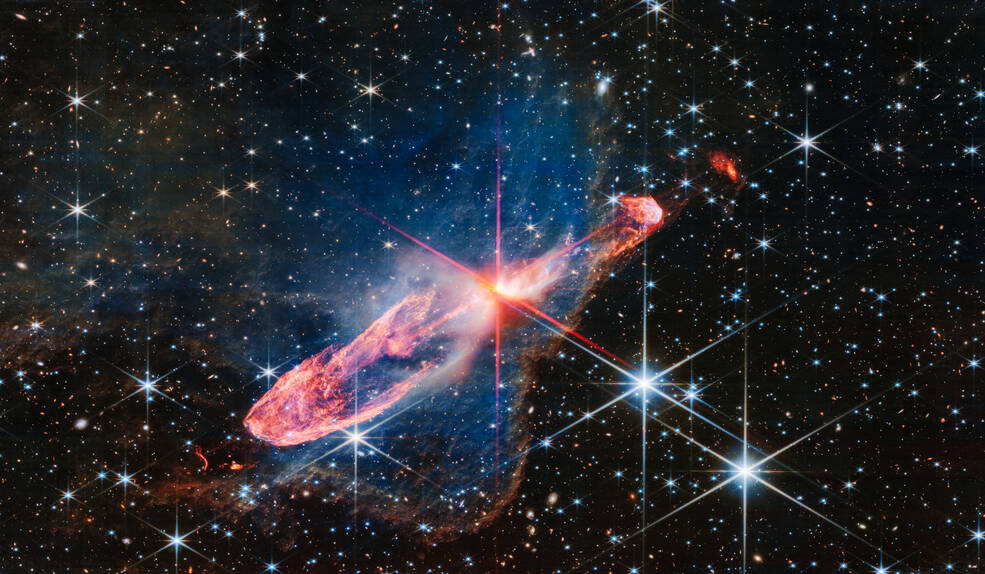
Pic of the Week: Anniversary Image from JWST

Image (Credit): The Rho Ophiuchi cloud complex as captured by JWST. (NASA, ESA, CSA, STScI, Klaus Pontoppidan (STScI))

This amazing image was released by NASA earlier this week in celebration of the James Webb Space Telescope’s (JWST) one year anniversary. It shows the Rho Ophiuchi cloud complex, which is the closest star-forming region to Earth.

Here is more from NASA:

Webb’s image shows a region containing approximately 50 young stars, all of them similar in mass to the Sun, or smaller. The darkest areas are the densest, where thick dust cocoons still-forming protostars. Huge bipolar jets of molecular hydrogen, represented in red, dominate the image, appearing horizontally across the upper third and vertically on the right. These occur when a star first bursts through its natal envelope of cosmic dust, shooting out a pair of opposing jets into space like a newborn first stretching her arms out into the world. In contrast, the star S1 has carved out a glowing cave of dust in the lower half of the image. It is the only star in the image that is significantly more massive than the Sun.

“Webb’s image of Rho Ophiuchi allows us to witness a very brief period in the stellar lifecycle with new clarity. Our own Sun experienced a phase like this, long ago, and now we have the technology to see the beginning of another’s star’s story,” said Klaus Pontoppidan, who served as Webb project scientist at the Space Telescope Science Institute in Baltimore, Maryland, since before the telescope’s launch and through the first year of operations.

A Day in Astronomy: The Anniversary of JWST

Tomorrow, July 12th, is the first anniversary of the James Webb Space Telescope (JWST). As a result, NASA has a few events planned that you may want to attend.

Here is the schedule from NASA:

  • 6 a.m.: Release of a new Webb image online
  • 6 a.m.: Live interview opportunities begin
    • Webb mission experts will be available to conduct live, remote interviews with broadcast media, in both English and Spanish. Details about scheduling these interviews are available online. Webb experts also are available for interviews outside of this window upon request.
  • 4 p.m.: NASA Science Live online
    • Two Webb experts will be featured on a NASA Science Live episode, discussing how Webb has made an impact in its first year on exploring the distant universe, characterizing exoplanet atmospheres, and understanding the solar system. The show will air live on the NASA Science Live website, as well as YouTubeFacebook, and Twitter. Viewers of this episode can submit questions on social media using the hashtag #UnfoldtheUniverse or by leaving a comment in the chat section of the Facebook or YouTube stream.

Space Stories: James Webb’s Partner, the Big Bang Black Holes, and Green Energy on the Red Planet

Image (Credit): James Webb Space Telescope. (NASA)

Here are some recent stories of interest.

Futurism: “NASA Sending Adorable Little Buddy to Hang Out Next to the James Webb

The space agency recently selected a toaster-sized cubesat that will become the much bigger telescope’s tiny, adorable “sidekick,” according to a statement. NASA chose the $8.5 million space mission, called the “Monitoring Activity from Nearby sTars with uv Imaging and Spectroscopy” (MANTIS), which will be designed and built by researchers at the University of Colorado Boulder. The diminutive but mighty spacecraft, scheduled to launch sometime in 2026, will make observations of the night sky in the full range of ultraviolet light, including extreme UV (EUV) light, a more energetic form.

Universe Today: “Why Didn’t the Big Bang Collapse in a Giant Black Hole?

Despite the enormous densities, the early universe didn’t collapse into a black hole because, simply put, there was nothing to collapse into…Even though the early universe was incredibly dense, it was also incredibly uniform. The average density throughout the universe was the same from place to place. There weren’t enough differences to trigger the formation of black holes.

University of Warwick: “Using Photosynthesis for Martian Occupation—While Making Space Travel More Sustainable

In a study published in Nature Communications, scientists assess a new technique which could convert renewable, green energy from outside the Earth’s atmosphere. They are taking advantage of photosynthesis—the chemical process plants undergo every day to create energy—to help the space industry become more sustainable. The research led by the University of Warwick evaluates the use of a special device known as semiconductor to absorb sunlight on moon and Mars. It is hoped that the devices could promote Martian life support systems.

In Case You Missed It/Television: JWST on 60 Minutes

Image (Credit): Scott Pelley on 60 Minutes discussing JWST. (CBS)

Last month 60 Minutes had a piece on the James Webb Space Telescope (JWST), titled The Origin of Everything, that provided viewers with more amazing images. I recommend the episode. I also plan to watch a few more times myself.

For a taste of the episode, here is Matt Mountain, who heads up JWST’s operations as president of the Association of Universities for Research in Astronomy, discussing the speckled images captured at the very start as engineers used a star to align the telescope’s 18 mirrors.

Matt Mountain: These were not artifacts from the detector. These were not strange stars. The whole of the sky was filled with galaxies. There was no empty sky. And that’s when I went, “This telescope’s going to be phenomenal.”

Scott Pelley: No empty sky? What do you mean by that?

Matt Mountain: On almost every image we’re taking now, we see galaxies everywhere. I mean, we took a simple picture of a planet in our own system, Neptune. You know, it was this beautiful orb just sitting there and we saw some rings. In the background are galaxies again. It tells us that our universe is filled with galaxies. We knew this theoretically but when you go out to the night sky, we’re used to saying, “Well, look up at the night sky, we see those stars.” We can no longer say that. We now have to say, “Look up at the night sky and there are galaxies everywhere.”

Scott Pelley: We call it space because we thought there was nothing out there.

Matt Mountain: There is no empty sky with James Webb. That is what we have discovered.

You can watch the episode here.