Space Stories: Merging Galaxies, Anniversary for TESS, and Helicopter Flights on Mars

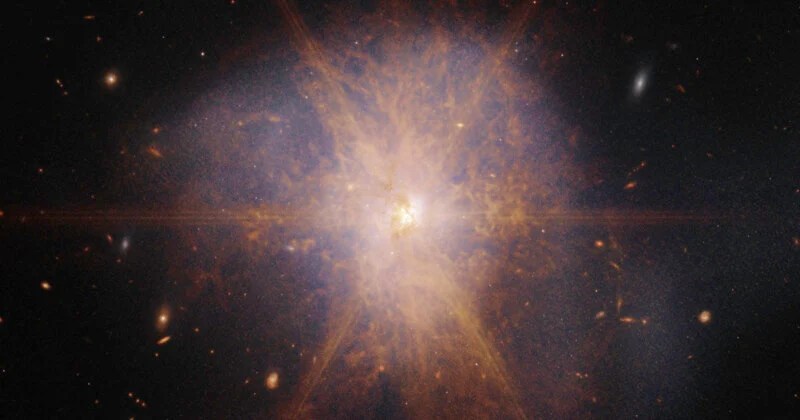
Image (Credit): Arp 220 as captured by NASA’s James Webb Space Telescope. (NASA, ESA, CSA, STScI, Alyssa Pagan)

Here are some recent stories of interest.

PetaPixel:Webb Captures Star-Forming Galactic Merger Brighter Than 1 Trillion Suns’”

NASA’s James Webb Space Telescope has captured a stunning “smash-up” of two spiral galaxies. Collectively called Arp 220, the collision of the pair of galaxies has facilitated massive star formation. Arp 220 is located within the constellation Serpens, about 250 million light-years from Earth. Arp 220 gets its namesake because it is the 220th object in Hallton Art’s Atlas of Peculiar Galaxies. Arp 220 is “peculiar” because it’s an ultra-luminous infrared galaxy (ULIRG), and the nearest ULIRG to Earth.

Phys.org:NASA’s TESS Celebrates Fifth Year Scanning the Sky for New Worlds’”

Now in its fifth year in space, NASA’s TESS (Transiting Exoplanet Survey Satellite) remains a rousing success. TESS’s cameras have mapped more than 93% of the entire sky, discovered 329 new worlds and thousands more candidates, and provided new insights into a wide array of cosmic phenomena, from stellar pulsations and exploding stars to supermassive black holes.

NASA:NASA’s Ingenuity Mars Helicopter Completes 50th Flight’”

NASA’s Ingenuity Mars Helicopter has completed its 50th flight on Mars. The first aircraft on another world reached the half-century mark on April 13, traveling over 1,057.09 feet (322.2 meters) in 145.7 seconds. The helicopter also achieved a new altitude record of 59 feet (18 meters) before alighting near the half-mile-wide (800-meter-wide) “Belva Crater.”

Space Stories: An Exoplanet’s Atmosphere, A Cosmic Explosion, and Stars Halfway to the Andromeda Galaxy

Here are some recent stories of interest.

WebbTelescope.org: “Weather Report: Expect Scattered, Patchy Clouds Made Up of Silicates on Planet VHS 1256 b

Ever had hot sand whip across your face? That’s a soothing experience compared to the volatile conditions discovered high in the atmosphere of planet VHS 1256 b. Researchers using NASA’s James Webb Space Telescope proved that its clouds are made up of silicate particles, ranging from fine specks to small grains. Plus, its near-constant cloud cover is on the move! The team projects that the silicates swirling in these clouds periodically get too heavy and rain into the depths of the planet’s atmosphere. Webb’s observations also show clear signatures of water, methane and carbon monoxide, and provide evidence for carbon dioxide. This is only the beginning of the team’s research – many more findings are expected as they continue to dig in to Webb’s “downpour” of data.

The Guardian: “Cosmic Explosion Last Year May be ‘Brightest Ever Seen’”

A cosmic explosion that blinded space instruments last year may be the brightest ever seen, according to astronomers. The blast took place 2bn light years from Earth, producing a pulse of intense radiation that swept through the solar system in October last year. The cosmic event, known as a gamma-ray burst (GRB), produced some of the strongest and brightest explosions in the universe, triggering detectors on multiple spacecraft. The October blast was deemed so exceptional that astronomers said it was the brightest of all time since the beginning of human civilisation.

Astronomy.com: “Milky Way Stars Found Nearly Halfway to Andromeda Galaxy

Astronomers have discovered a slew of stars lingering in the far fringes of our galaxy. And when we say far, we mean far. The most distant of these stars is located more than 1 million light-years away. That’s almost halfway to our largest galactic neighbor, the Andromeda Galaxy, which is located some 2.5 million light-years away. “This study is redefining what constitutes the outer limits of our galaxy,” said Raja GuhaThakurta, professor and chair of astronomy and astrophysics at UC Santa Cruz, in a news release. “Our galaxy and Andromeda are both so big, there’s hardly any space between the two galaxies.”

Television: The JWST on NOVA, Again

Credit: PBS

NOVA has a new episode this season on the James Webb Space Telescope (JWST). Unlike last season’s episode, Ultimate Space Telescope, which discussed the creation, launch, and early success of the space telescope, this episode, New Eye on the Universe, goes deeper into the goals of the space telescope as well as the findings since the first images appeared.

Here is a list of the topics covered in the latest episode (and their spot on the recording):

  • 00:00 Introduction
  • 04:11 The James Webb Space Telescope’s First Images
  • 05:47 Searching for Life on Exoplanets: Are We Alone in the Universe?
  • 14:40 Looking for Life in Our Own Solar System: Moons of Jupiter and Saturn
  • 18:52 Adjusting New Images from JWST: Science Meets Art
  • 23:55 Studying Supermassive Black Holes and Merging Galaxies
  • 30:25 Detecting the Oldest Galaxies with the JWST
  • 37:13 Troubleshooting the New Telescope’s Light Measurements
  • 42:12 Detecting the Atmosphere of a Rocky Exoplanet
  • 46:28 Results from the Team’s New Studies
  • 51:05 Conclusion

The section on adjusting the images is interesting in that we would not see these beautiful images as portrayed even if we could fly though space for an up-close look. Our eyes cannot see all of what the JWST can see in infrared. This is further explained in a Scientific American article, “Are the James Webb Space Telescope’s Pictures ‘Real’?

You can watch the latest episode on the PBS internet site, your local PBS station, or YouTube.

Pic of the Week: The Shining Nucleus of NGC 7496

Image (Credit): Barred spiral galaxy NGC 7496. (NASA, ESA, CSA, Janice Lee (NOIRLab), Joseph DePasquale (STScI))

This week’s image from the James Webb Space Telescope shows the barred spiral galaxy NGC 7496, which is over 24 million light-years away from Earth. The glowing center is a supermassive black hole.

Here is the full story about the image from the Webb Space Telescope site:

The spiral arms of NGC 7496, one of a total of 19 galaxies targeted for study by the Physics at High Angular resolution in Nearby Galaxies (PHANGS) collaboration, are filled with cavernous bubbles and shells overlapping one another in this image from Webb’s Mid-Infrared Instrument (MIRI). These filaments and hollow cavities are evidence of young stars releasing energy and, in some cases, blowing out the gas and dust of the interstellar medium surrounding them.

Until Webb’s high resolution at infrared wavelengths came along, stars at the earliest point of the lifecycle in nearby galaxies like NGC 7496 remained obscured by gas and dust. Webb’s specific wavelength coverage allows for the detection of complex organic molecules called polycyclic aromatic hydrocarbons, which play a critical role in the formation of stars and planets. In Webb’s MIRI image, these are mostly found within the main dust lanes in the spiral arms. 

In their analysis of the new data from Webb, scientists were able to identify nearly 60 new, embedded cluster candidates in NGC 7496. These newly identified clusters could be among the youngest stars in the entire galaxy. 

At the center of NGC 7496, a barred spiral galaxy, is an active galactic nucleus (AGN). AGN is another way to refer to an active supermassive black hole that is emitting jets and winds. This glows quite brightly at the center of the Webb image. Additionally, Webb’s extreme sensitivity also picks up various background galaxies, which appear green or red in some instances.

Massive Galaxies Stump Astronomers

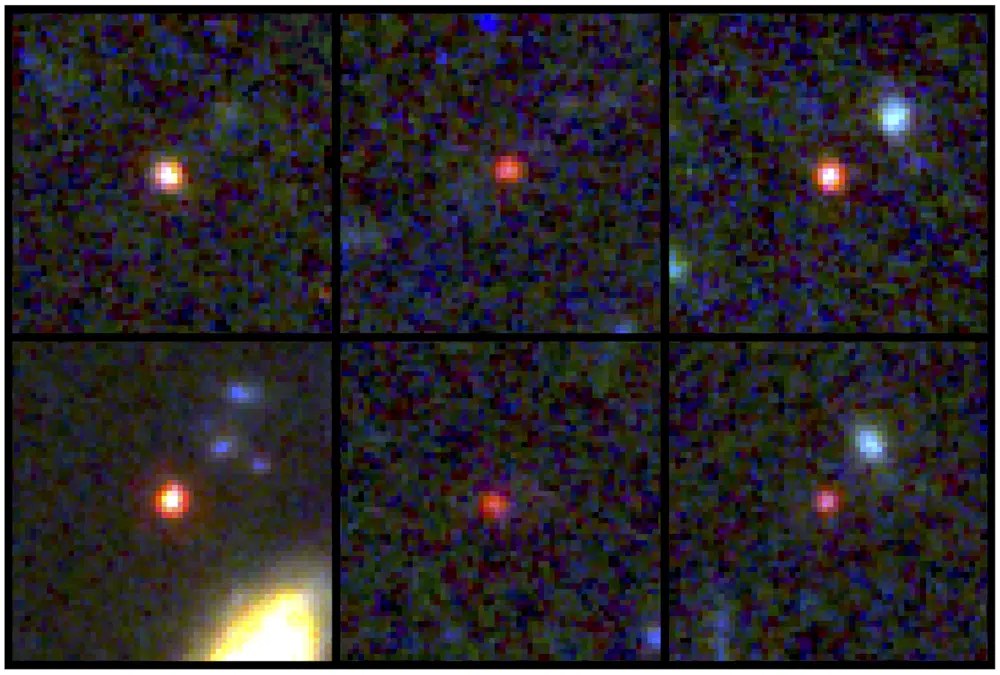
Image (Credit): JWST images of six candidate massive galaxies 500-800 million years after the Big Bang. (NASA)

I was reading the recent news that the James Webb Space Telescope (JWST) astonished astronomers again. We continue to get big benefits from this relatively new distant telescope.

The latest news involves massive compact galaxies that should not be there if our theories about galaxy formation are valid. The researchers behind this latest finding state the six observed galaxies were from a period about 600 million years after the Big Bang.

Lead researcher Ivo Labbe of Australia’s Swinburne University of Technology said in a statement:

The revelation that massive galaxy formation began extremely early in the history of the universe upends what many of us had thought was settled science…It turns out we found something so unexpected it actually creates problems for science. It calls the whole picture of early galaxy formation into question.

The more we look the more we learn, and the more theories we can toss out the window.

You can read more about this finding in the study published in the journal Nature.