Space Stories: JWST Confirms Earth-Size Exoplanet, Russia Sending Rescue Mission to ISS, and IO Erupts

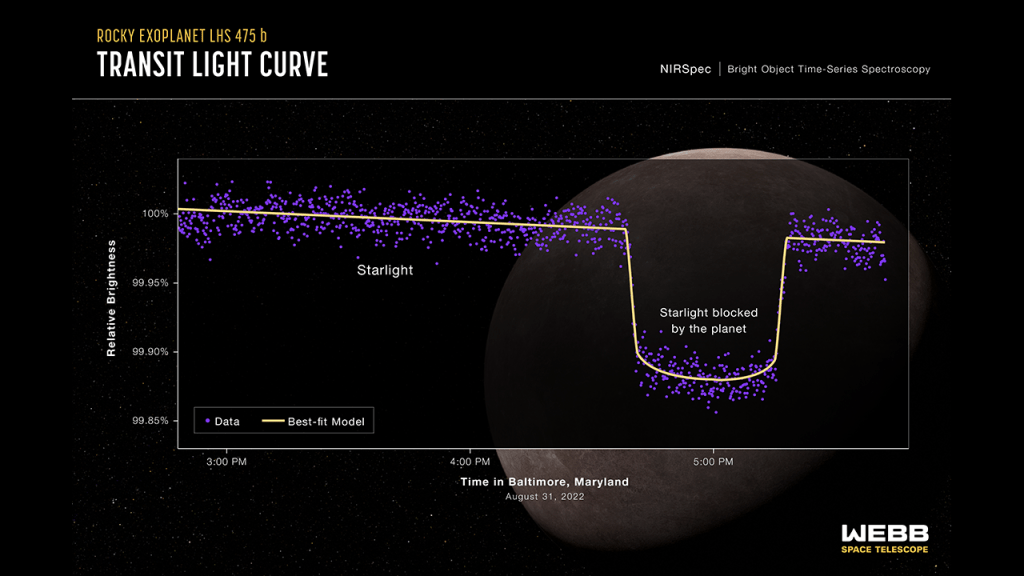
Image (Credit): James Webb Space Telescope (JWST) data associated with exoplanet LHS 475 b. (NASA, ESA, CSA, Leah Hustak (STScI))

Here are some recent stories of interest.

Webb Space Telescope: “NASA’s Webb Confirms Its First Exoplanet

Researchers confirmed an exoplanet, a planet that orbits another star, using NASA’s James Webb Space Telescope for the first time. Formally classified as LHS 475 b, the planet is almost exactly the same size as our own, clocking in at 99% of Earth’s diameter. The research team is led by Kevin Stevenson and Jacob Lustig-Yaeger, both of the Johns Hopkins University Applied Physics Laboratory in Laurel, Maryland.

ABC News: “Russia Will Launch New Capsule to Return Space Station Crew

Russia will send up a new capsule next month to bring back three space station crew members whose original ride home was damaged, officials said Wednesday. The two Russians and one American will stay several extra months at the International Space Station as a result of the capsule switch, possibly pushing their mission to close to a year, NASA and Russian space officials told reporters.

MSN Science Alert: “Massive Volcanic Outburst Detected on Jupiter’s Hellish Moon Io

In the space around Jupiter, a torus of plasma created and fed by Io’s volcanic emissions grew significantly richer between July and September of last year and persisted until December, showing the moon underwent a spate of volcanic activity that released a huge amount of material. For something that’s just a little bit bigger than Earth’s Moon, Io is an absolute beast of volcanism. It’s bristling with volcanoes, with around 150 of the 400 known volcanoes erupting at any given time, creating vast lakes of molten lava.

Top Astronomy Stories in 2022

Image (Credit): The stellar nursery 30 Doradus, nickname of the Tarantula Nebula, captured by the James Webb Space Telescope. (webb.nasa.gov)

Given that 2022 was a busy year, I thought I would highlight the top astronomy stories on the site – the good and the bad covering space missions to TV shows. Unlike other websites, I waited until the new year to create the list just in case we were visited by extraterrestrials. In this way, we now have a full catalog of the 2022 happenings.

Here is the list in no particular order other than science first, politics and commercial space second, and entertainment third.

  1. James Webb Space Telescope begins operation – see site link here;
  2. Double Asteroid Redirection Test (DART) successfully shifts the course of an asteroid pair – see site link here;
  3. Artemis I Orion capsule successfully orbits the Moon – see site link here;
  4. Commercial satellites become an increasing threat to Earth-based telescopes – see site link here;
  5. China completes its first space station – see site link here;
  6. Boeing is closer to being the second U.S. company to send astronauts to the International Space Station – see site link here;
  7. Ukraine invasion derails the Russian space program – see site link here;
  8. Russia reconfirms support for International Space Station – see site link here;
  9. Star Trek gets it right by returning to the past with Strange New Worlds – see site link here; and
  10. Star Wars gets it right with its new Andor series. – see site link here.

I cannot wait to see what 2023 will bring.

Pic of the Week: A Wreath Just in Time for Christmas

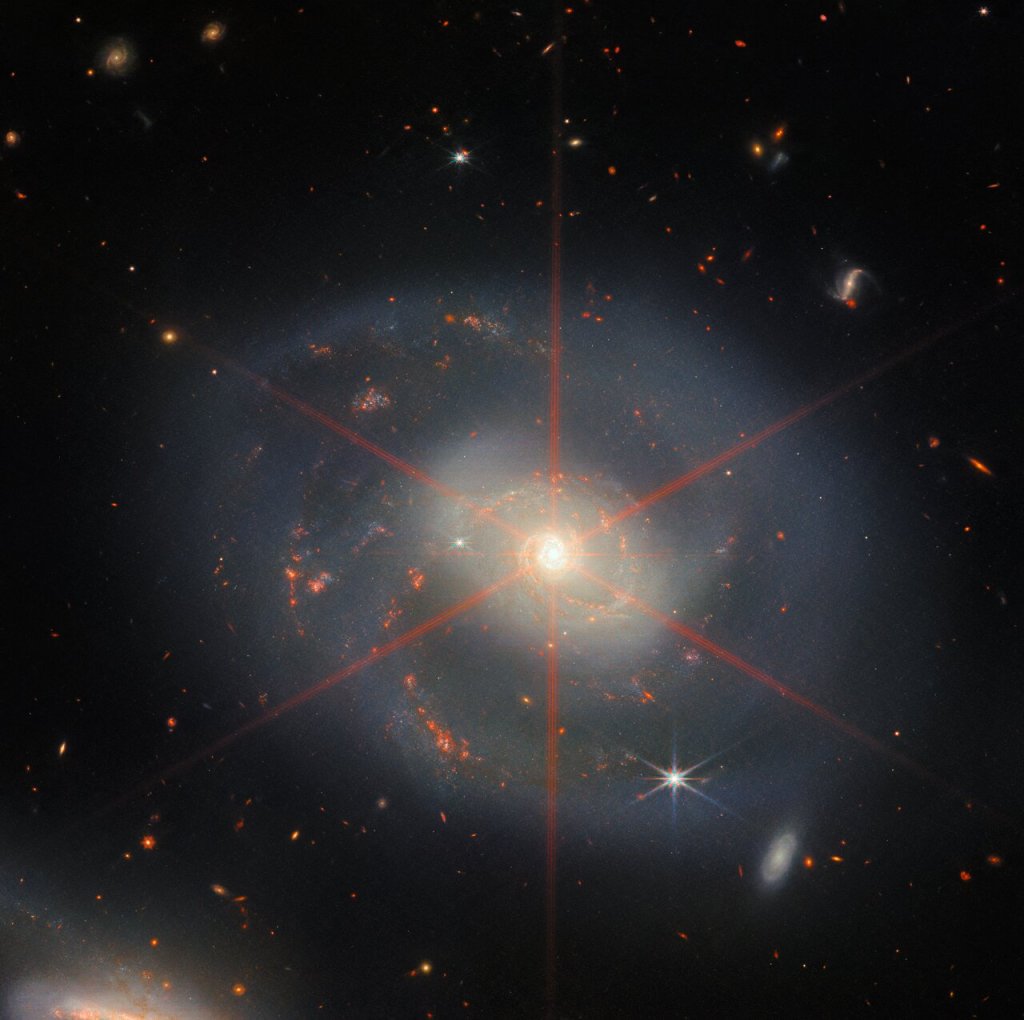
Image (Credit): Spiral galaxy NGC 7469 face-on. (NASA)

This week’s image is from the James Webb Space Telescope (JWST). It is a face-on view of wreath-like spiral galaxy NGC 7469, which is about 220 million light-years from Earth.

Here is a little more from the European Space Agency on the image:

While NGC 7469 is one of the best studied AGNs in the sky, the compact nature of this system and the presence of a great deal of dust have made it difficult for scientists to achieve both the resolution and sensitivity needed to study this relationship in the infrared. Now, with Webb, astronomers can explore the galaxy’s starburst ring, the central AGN, and the gas and dust in between. Using Webb’s MIRI, NIRCam and NIRspec instruments to obtain images and spectra of NGC 7469 in unprecedented detail, the GOALS team has uncovered a number of details about the object. This includes very young star-forming clusters never seen before, as well as pockets of very warm, turbulent molecular gas, and direct evidence for the destruction of small dust grains within a few hundred light-years of the nucleus — proving that the AGN is impacting the surrounding interstellar medium. Furthermore, highly ionised, diffuse atomic gas seems to be exiting the nucleus at roughly 6.4 million kilometres per hour — part of a galactic outflow that had previously been identified, but is now revealed in stunning detail with Webb. With analysis of the rich Webb datasets still underway, additional secrets of this local AGN and starburst laboratory are sure to be revealed.

A prominent feature of this image is the striking six-pointed star that perfectly aligns with the heart of NGC 7469. Unlike the galaxy, this is not a real celestial object, but an imaging artifact known as a diffraction spike, caused by the bright, unresolved AGN. Diffraction spikes are patterns produced as light bends around the sharp edges of a telescope. Webb’s primary mirror is composed of hexagonal segments that each contain edges for light to diffract against, giving six bright spikes. There are also two shorter, fainter spikes, which are created by diffraction from the vertical strut that helps support Webb’s secondary mirror.

Good Article: The Old and the New in Space Telescopes

Image (Credit): Costs and timescales of past, current and future NASA missions. Cost is at launch, i.e. does not include servicing missions. Development timescale indicates time from survey recommendation to launch. For future missions, the estimated cost is a minimum, assuming immediate start and optimum budget profile. (PhysicsWorld using data taken from the NASA Astro2020 decadal survey)

The above table from a Physics World article, “‘Great observatories’ – the next generation of NASA’s space telescopes, and their impact on the next century of observational astronomy,” gives you some idea about what is already floating in space and what we hope to launch in the future.

Take a look at the article to learn more about the science and politics surrounding space telescopes and the likelihood we will see other great space telescopes like the James Webb Space Telescope in the near future.

Space Quote: The James Webb Space Telescope Keeps its Name

Image (Credits): Artist’s impression of the James Webb Space Telescope. (Northrop Grumman)

“In conclusion, to date, no available evidence directly links Webb to any actions or follow-up related to the firing of individuals for their sexual orientation. However, the research and this report make clear that the Lavender Scare was a painful chapter in our national history. Every effort was made to be as thorough in research and objective in analysis as possible. We must make great efforts to learn from the experience to guarantee that the core values of diversity, equity, accessibility, and inclusion are advanced, not only at NASA, but across the federal government. Only then can we ensure that dark episodes such as the Lavender Scare remain our history and not our future.”

-Concluding statement from the NASA Chief Historian’s report on James Webb, titled NASA Historical Investigation into James E. Webb’s Relationship to the Lavender Scare. As the reports notes, “The central purpose of this investigation was to locate any evidence that could indicate whether James Webb acted as a leader of or proponent for firing LGBTQ+ employees from the federal workforce.” It is sad summary of the federal government’s treatment of its gay employees following World War II, which represents a dark chapter in American history that we only recently left behind.