Image (Credit): Costs and timescales of past, current and future NASA missions. Cost is at launch, i.e. does not include servicing missions. Development timescale indicates time from survey recommendation to launch. For future missions, the estimated cost is a minimum, assuming immediate start and optimum budget profile. (PhysicsWorld using data taken from the NASA Astro2020 decadal survey)
Take a look at the article to learn more about the science and politics surrounding space telescopes and the likelihood we will see other great space telescopes like the James Webb Space Telescope in the near future.
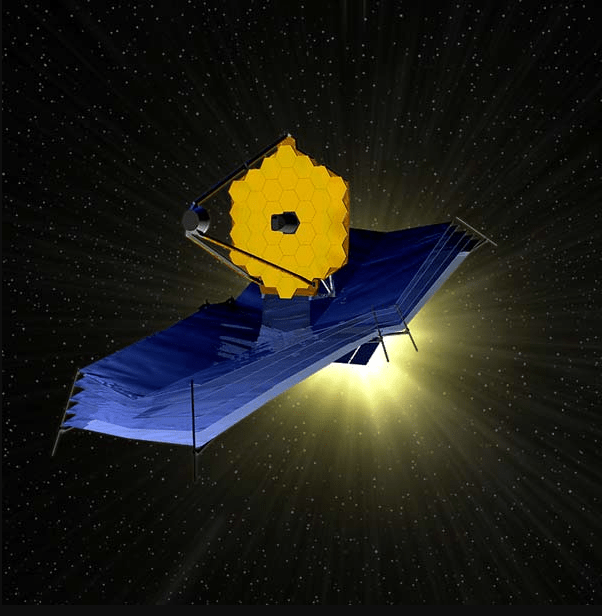
Image (Credits): Artist’s impression of the James Webb Space Telescope. (Northrop Grumman)
“In conclusion, to date, no available evidence directly links Webb to any actions or follow-up related to the firing of individuals for their sexual orientation. However, the research and this report make clear that the Lavender Scare was a painful chapter in our national history. Every effort was made to be as thorough in research and objective in analysis as possible. We must make great efforts to learn from the experience to guarantee that the core values of diversity, equity, accessibility, and inclusion are advanced, not only at NASA, but across the federal government. Only then can we ensure that dark episodes such as the Lavender Scare remain our history and not our future.”
-Concluding statement from the NASA Chief Historian’s report on James Webb, titled NASA Historical Investigation into James E. Webb’s Relationship to the Lavender Scare. As the reports notes, “The central purpose of this investigation was to locate any evidence that could indicate whether James Webb acted as a leader of or proponent for firing LGBTQ+ employees from the federal workforce.” It is sad summary of the federal government’s treatment of its gay employees following World War II, which represents a dark chapter in American history that we only recently left behind.
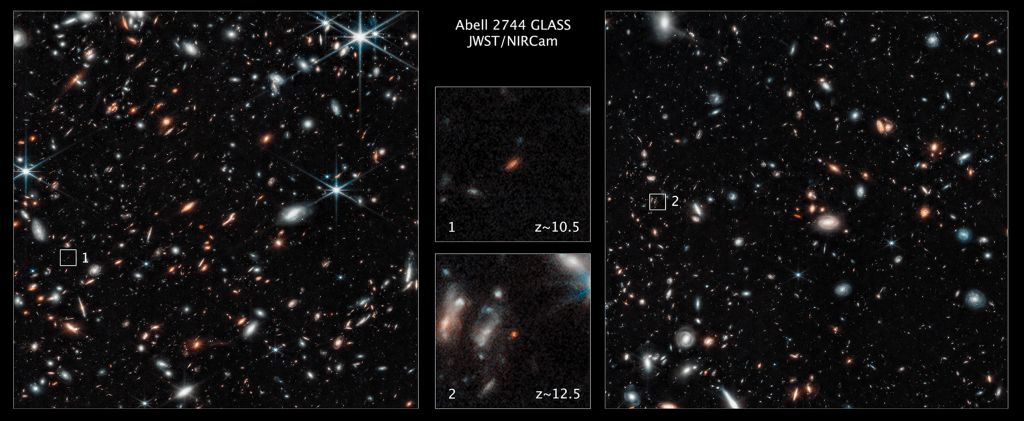
Image (Credit): Two of the farthest galaxies seen to date are captured in these Webb Space Telescope pictures of the outer regions of the giant galaxy cluster Abell 2744. The galaxies are not inside the cluster, but many billions of light-years farther behind it. The galaxy labeled (1) existed only 450 million years after the big bang. The galaxy labeled (2) existed 350 million years after the big bang. Both are seen really close in time to the big bang which occurred 13.8 billion years ago. These galaxies are tiny compared to our Milky Way, being just a few percent of its size, even the unexpectedly elongated galaxy labeled (1). (NASA, ESA, CSA, Tommaso Treu (UCLA), Zolt G. Levay (STScI))
With just four days of analysis, researchers found two exceptionally bright galaxies in the GLASS-JWST images. These galaxies existed approximately 450 and 350 million years after the big bang (with a redshift of approximately 10.5 and 12.5, respectively), though future spectroscopic measurements with Webb will help confirm…“These observations just make your head explode. This is a whole new chapter in astronomy. It’s like an archaeological dig, and suddenly you find a lost city or something you didn’t know about. It’s just staggering,” added Paola Santini, fourth author of the Castellano et al. GLASS-JWST paper.
When Mars was a young planet, it was bombarded by ice asteroids delivering water and organic molecules necessary for life to emerge. According to the professor behind a new study, this means that the first life in our solar system may have been on Mars.
Recently, hundreds of gold-rich stars have been detected by state-of-the-art telescopes worldwide. New simulations of galaxy formation, with the highest resolution in both time and mass, show that these gold-rich stars formed in progenitor galaxies, small galaxies which merged to create the Milky Way…According to the research, most gold-rich stars formed over 10 billion years ago in small, building-block galaxies―known as progenitor galaxies. Some but not all progenitor galaxies experience a neutron star merger, where large amounts of heavy r-process elements are produced and released, enriching that particular small galaxy. The predicted abundance of gold-enriched stars in the final Milky-Way-sized galaxy matches what is actually observed.
Image (Credit): Artist’s drawing of the Euclid space telescope. (ESA/ATG-medialab)
To follow up on the previous post, Russia also lost out on launching the European Space Agency’s (ESA) Euclid spacecraft. Russia was supposed to launch it on a Soyuz-ST/Fregat rocket this December, but the country’s invasion of Ukraine led to a change in plans. SpaceX will now be launching the spacecraft next year.
Euclid was designed to study dark energy and dark matter, and make a 3D-map of the Universe. The project includes scientists from 14 countries: Austria, Denmark, France, Finland, Germany, Italy, Netherlands, Norway, Spain, Switzerland, Portugal, Romania, the UK, and the US.
Euclid hopes to answer the following questions:
How did the Universe originate? What were the conditions just after the Big Bang, and how did these give rise to the large-scale structures we see today?
Why is the Universe expanding at an accelerating rate today?
Is dark energy – a term often used to signify the mysterious force behind this cosmic acceleration – real? If so, is it a constant energy density intrinsic to and spread throughout space, or a new force of nature that slowly evolves as the Universe expands?
What is the nature of dark matter, and how do neutrinos possibly contribute? Are there other as-yet-undetected massive particles in the Universe?
Once launched, Euclid will operate in the Sun-Earth Lagrange point 2 (L2), which is where the James Webb Space Telescope is located as well as ESA’s Gaia spacecraft. Gaia, launched in December 2013, is currently mapping the stars in the Milky Way galaxy. It seems L2 is the place to be.
NASA is contributing infrared flight detectors for one of Euclid’s two science instruments. You can read more about the NASA contribution here.
Image (Credit): JWST deep field view of the cosmos. (NASA, ESA, CSA, STScI)
This week we have another recent image from the James Webb Space Telescope (JWST) showing a thousands of galaxies, some of which have images distorted by the gravity of other galaxies. It is quite a collection of distant worlds.
Thousands of galaxies flood this near-infrared image of galaxy cluster SMACS 0723. High-resolution imaging from NASA’s James Webb Space Telescope combined with a natural effect known as gravitational lensing made this finely detailed image possible.
First, focus on the galaxies responsible for the lensing: the bright white elliptical galaxy at the center of the image and smaller white galaxies throughout the image. Bound together by gravity in a galaxy cluster, they are bending the light from galaxies that appear in the vast distances behind them. The combined mass of the galaxies and dark matter act as a cosmic telescope, creating magnified, contorted, and sometimes mirrored images of individual galaxies.
Clear examples of mirroring are found in the prominent orange arcs to the left and right of the brightest cluster galaxy. These are lensed galaxies – each individual galaxy is shown twice in one arc. Webb’s image has fully revealed their bright cores, which are filled with stars, along with orange star clusters along their edges.
Not all galaxies in this field are mirrored – some are stretched. Others appear scattered by interactions with other galaxies, leaving trails of stars behind them.




 Our Awesome Universe