Pic of the Week: Dead Comet From Halloween Past

Image (Credit): Asteroid 2015 TB145 as captured by the Arecibo Observatory in Puerto Rico on October 30, 2015. (NAIC-Arecibo/NSF)

This spooky image of a dead comet was captured 10 years ago, but it still serves this purpose this time of year. It passed the Earth on Halloween evening that year at a distance of about 302,000 miles.

Here is more from NASA’s Jet Propulsion Laboratory:

Scientists observing asteroid 2015 TB145 with NASA’s Infrared Telescope Facility (IRTF) on Mauna Kea, Hawaii, have determined that the celestial object is more than likely a dead comet that has shed its volatiles after numerous passes around the sun.

The belated comet has also been observed by optical and radar observatories around the world, providing even more data, including our first close-up views of its surface…

The first radar images of the dead comet were generated by the National Science Foundation’s 305-meter (1,000-foot) Arecibo Observatory in Puerto Rico. The radar images from Arecibo indicate the object is spherical in shape and approximately 2,000 feet (600 meters) in diameter and completes a rotation about once every five hours.

“The IRTF data may indicate that the object might be a dead comet, but in the Arecibo images it appears to have donned a skull costume for its Halloween flyby,” said Kelly Fast, IRTF program scientist at NASA Headquarters and acting program manager for NASA’s NEO Observations Program.

NASA Cuts Endanger Mars Rover Missions

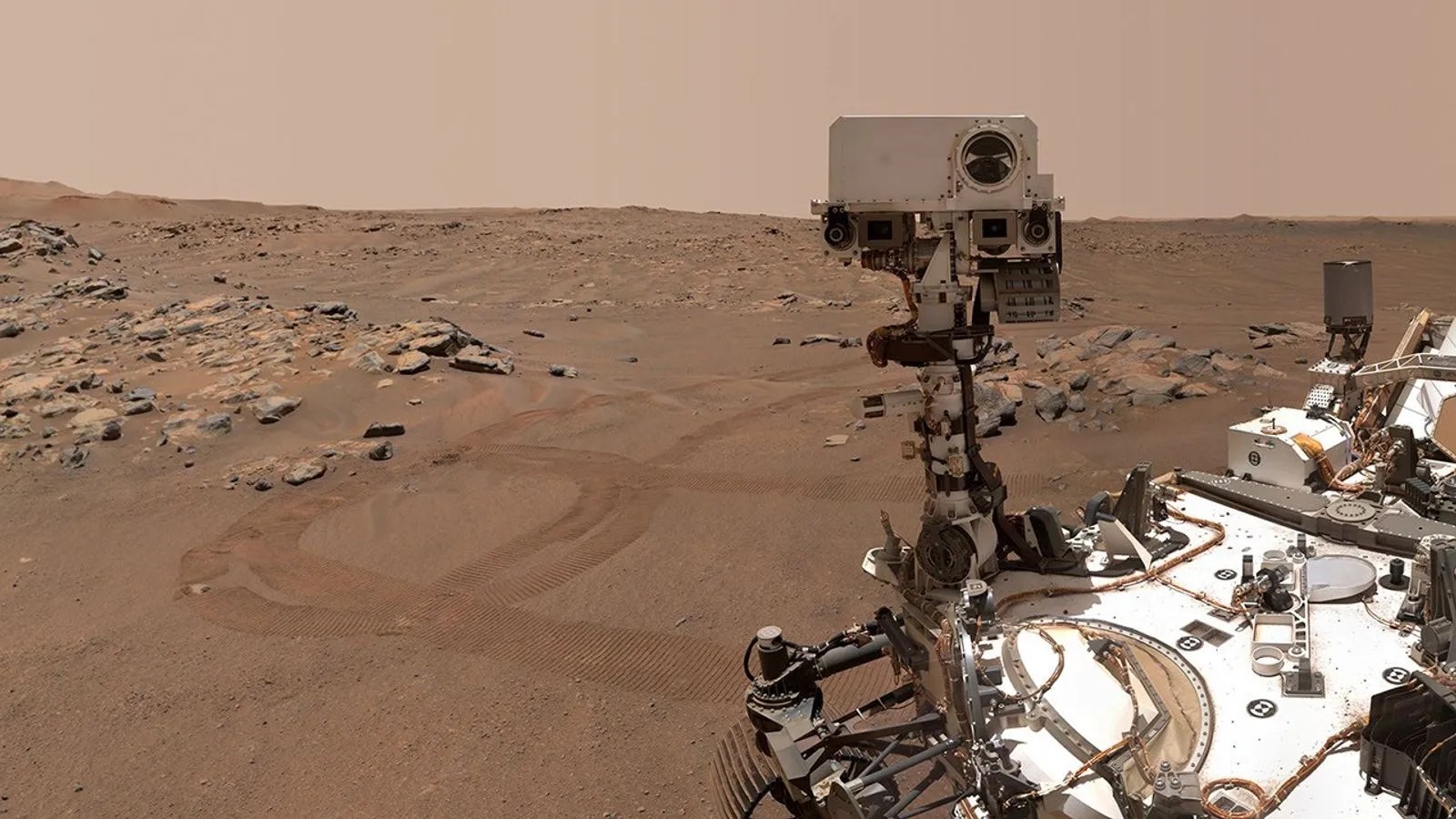
Image (Credit): Selfie by NASA’s Perseverance Mars rover taken on September 10, 2021. (NASA/JPL-Caltech)

First the White House dropped the idea of retrieving soil samples from Mars. Now it is going after the rover collecting those samples.

This week NASA’s Jet Propulsion Laboratory (JPL), which manages the rovers on Mars, announced the layoff of 550 workers, stating:

In order to best position JPL going forward, we are taking steps to restructure and establish an appropriate size to ensure future success. As part of this effort, JPL is undergoing a realignment of its workforce, including a reduction in staff. This reduction — part of a reorganization that began in July and not related to the current government shutdown — will affect approximately 550 of our colleagues across technical, business, and support areas.

One of the employees at JPL who formerly operated rovers noted that the White House cuts is reducing the funding for the Perseverance Mars rover, which collected the soil samples, by two-thirds. He was quoted as saying that they cuts are “…just enough to technically keep it going and not get the full PR backlash of canceling a working rover.”

We only have two rovers left on Mars, the Perseverance rover and the Curiosity rover. Are we going to see these rovers go dark in the near future as they continue to look for life on the planet? And what does it say that we are hoping to put humans on Mars when we cannot even find a way to properly fund the robots that are already there? Would you be your life on this government?

None of this give the US public any confidence, nor does it give bright students much hope for a NASA career when the roles they want to fill are being eliminated.

We are treading water nowadays rather than reaching for the stars. It will have repercussions that may be long-lasting.

Space Stories: Layoffs at NASA’s JPL, Rocky Giants in our Solar System, and New Findings from Apollo 17

Here are some recent space-related stories of interest.

NBC News: NASA’s Jet Propulsion Laboratory Lays Off 550 Workers

NASA’s Jet Propulsion Laboratory announced Monday that it will cut around 550 jobs — around 10% of its staff. In a statement posted online, the lab’s director, Dave Gallagher, said the layoffs are part of a broad “realignment of its workforce” and not a result of the government shutdown. The cuts will affect positions across the NASA center’s technical, business and support areas, he said.

Space.com: Uranus and Neptune May Not Be ‘Ice Giants’ After All, New Research Suggests

Astronomers have long called Uranus and Neptune the “ice giants” because models suggested that these outer planets’ interiors are largely made of mixtures of water, ammonia and other ices — compounds that freeze easily in deep space. But new research reveals that we actually know very little about what’s going on inside these planets, causing researchers to propose that Uranus and Neptune be called “rocky giants” instead.

Brown University: “With New Analysis, Apollo Samples Brought to Earth in 1972 Reveal Exotic Sulfur Hidden in Moon’s Mantle

In a study published in JGR: Planets, researchers report a sulfuric surprise in rock samples taken from the Moon’s Taurus Littrow region during Apollo 17. The analysis shows that volcanic material in the sample contains sulfur compounds that are highly depleted of sulfur-33 (or 33S), one of four radioactively stable sulfur isotopes. The depleted 33S samples contrast sharply with sulfur isotope ratios found on Earth, the researchers say.

Space Quote: Potential Biosignature Found on Mars

Image (Credit): The Martian rock nicknamed “Cheyava Falls” found in Jezero Crater last year. (NASA/JPL-Caltech/MSSS)

““The discovery of a potential biosignature, or a feature or signature that could be consistent with biological processes, but that requires further work and study to confirm a biological origin is something that we’re sharing with you all today that grows from years of hard work, dedication and collaboration between over 1,000 scientists and engineers here at the (NASA) Jet Propulsion Laboratory and our partner institutions around the country and internationally.”

Statement by Katie Stack Morgan, Perseverance project scientist at the Jet Propulsion Laboratory (JPL), at a news conference earlier on Wednesday. The rock in question, found in an ancient dry riverbed in Jezero Crater, was sampled by the Perseverance rover last year. For more on the findings you can visit the NASA site here.

Space Stories: Aliens Using Black Holes, Fire Approaches JPL, and New Approaches for the Mars Sample

Credit: Image by Gerd Altmann from Pixabay

Here are some recent stories of interest.

Universe TodayScientists Propose New Method to Detect Alien Civilizations via Black Holes

A new paper looks at another way we might be able to detect advanced civilizations, and at its center is the need for energy. The more advanced a civilization becomes, the greater their need for energy and one of the most efficient ways, according to current theories, is to harness the energy from an actively feeding black hole. The paper suggests a civilization feeding matter into a black hole could harvest energy from it; more excitingly perhaps, the process could be detectable within 17,000 light years.

LA TimesFirefighters Battle to Protect NASA’s Jet Propulsion Laboratory, Mt. Wilson

Officials said they are making progress in protecting two key institutions from the Eaton fire. Don Fregulia, an operations section chief for the California Department of Forestry and Fire Protection, which has joined in the Eaton fire response, said that efforts to protect Mt. Wilson had proved successful and he expected that to remain the case. “We’re actively engaged there, and so far, no loss to any values at risk at Mt. Wilson,” Fregulia said. “We’re feeling good about what we have to do up there tonight to keep that site secure.” He said the fire had also spread close to NASA’s Jet Propulsion Laboratory, but he said that’s a priority and crews were “making good progress there as well.”

NASANASA to Explore Two Landing Options for Returning Samples from Mars

To maximize chances of successfully bringing the first Martian rock and sediment samples to Earth for the benefit of humanity, NASA announced Tuesday a new approach to its Mars Sample Return Program. The agency will simultaneously pursue two landing architectures, or strategic plans, during formulation, encouraging competition and innovation, as well as cost and schedule savings. NASA plans to later select a single path forward for the program, which aims to better understand the mysteries of the universe, and to help determine whether the Red Planet ever hosted life. NASA is expected to confirm the program – and its design – in the second half of 2026.