
Here are some recent space-related stories of interest.
—Ars Technica: “A Mission NASA Might Kill is Still Returning Fascinating Science from Jupiter“
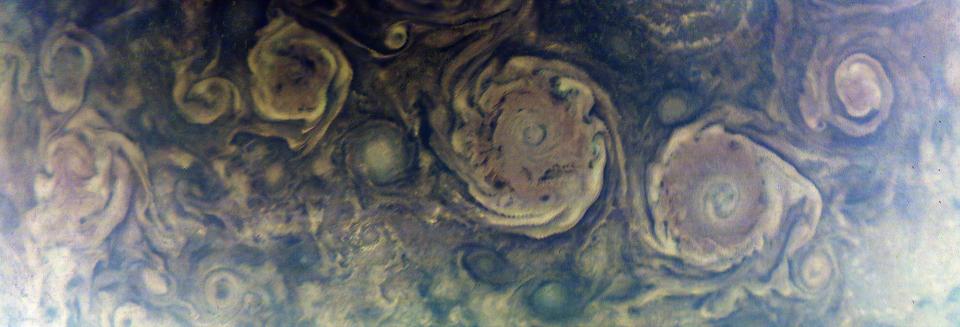
Jupiter’s colossal storms generate lightning flashes at least 100 times more powerful than those on Earth, according to scientists analyzing data from NASA’s Juno spacecraft. The findings were published March 20 in the journal AGU Advances. Researchers used data recorded by Juno in 2021 and 2022, after NASA granted an extension to the spacecraft’s operations upon completing a five-year science campaign at Jupiter. Juno remains in good health, but NASA officials have not said if they will approve another extension for the mission. The issue is money.
—Astronomy.com: “NASA’s Van Allen Probe A Burns Up Over the Pacific after 14 Years in Space“
NASA’s Van Allen Probe A re-entered Earth’s atmosphere on Wednesday, March 11, at 6:37 a.m. EDT, marking the final chapter for a spacecraft that reshaped scientists’ understanding of the radiation environment around our planet. The U.S. Space Force confirmed the spacecraft came down over the eastern Pacific Ocean. NASA said most of the 1,300-pound (600 kilograms) probe burned up during reentry, though some pieces may have reached the surface. Its twin, Probe B, remains in orbit and is not expected to re-enter before 2030. The twin probes launched together on Aug. 30, 2012, on what was supposed to be a two-year mission. They operated for nearly seven years instead, circling Earth inside the Van Allen radiation belts — zones of high-energy charged particles held in place by the planet’s magnetic field.
—Carnegie Science: ““Extragalactic Archeology” Reveals Nearby Galaxy’s Evolution“
A team of astronomers, including Carnegie Science’s Jeff Rich and other former Carnegie Observatories astronomers, have for the first time traced the history of a galaxy outside our own Milky way by studying chemical fingerprints in deep space, a new approach they are calling “extragalactic archeology.” Their findings are published in Nature Astronomy. “This is the first time that a chemical archaeology method has been used with such fine detail outside our own galaxy,” said lead author Lisa Kewley of the Center for Astrophysics | Harvard and Smithsonian.

 Our Awesome Universe