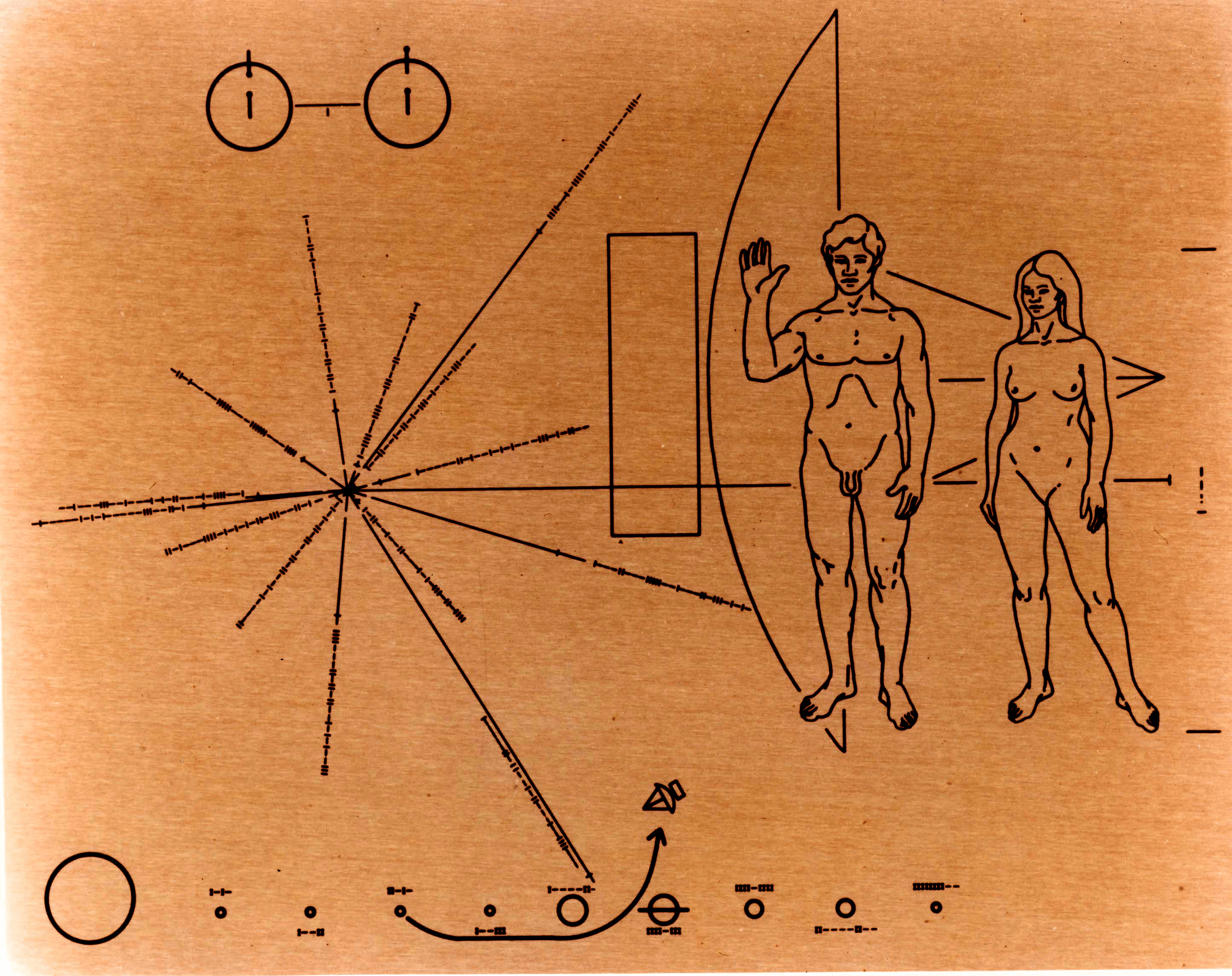
Image (Credit): The visual message on the Pioneer 10 and 11 plaques. (NASA Ames)
On this day in 2003, NASA heard its last message from Pioneer 10, the Jupiter space probe. Launched in 1972, it was the first spacecraft to cross the asteroid belt between Mars and Jupiter on its way to the outer planets. It is also one of only five spacecraft to leave our solar system.
If all goes well, in about 2 million years the Pioneer 10 spacecraft will encounter the star Aldebaran. Maybe some civilization in that solar system will be arguing about this object floating through the neighborhood the way we have argued about the origins of the interstellar object we call 3I/ATLAS.
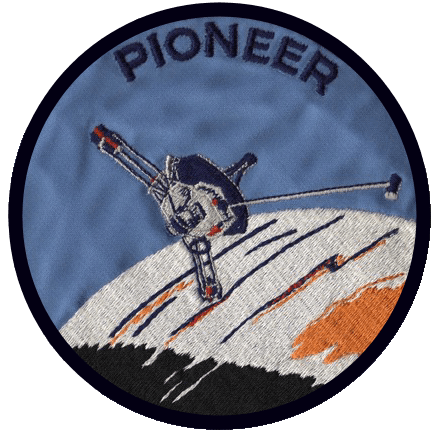
Image (Credit): Mission patch for Pioneer 10 and 11. (NASA)
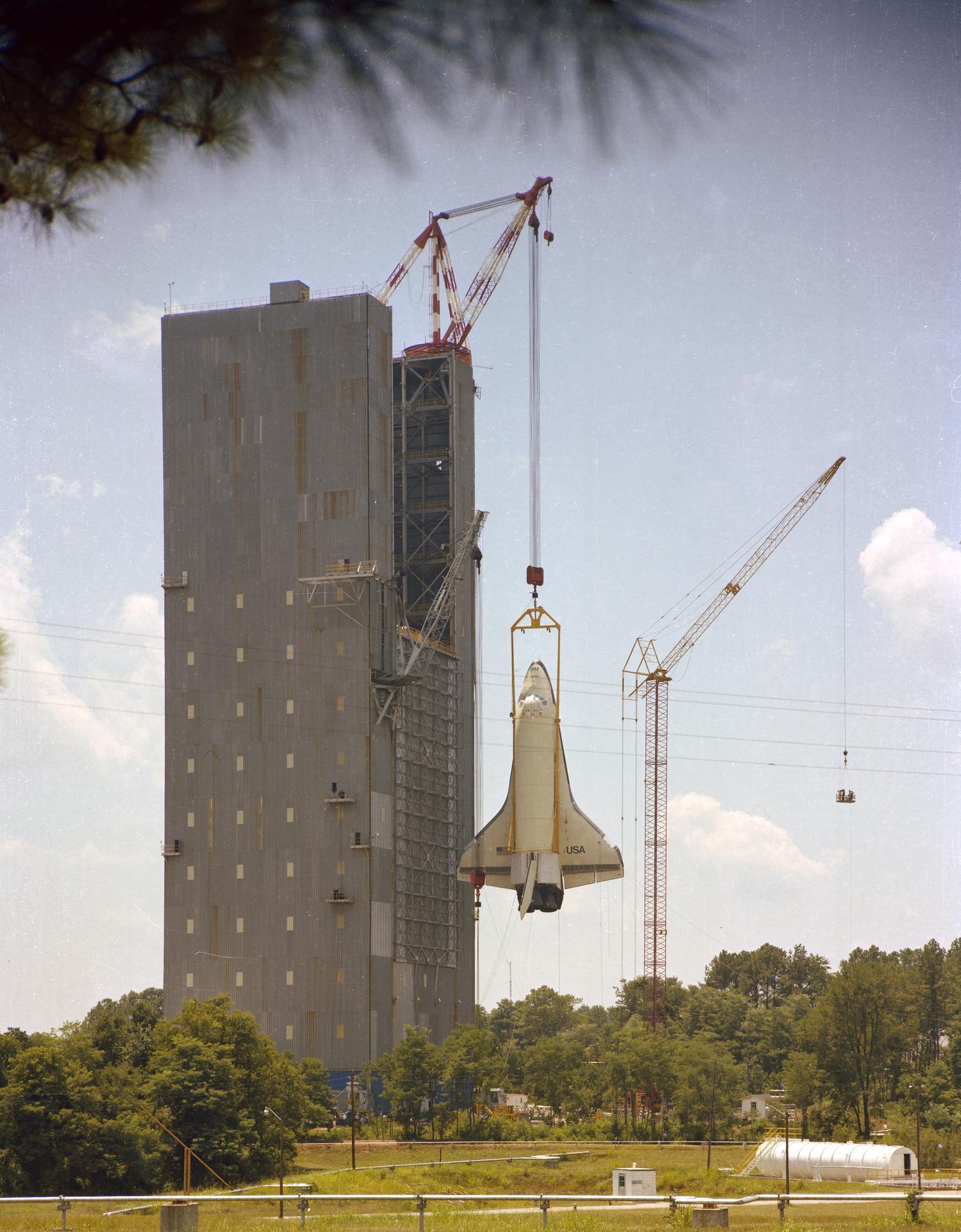
Image (Credit): The space shuttle orbiter Enterprise lifted by crane into the Structural Dynamic Test Facility at NASA’s Marshall Space Flight Center in Huntsville, Alabama, for vibration testing in July 1978. (NASA)
Here are some recent space-related stories of interest.
With NASA Administrator Jared Isaacman in place, the agency is spearheading a major infrastructure modernization initiative, starting with the demolition of historic testing facilities at Marshall Space Flight Center. The space agency will tear down the Dynamic Test Stand and the Propulsion and Structural Test Facility, known as the T-Tower, beginning Jan. 10. The move marks the first phase of removing 25 outdated structures at the Alabama center.
Most planets orbit comfortably around their stars, but some worlds are not so lucky. Astronomers have discovered a number of these rogue planets, which float through the Milky Way untethered to a solar system. Now, for the first time, they’ve directly measured the mass of one of these worlds, finding that it’s around Saturn’s mass. The planet might’ve been flung far from its star through a past gravitational interaction. But such encounters are surprising for a planet with such a hefty mass.
The giant planet Jupiter has nearly 100 known moons, yet none have captured the interest and imagination of astronomers and space scientists quite like Europa, an ice-shrouded world that is thought to possess a vast ocean of liquid salt water. For decades, scientists have wondered whether that ocean could harbor the right conditions for life, placing Europa near the top of the list of solar system bodies to explore. A new study led by Paul Byrne, an associate professor of Earth, environmental, and planetary sciences, throws cold water on the idea that Europa could support life at the seafloor. Using calculations that consider the moon’s size, the makeup of its rocky core, and the gravitational forces from Jupiter, Byrne and a team of scientists conclude that Europa likely lacks the tectonic motion, warm hydrothermal vents, or any other sort of underwater geologic activity that would presumably be a prerequisite for life.
The shape of the universe is not something we often think about. My colleagues and I have published a new study that suggests it could be asymmetric or lopsided, meaning not the same in every direction. Should we care about this? Well, today’s “standard cosmological model”—which describes the dynamics and structure of the entire cosmos—rests squarely on the assumption that it is isotropic (looks the same in all directions), and homogeneous when averaged on large scales.
A groundbreaking discovery published in Nature Astronomy has revealed a cosmic phenomenon that may finally settle a 30-year-old mystery surrounding the early life cycles of stars. Astronomers observing the binary system SVS 13 within the NGC 1333 reflection nebula, located 1,000 light-years away in the constellation Perseus, have identified more than 400 bow-shaped rings created by violent ejections from a newborn star.
The Southwest Research Institute-led Ultraviolet Spectrograph (UVS) aboard NASA’s Europa Clipper spacecraft has made valuable observations of the interstellar comet 3I/ATLAS, which in July became the third officially recognized interstellar object to cross into our solar system. UVS had a unique view of the object during a period when Mars- and Earth-based observations were impractical or impossible. “We’re excited that this opportunity to view another target on the way to Jupiter was completely unexpected,” said SwRI’s Dr. Kurt Retherford, the principal investigator for Europa-UVS. “Our observations have allowed for a unique and nuanced view of the comet.”
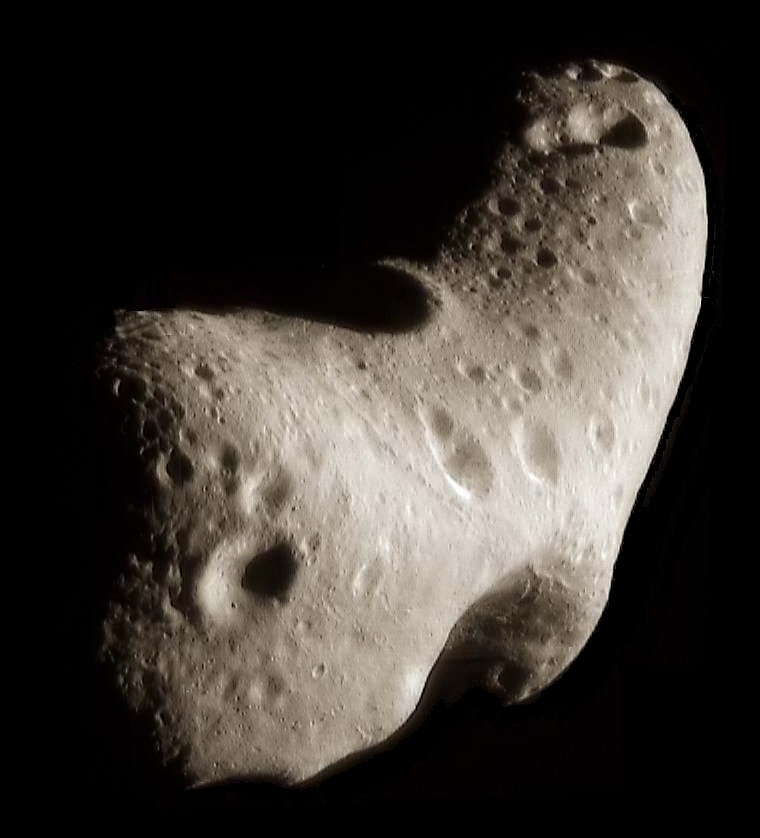
Image (Credit): Asteroid 433 Eros, which is the first asteroid ever orbited by a spacecraft, Near Earth Asteroid Rendezvous – Shoemaker (NEAR Shoemaker), in 1998. (NASA)
Multiple Choice: What is the average distance between the asteroids located in the asteroid belt between Mars and Jupiter?
A. 4,000 miles B. 50,000 miles C. 600,000 miles D. 1.1 million miles