Space Stories: Stargazing Apps, Ringless Jupiter, and Detecting Exoplanets

Image (Credit): This enhanced color view of Jupiter’s south pole was created by citizen scientist Gabriel Fiset using data from the JunoCam instrument on NASA’s Juno spacecraft. (NASA/JPL-Caltech/SwRI/MSSS/Gabriel Fiset)

Here are some recent stories of interest.

Mashable.com:The Best Astronomy Apps for Stargazing This Summer

Thanks to these astronomy apps, you can use your phone to see which stars and constellations are above you in real time, day or night. Whether you’re planning on stargazing, are curious about which constellations are in your location, or simply want to flex on your family and friends around the campfire, the following apps can show you what you’re seeing in the sky.

Technology.org:Why Jupiter Doesn’t Have Rings Like Saturn

To understand the reason Jupiter currently looks the way it does, Kane and his graduate student Zhexing Li ran a dynamic computer simulation accounting for the orbits of Jupiter’s four main moons, as well as the orbit of the planet itself, and information about the time it takes for rings to form. Their results are detailed here, soon to be published in the Planetary Science journal.

ScienceDaily.com:A New Method to Detect Exoplanets

In recent years, a large number of exoplanets have been found around single ‘normal’ stars. New research shows that there may be exceptions to this trend. Researchers suggest a new way of detecting dim bodies, including planets, orbiting exotic binary stars known as Cataclysmic Variables (CVs).

More JWST Priorities

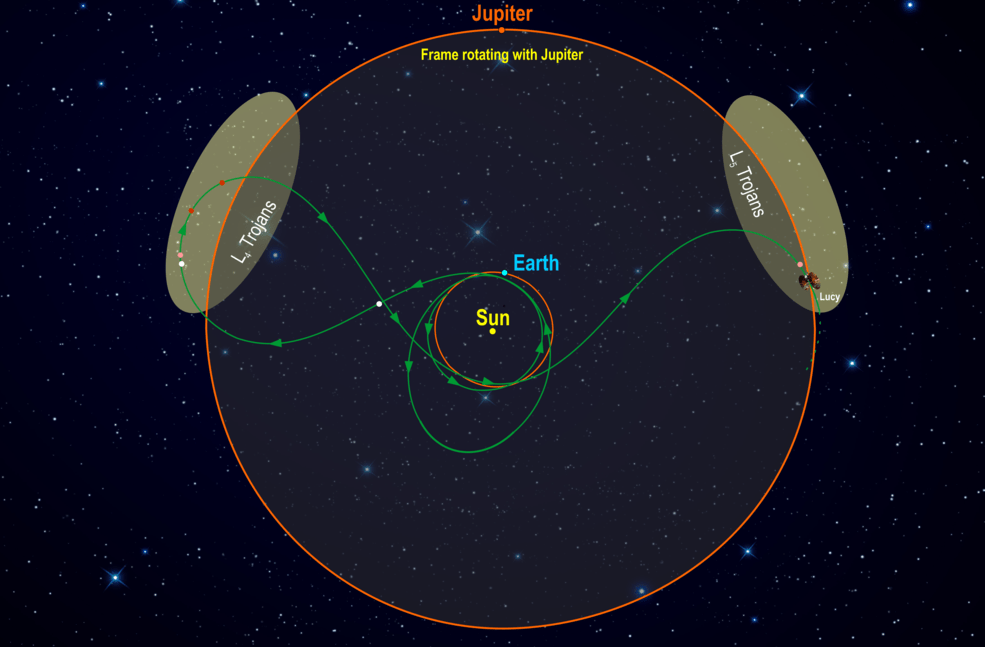
Image (Credit): This diagram shows Lucy’s orbital path in green after her October 2021 launch to visit the Trojan asteroids. (Southwest Research Institute)

Last week I noted some of the mission priorities in the James Webb Space Telescope’s (JWST) first year. Those priorities were listed under “Exoplanets and Disks.” I thought I would highlight a few more, this time from the “Solar System Astronomy” list. Here are five more priorities:

  • Pluto’s Climate System with JWST;
  • The Moons of Uranus: A NIRSpec Investigation of Their Origins, Organic Constituents, and Possible Ocean World Activity;
  • A Pure Parallel Survey of Water in the Asteroid Belt;
  • DiSCo-TNOs: Discovering the Composition of the Trans-Neptunian Objects, Icy Embryos for Planet Formation; and
  • JWST Observations of Lucy Mission Targets.

Each of these priorities come with an explanation of the mission. For example, here is a little more about NASA’s Lucy mission from the JWST proposal:

The Lucy spacecraft – to be launched at approximately the same time as JWST – will perform the first ever in situ exploration of the Jupiter Trojan asteroids. Trojans are the largest population of solar system bodies currently unvisited by spacecraft, and revealing their composition and formation history is the key to untangling disparate hypothesis for the early dynamical evolution of the entire solar system.

Understanding these enigmatic bodies requires not just the high spatial resolution imagery and spectroscopy that will be afforded by Lucy, but also the superb near- and mid-infrared spectroscopy of which JWST is uniquely capable. The high signal-to-noise, high spectral resolution, and extended wavelength coverage beyond the capabilities of Lucy will allow JWST to sensitively probe the organic, carbonate, and silicate components of the surfaces of the Trojans. Meanwhile, the Lucy spectra and images will place these observations into their geological and historical context, greatly extending the scientific utility of both the JWST observations and the Lucy visit. Together these observations will paint a rich picture of this population, allowing us to trace connections with other bodies studied remotely and in situ across the solar system.

Lucy was launched last October and is expected to encounter its first Trojan asteroid until August 2027. You can find the full mission timeline here.

Pic of the Week: The Durable Hubble

Image (Credit): The Hubble Space Telescope. (NASA/ESA)

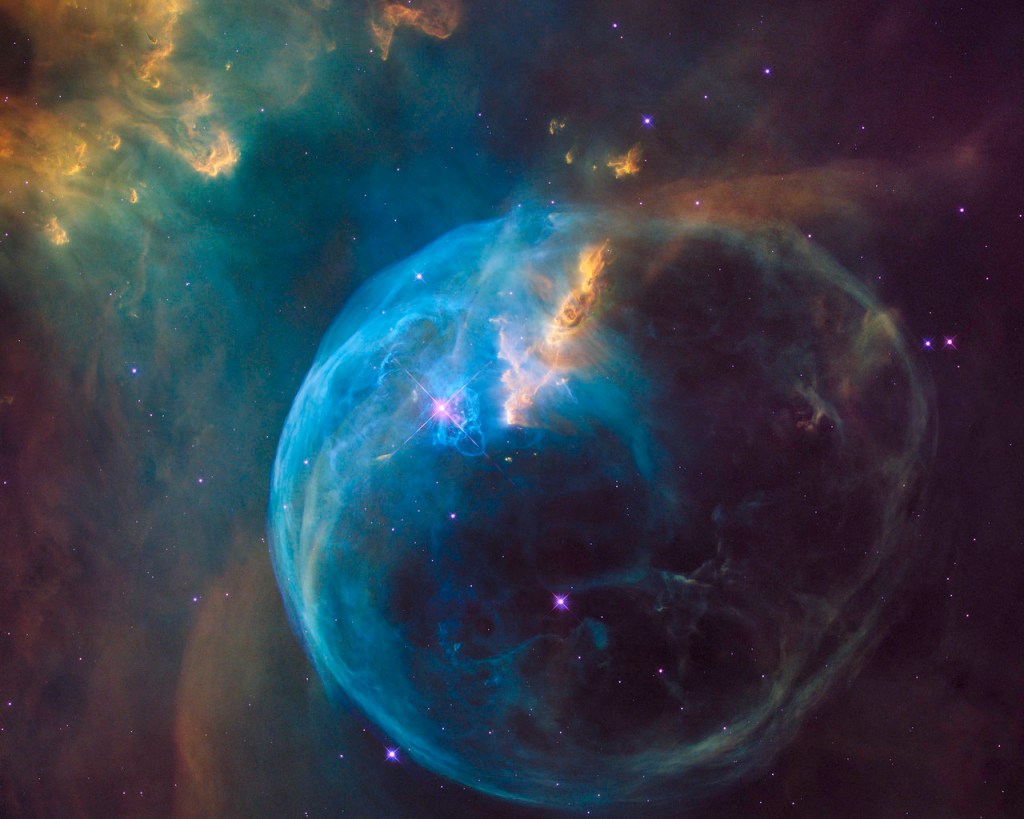
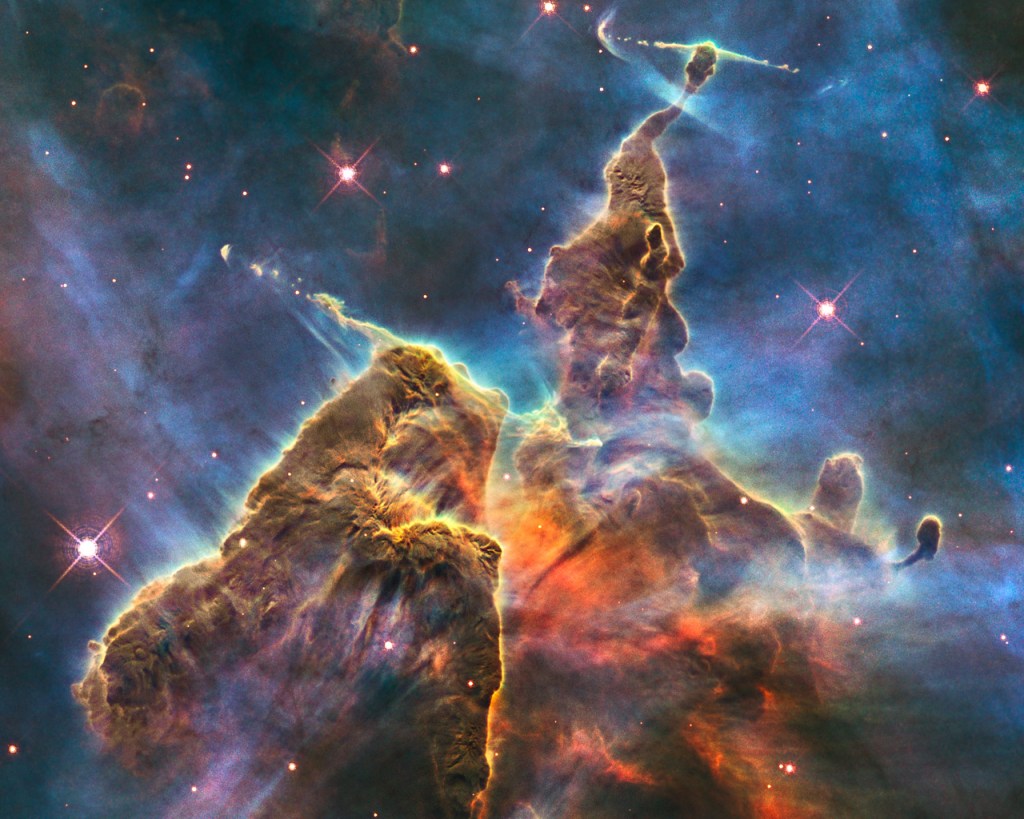
This week’s image is the Hubble Space Telescope, still going strong after more than 32 years. It left the Space Shuttle Discovery’s cargo bay on April 25, 1990. With all of the attention on the James Webb Space Telescope (JWST), it’s important to remember this dependable space telescope that brought us so many amazing images over the years, including those shown below.

Given the concern over the recent concerns about a micrometeroid impacting the JWST, let’s not forget that the Hubble had a few growing pains as well. Most importantly, it had to deal with a flawed mirror that required astronauts to visit the space telescope so they could add five pairs of corrective mirrors. More than three years had passed before the astronauts could make this correction. So the current issues with the JWST are pretty minor by comparison.

Image (Credit): The Bubble Nebula, also known as NGC 7635, located 8 000 light-years away. (NASA/ESA)
Image (Credit): A pillar of gas and clouds within the stellar nursery called the Carina Nebula, located 7500 light-years away in the southern constellation of Carina. (NASA/ESA).
Image (Credit): The planet Jupiter. (NASA/ESA)

Television: More Space Stories This Summer

Image (Credit): The eight plants of our solar system. (NOVA)

If you are looking for space series beyond the Moon, PBS has a few more shows for you. With the James Webb Space Telescope releasing the first photos next week, now is the time to brush up on the mission with a NOVA special. And check out the earlier NOVA piece on the planets as well. Dates and times may vary by region.

NOVA: Ultimate Space Telescope, July 13 at 9pm (28 minutes):

How did NASA engineers build and launch the most ambitious telescope of all time? Follow the dramatic story of the James Webb Space Telescope—the most complex machine ever launched into space. If it works, scientists believe that this new eye on the universe will peer deeper back in time and space than ever before to the birth of galaxies, and may even be able to “sniff” the atmospheres of exoplanets as we search for signs of life beyond Earth. But getting it to work is no easy task. The telescope is far bigger than its predecessor, the famous Hubble Space Telescope, and it needs to make its observations a million miles away from Earth—so there will be no chance to go out and fix it. That means there’s no room for error; the most ambitious telescope ever built needs to work perfectly. Meet the engineers making it happen and join them on their high stakes journey to uncover new secrets of the universe.

NOVA: The Planets, July 7 & 14 at 8pm (5 episodes)

Among the stars in the night sky wander the eight-plus worlds of our own solar system—each home to truly awe-inspiring sights. Volcanoes three times higher than Everest, geysers erupting with icy plumes, cyclones larger than Earth lasting hundreds of years. Each of our celestial neighbors has a distinct personality and a unique story. In this five-part series, NOVA will explore the awesome beauty of “The Planets,” including Saturn’s 175,000-mile-wide rings, Mars’ ancient waterfalls four times the size of any found on Earth, and Neptune’s winds—12 times stronger than any hurricane felt on our planet. Using unique special effects and extraordinary footage captured by orbiters, landers and rovers, we’ll treat viewers to an up-close look at these faraway worlds. We’ll stand on the dark side of Pluto, lit only by the reflected light of its moons, watch the sun set over an ancient Martian waterfall, and witness a storm twice the size of Earth from high above Saturn. And, we’ll reveal how each of them has affected our own planet: Earth. 

Video: The Problem With “The Rare Earth Hypothesis”

Image (Credit): Upgraded Drake Equation to account for the Rare Earth factors. (Cool Worlds Lab)

Cool Worlds Lab has another great video out, this time discussing the Rare Earth Hypothesis. This hypothesis assumes that a multitude of factors are necessary for life to develop in the universe, and the program goes deeper into a few of these factors, including the need for:

  1. A magnetosphere;
  2. Plate tectonics;
  3. A large moon;
  4. Impacts from asteroids and comets; and
  5. A Jupiter-sized planet.

The program challenges some of these factors and also highlights the need for a more open understanding of the origins of life beyond our current understanding. Basically, the conditional probably of the Drake Equation or even the modified Drake Equation unnecessarily leads one down a very narrow path.

It’s an eye-opening review of the evidence and worth watching. Check it out.