Television: More Space Stories This Summer

Image (Credit): The eight plants of our solar system. (NOVA)

If you are looking for space series beyond the Moon, PBS has a few more shows for you. With the James Webb Space Telescope releasing the first photos next week, now is the time to brush up on the mission with a NOVA special. And check out the earlier NOVA piece on the planets as well. Dates and times may vary by region.

NOVA: Ultimate Space Telescope, July 13 at 9pm (28 minutes):

How did NASA engineers build and launch the most ambitious telescope of all time? Follow the dramatic story of the James Webb Space Telescope—the most complex machine ever launched into space. If it works, scientists believe that this new eye on the universe will peer deeper back in time and space than ever before to the birth of galaxies, and may even be able to “sniff” the atmospheres of exoplanets as we search for signs of life beyond Earth. But getting it to work is no easy task. The telescope is far bigger than its predecessor, the famous Hubble Space Telescope, and it needs to make its observations a million miles away from Earth—so there will be no chance to go out and fix it. That means there’s no room for error; the most ambitious telescope ever built needs to work perfectly. Meet the engineers making it happen and join them on their high stakes journey to uncover new secrets of the universe.

NOVA: The Planets, July 7 & 14 at 8pm (5 episodes)

Among the stars in the night sky wander the eight-plus worlds of our own solar system—each home to truly awe-inspiring sights. Volcanoes three times higher than Everest, geysers erupting with icy plumes, cyclones larger than Earth lasting hundreds of years. Each of our celestial neighbors has a distinct personality and a unique story. In this five-part series, NOVA will explore the awesome beauty of “The Planets,” including Saturn’s 175,000-mile-wide rings, Mars’ ancient waterfalls four times the size of any found on Earth, and Neptune’s winds—12 times stronger than any hurricane felt on our planet. Using unique special effects and extraordinary footage captured by orbiters, landers and rovers, we’ll treat viewers to an up-close look at these faraway worlds. We’ll stand on the dark side of Pluto, lit only by the reflected light of its moons, watch the sun set over an ancient Martian waterfall, and witness a storm twice the size of Earth from high above Saturn. And, we’ll reveal how each of them has affected our own planet: Earth. 

Video: The Problem With “The Rare Earth Hypothesis”

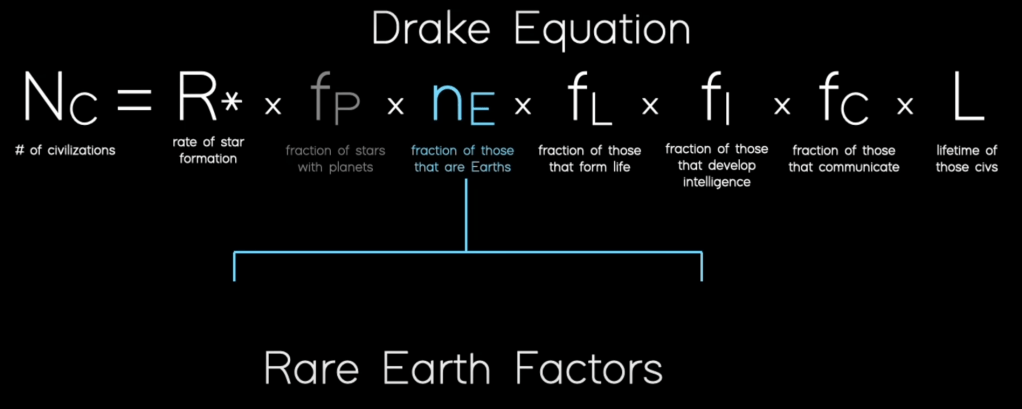
Image (Credit): Upgraded Drake Equation to account for the Rare Earth factors. (Cool Worlds Lab)

Cool Worlds Lab has another great video out, this time discussing the Rare Earth Hypothesis. This hypothesis assumes that a multitude of factors are necessary for life to develop in the universe, and the program goes deeper into a few of these factors, including the need for:

  1. A magnetosphere;
  2. Plate tectonics;
  3. A large moon;
  4. Impacts from asteroids and comets; and
  5. A Jupiter-sized planet.

The program challenges some of these factors and also highlights the need for a more open understanding of the origins of life beyond our current understanding. Basically, the conditional probably of the Drake Equation or even the modified Drake Equation unnecessarily leads one down a very narrow path.

It’s an eye-opening review of the evidence and worth watching. Check it out.

Pic of the Week: Europa in All its Glory

Image (Credit): Hubble images of Jupiter’s moon Europa. (NASA, NASA-JPL, University of Arizona)

This week’s photo of Jupiter’s moon Europa was taken by the Hubble Space Telescope in June 1997 (and released by NASA on October 14, 2021). Here is the story about these two images (the left one in natural color and the right one enhanced) from the Hubble site:

This photograph of the Jovian moon Europa was taken in June 1997 at a range of 776,700 miles by NASA’s Galileo spacecraft.

Slightly smaller than Earth’s moon, Europa has a very smooth surface and the solid ice crust has the appearance of a cracked eggshell. The interior has a global ocean with more water than found on Earth. It could possibly harbor life as we know it.

Hubble Space Telescope observations of Europa have revealed the presence of persistent water vapor in its very tenuous atmosphere. Hubble observations, spanning 1999 to 2015, find that water vapor is constantly being replenished throughout one hemisphere of the moon. This is a different finding from Hubble’s 2013 observations that found localized water vapor from geysers venting from its subsurface ocean. This water vapor comes from a different process entirely. Sunlight causes the surface ice to sublimate, transitioning directly into gas.

This color composite Galileo view combines violet, green, and infrared images. The view of the moon is shown in natural color (left) and in enhanced color designed to bring out subtle color differences in the surface (right). The bright white and bluish part of Europa’s surface is composed mostly of water ice, with very few non-ice materials. Long, dark lines are fractures in the crust, some of which are more than 1,850 miles long.

Exoplanet or Star?

Image(Credit): Kepler-854b (NASA Exoplanet Exploration).

Phys.org had a good story on the reclassification of objects captured by the NASA’s Kepler Space Telescope once believed to be exoplanets. New evidence indicates three “exoplanets” – Kepler-854b, Kepler-840b, and Kepler-699b – are actually stars (hence, the NASA image above will need to be modified).

The article notes that the three objects are too large to be considered planets, being between two and four times the size of Jupiter. The results were part of a study from the Astronomical Journal. A fourth exoplanet, Kepler-747 b, might also be a star.

After updated information indicated Kepler-854b was about three times the size of Jupiter, one of the study authors said, “There’s no way the universe can make a planet of that size…It just doesn’t exist.”

While the team reviewed about 2,000 Kepler exoplanets to find these four questionable items, it is likely that more will be found in the future among other reported exoplanets. Fortunately, that still leaves us with plenty of real exoplanets to study.

Where Should NASA Travel To In The Years to Come?

Source/Credit: Voyager 2 image of Neptune and Triton from NASA/JPL-Caltech/Björn Jónsson.

In a recent posting, the non-profit Planetary Society is recommending NASA consider a return to Neptune and its moon Triton, noting that such a mission was part of the plan in the last Decadal Survey in 2010 along with trips to Mars and Europa (both of which are underway). NASA was aiming for Uranus or Neptune, but the Planetary Society stated a preference for Neptune.

The last and only visit to Neptune back in 1989 with NASA’s Voyager 2 spacecraft providing our first close view of the planet. The Voyager 2 mission also led to the discovery of six new moons as well as four rings around the planet. Moreover, the mission detected what may be underground oceans on the moon Triton.

The Planetary Society believes Triton, most likely a captured object from the Kuiper Belt, should be the deciding factor for visiting Neptune rather than Uranus. A 2019 paper, “The NASA Roadmap to Ocean Worlds,” highlights the value of visiting Triton to learn more about its potential oceans:

Triton is deemed the highest priority target to address as part of an Ocean Worlds Program. This priority is given based on the extraordinary hints of activity shown by the Voyager spacecraft (e.g., plume activity; smooth, walled plains units; the cantaloupe terrain suggestive of convection)…and the potential for ocean-driven activity given by Cassini results at Enceladus. Although the source of energy for Triton’s activity remains unclear, all active bodies in the Solar System are driven by endogenic heat sources, and Triton’s activity coupled with the young surface age makes investigation of an endogenic source important. Further, many Triton mission architectures would simultaneously address Ice Giant goals on which high priority was placed in the Visions and Voyages Decadal Survey. Finally, as Triton likely represents a captured Kuiper Belt object (KBO), some types of comparative planetology with KBOs could also be addressed in a Triton mission. Before the next Decadal Survey, a mission study should be performed that would address Triton as a potential ocean world; such a study could be part of a larger Neptune orbiter mission. The Decadal Survey should place high priority on Triton as a target in the Ocean Worlds Program.

The next Decadal Survey is being prepared now and among the papers submitted for consideration is this one highlighted by the Planetary Society – “Neptune and Triton: A Flagship for Everyone.” This paper states that a large strategic mission, called a “Flagship Mission,” to Neptune and Triton would have may benefits:

A Flagship Mission to Neptune and Triton would provide many firsts, an orbiter and atmospheric probe would not only be feasible on a Flagship budget, but achievable given the current state of the technology required by such a venture. This bold mission of exploration would be the first to orbit an ice giant to study the planet, its rings, small satellites, space environment, and the planetsized moon, Triton, itself a captured dwarf planet from the Kuiper Belt and a geophysically reactivated twin of Pluto. Broadly, the mission would address the following questions: How do the interiors and atmospheres of ice giant (exo)planets form and evolve? What causes Neptune’s strange magnetic field, and how do its magnetosphere and aurora work? What are the origins of and connections between Neptune’s rings, arcs, and small moons? Is Triton an ocean world? What causes its plumes? What is the nature of its atmosphere? and how can Triton’s geophysics and composition expand our knowledge of dwarf planets like Pluto?

It sounds like a strong argument to me. I imagine the other 500 or so papers submitted as part of the upcoming Decadal Survey have some other great scientific missions in mind as well. I look forward to seeing the final recommendations to NASA.