NASA’s Travel Agency

Source: NASA’s Jet Propulsion Laboratory.

If you are getting tired of staying home these days, NASA has some fun destinations in mind for you. Late last year, NASA’s Jet Propulsion Laboratory (JPL) put together “Visions of the Future” to show you where the space agency hopes to go someday. You may not want to pack just yet, but whether it is this solar system or some other solar system, NASA wants to help.

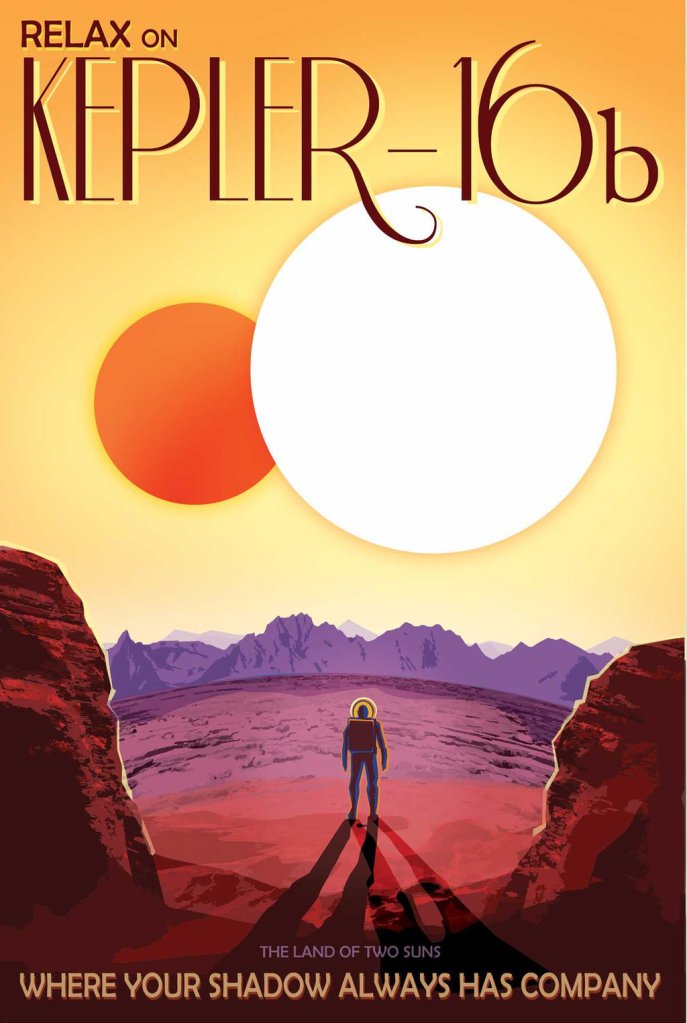
The poster above for Kepler-16b comes with this enticing description:

Like Luke Skywalker’s planet “Tatooine” in Star Wars, Kepler-16b orbits a pair of stars. Depicted here as a terrestrial planet, Kepler-16b might also be a gas giant like Saturn. Prospects for life on this unusual world aren’t good, as it has a temperature similar to that of dry ice. But the discovery indicates that the movie’s iconic double-sunset is anything but science fiction.

You might also enjoy this NASA video showing some space activities in these prime locations.

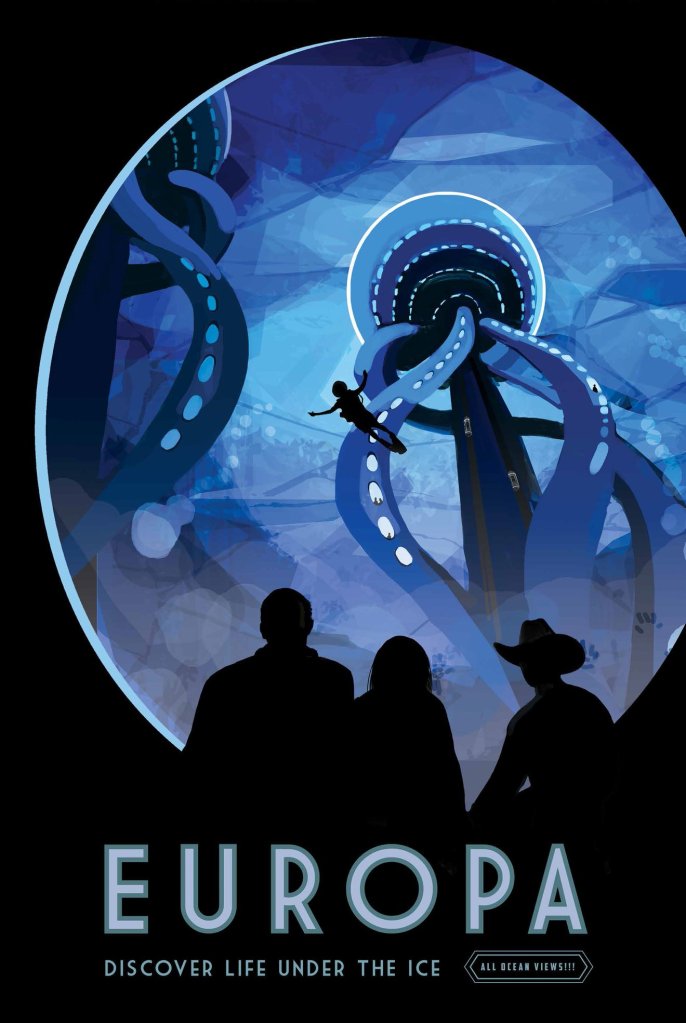
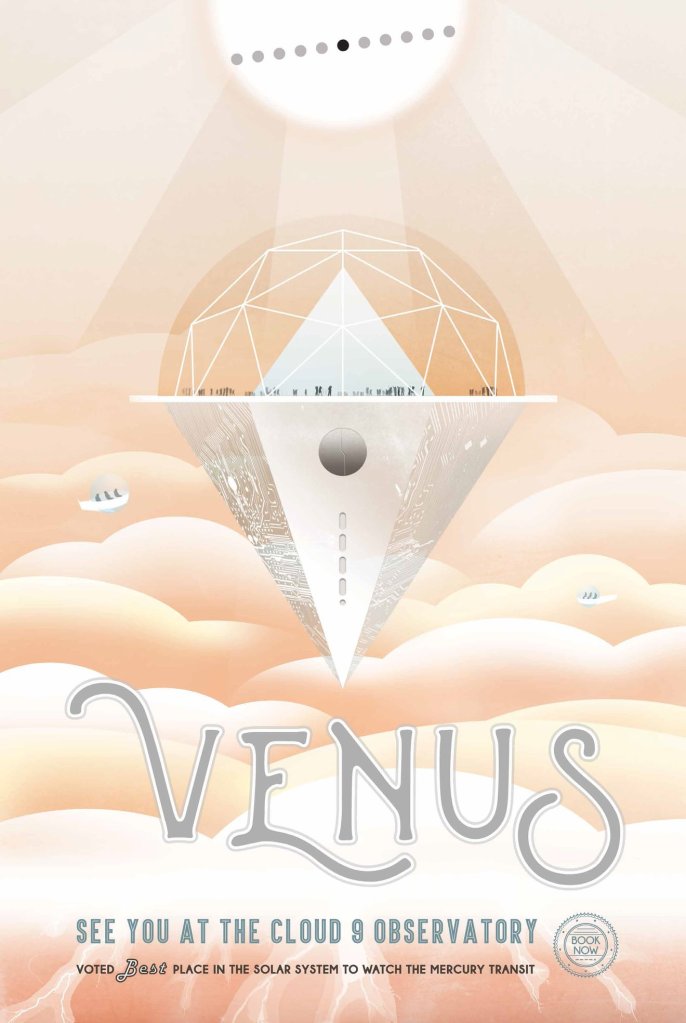
I dropped in a few more posters below, but be sure to check out all of them. A big thanks also to the folks at JPL for these fun images. The 14 posters were created by nine artists, designers, and illustrators.

Of course, these free photos are already being sold on Etsy.com and elsewhere as posters and t-shirts.
Source: NASA’s Jet Propulsion Laboratory.

Television: The End of “The Expanse”

Source: The Expanse on Amazon Prime.

This week Amazon Prime released the final episode of the The Expanse, a brilliant space drama that has been running for six seasons, first on Syfy and later on Amazon Prime. Based on a series of books written by James S. A. Corey (a two-person team), it tells the story of a settled solar system where the old problems dividing all of us are simply moved onto a larger playing field. Mars and Earth are jockeying for power while the miners in the asteroid belt creating the necessary resources feel forgotten and abused. War ensues as does new discoveries (and related weapons), which simply get folded into the ongoing battles. And the playing field widens again as a portal, called the Ring, gives the warring factions access to more star systems and planets.

The television series is a wonder to watch, with excellent acting, fantastic story-lines, and the creative use of venues in our solar system, from Ceres in the asteroid belt to the various moons of Jupiter, Saturn, and Uranus. It is also a very dark show as it illustrates an ugly side to our expansion into new worlds – ruthless ambition, terrorism, revolution, and civil war.

I have not seen anything like it since the remake of Battlestar Galactica, and I would put it on the same level (with some better special effects given the time that has passed). But the most important part is the characters, and you will find a team in the center of this series that you would follow anywhere.

If you are new to the series, you are in for a lot of fun. If you are finishing the series like me and you have only experienced the television show, I think the next step is to dig into the books to live in this world a little longer.

Extra: Check out this Den of Geek article concerning whether The Expanse will continue in any format – “The Expanse: The Possibility of a Season 7 or Sequel Series.”

Top 10 Astronomy Stories from 2021

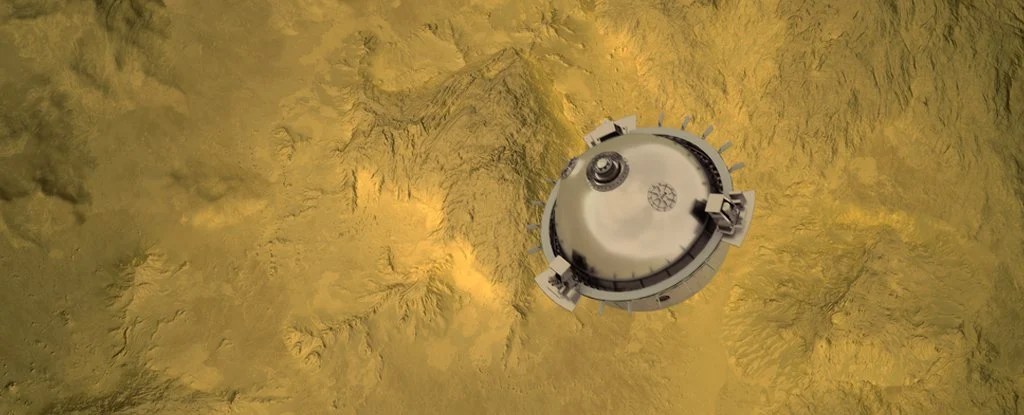
Source: Sciencealert.com webpage – “We’re Going Back to Venus! NASA Announces Two New Missions by 2030.”

Before we get too far into 2022, it is worth considering some of the top astronomy stories from 2021. Space.com put together a nice list that I highlighted below.

  1. Discovery of Comet Bernardinelli-Bernstein: “…It may be 10 times wider and 1,000 times more massive than a typical comet.”
  2. Amateur astronomer discovers a new moon around Jupiter: “The new moon, called EJc0061, belongs to the Carme group of Jovian moons.”
  3. NASA will return to Venus this decade: “…NASA has not launched a dedicated mission to the planet since 1989.”
  4. The sun is reawakening: “In early November, for instance, a series of solar outbursts triggered a large geomagnetic storm on our planet.”
  5. James Webb Space Telescope flies into space: “…JWST is heading to an observational perch located about a million miles from our planet.”
  6. Event Horizon Telescope takes high-resolution image of black hole jet: “The end result is a resolution that is 16 times sharper and an image that is 10 times more accurate than what was possible before.”
  7. Scientists spot the closest-known black hole to Earth: “Just 1,500 light-years from Earth…”
  8. Earth’s second ‘moon’ flies off into space: “…the object, known as 2020 SO, is a leftover fragment of a 1960s rocket booster from the American Surveyor moon missions.”
  9. Parker Solar Probe travels through the sun’s atmosphere: “The probe managed to get as low as 15 solar radii, or 8.1 million miles (13 million km) from the sun’s surface.”
  10. Perseverance begins studying rocks on Mars: “Perseverance is taking its observations from the 28-mile-wide (45 kilometers) Jezero Crater, which was home to a river delta and a deep lake billions of years ago.”

Visit the Space.com website for more details on each of these astronomy science stories.