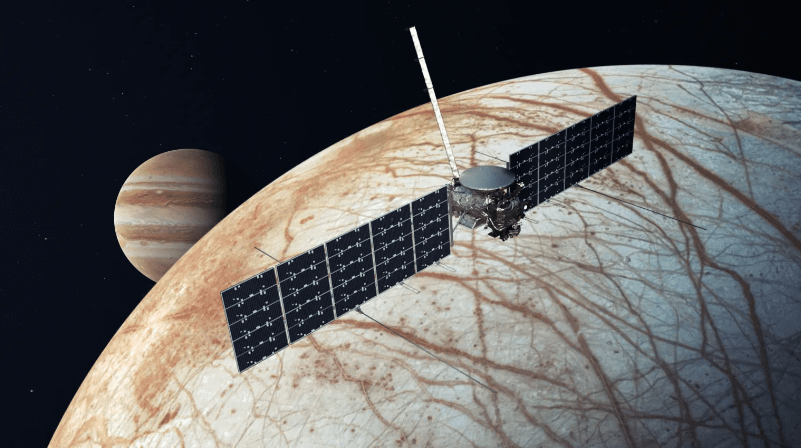
Image (Credit): An artist’s rendering of NASA’s Europa Clipper spacecraft over Europa. (NASA/JPL-Caltech)
Another list worth highlighting at year-end covers all of the space missions from 2024. For example, this list from Freethink, “the top 10 space stories of 2024,” includes the launch of the Europa Clipper, China’s Chang’e 6 round-trip to the Moon, and a successful commercial launch to the Moon (Odysseus lunar lander).
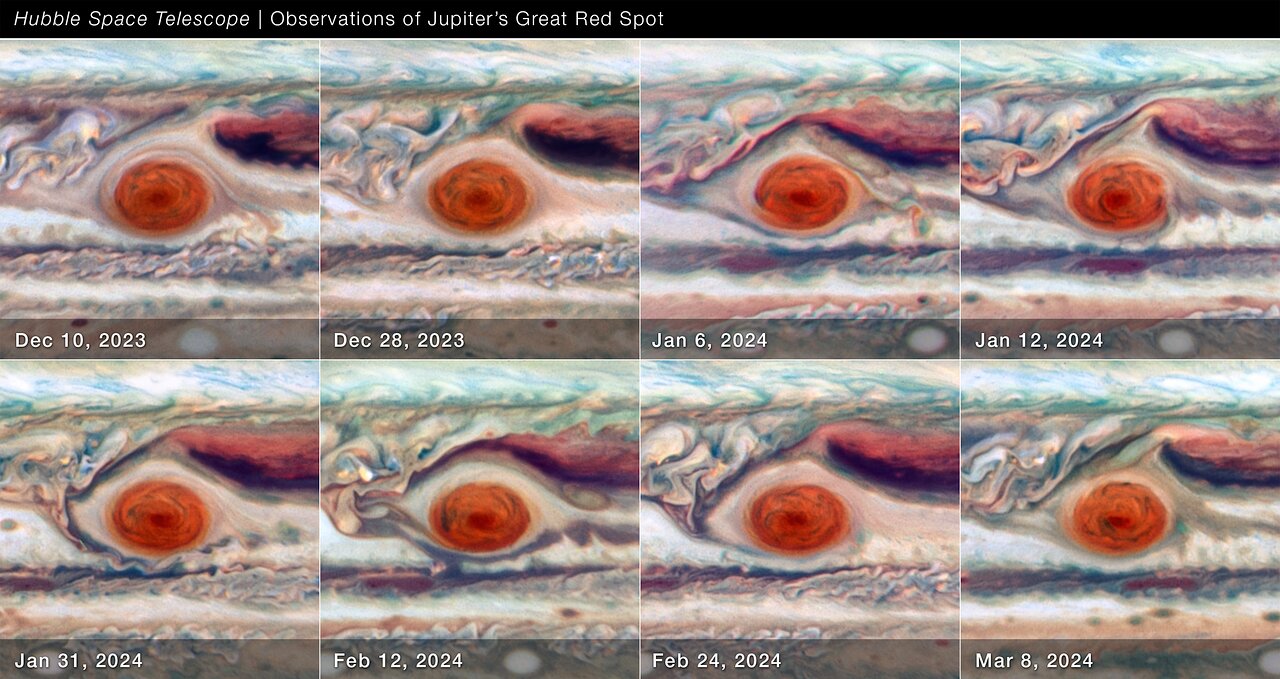
Image (Credit): Jupiter’s Great Red Spot captured by the Hubble Space Telescope over a 90 day period. (NASA, ESA, A. Simon (GSFC))
This week’s image is from the NASA/European Space Agency (ESA) Hubble Space Telescope. It captures one of the most identifiable objects in our solar system – Jupiter’s Great Red Spot.
Using Hubble Space Telescope data spanning approximately 90 days (between December 2023 and March 2024) when the giant planet Jupiter was approximately 630 million to 820 million kilometres from the Sun, astronomers measured the Great Red Spot’s size, shape, brightness, colour, and vorticity over one full oscillation cycle. The data reveal that the Great Red Spot is not as stable as it might look. It was observed going through an oscillation in its elliptical shape, jiggling like a bowl of gelatin. The cause of the 90-day oscillation is unknown.
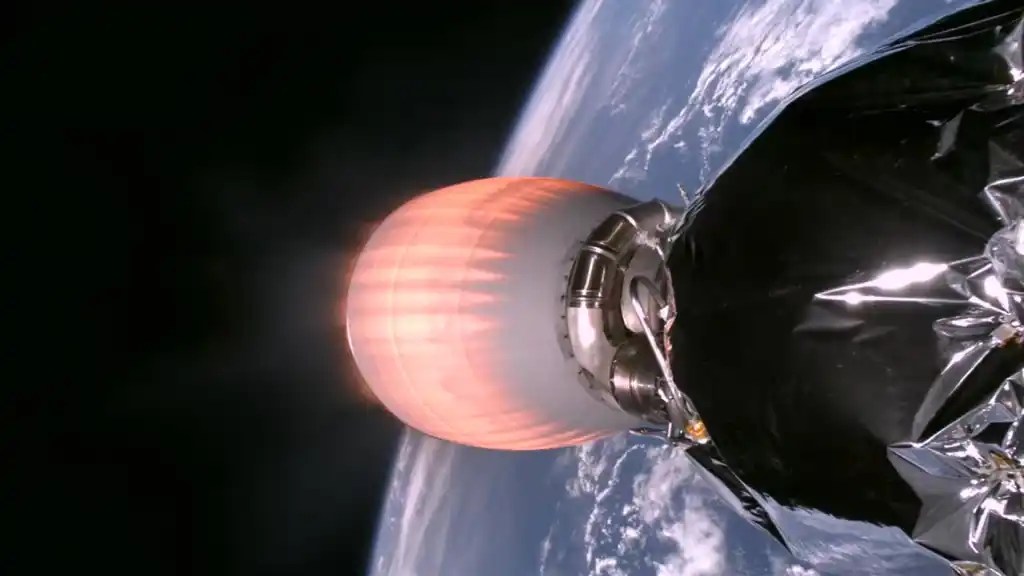
Image (Credit): View of SpaceX’s Falcon Heavy second stage engine as it completes its burn after launching the Europa Clipper spacecraft. (NASA)
Earlier today, the Europa Clipper spacecraft was launched from Kennedy Space Center for its 2030 rendezvous with the Jovian moon Europa. It can then begin to analyze the moon’s salt water ocean and look for any signs of life.
The mission is expected to last for three years, maybe longer should the spacecraft prove to be durable and ready for more scientific work. After that, it will plummet down into the Jovian moon Ganymede.
Scientists believe Europa may contain more water than is found here on Earth. That is interesting in terms of what may lie below the surface in terms of potential life. It also offers mankind a priceless resource should we ever find ourselves living in that region.
Europa Clipper Project Scientist Robert Pappalardo stated:
We know of our Earth as an ocean world, but Europa is representative of a new class of ocean worlds, icy worlds in the distant outer solar system where saltwater oceans might exist under their icy surfaces…In fact, icy ocean worlds could be the most common habitat for life, not just in our solar system, but throughout the universe.
This week we expected to see the launch of NASA’s Europa Clipper, but an approaching hurricane has again thrown NASA’s plans into the wind. The original launch was scheduled for October 10.
NASA and SpaceX are standing down from the Thursday, Oct. 10, launch attempt of the agency’s Europa Clipper mission due to anticipated hurricane conditions in the area. Hurricane Milton is expected to move from the Gulf of Mexico this week moving east to the Space Coast. High winds and heavy rain are expected in the Cape Canaveral and Merritt Island regions on Florida’s east coast. Launch teams have secured NASA’s Europa Clipper spacecraft in SpaceX’s hangar at Launch Complex 39A at the agency’s Kennedy Space Center in Florida ahead of the severe weather, and the center began hurricane preparations Sunday.
I just hope hurricane season comes to an early close after this.


 Our Awesome Universe