Image (Credit): Artist’s rendering of the Europa Clipper above Europa. (NASA)
NASA has decided to move forward with the Europa Clipper mission even though there have been some questions about its ability to withstand the moon’s radiation. The launch is set for an October 10 aboard a SpaceX Falcon Heavy rocket from Launch Complex 39A at NASA’s Kennedy Space Center in Florida.
NASA is also moving forward with the return of the empty Starliner capsule currently attached to the International Space Station. This Friday, September 6, Boeing’s CST-100 Starliner will disconnect from the station and land at White Sands Space Harbor in New Mexico. If all goes well, NASA can continue to study the capsule and learn more about what went wrong.
Just in time for the Labor Day weekend, we are offered a new space film that seemed to have had little publicity until it popped onto the scene. The new film Slingshot, starting today and starring Casey Affleck and Laurence Fishburne, takes us on a trip to Saturn’s moon Titan, or that is the plan.
A psychological thriller starring Casey Affleck and Laurence Fishburne, SLINGSHOT follows an elite trio of astronauts aboard a years-long, possibly compromised mission to Saturn’s moon Titan. As the team gears up for a highly dangerous slingshot maneuver that will either catapult them to Titan or into deep space, it becomes increasingly difficult for one astronaut to maintain his grip on reality.
The trailer indicates plenty of issues with both the hardware and software – the softest ware being the mind of man on a distant voyage. Yes, we have another story about the struggle of man with himself, with space playing a supporting actor.
Fortunately, we are not dealing with a film that questions the space program, but NASA may be pleased that it is sending a robot to study Europa rather than taking chances with such fragile humans.
The derivative look and feel of Slingshot – a little bit of Interstellar, a dash of 2010: The Year We Make Contact for whenever Håfström wants to add some grit, and most especially Steven Soderbergh’s Solaris remake – make it unclear exactly what kind of movie Håfström is trying to make.
It’s fairly boilerplate material, and Håfström frankly seems more interested in exploring John’s memories, nightmares, visions and wavering psyche..If you put aside all the space stuff, Slingshot is basically a one-set, one-character thriller that constantly tests the viewer’s belief in what’s happening.
A JuMBO means Jupiter-mass binary objects, which is just part of the story in this video. The presentation starts with a finding from astronomers using the James Webb Space Telescope, who identify 520 rogue planet candidates. This is interesting in itself, but the intriguing part is that a number of these planets are found in pairs. This would not make a lot of sense if we believed these planets were once within a solar system before being pushing into space.
The video discusses the various theories explaining these JuMBOs and rogue planets in general. It also discusses the potential impact on our own solar system, such as whether we lost one of our own planets in the past and/or a nearby rogue planet (and its moons) is out there today waiting to be discovered.
As always, Cool Worlds Lab keeps astronomy even more interesting.
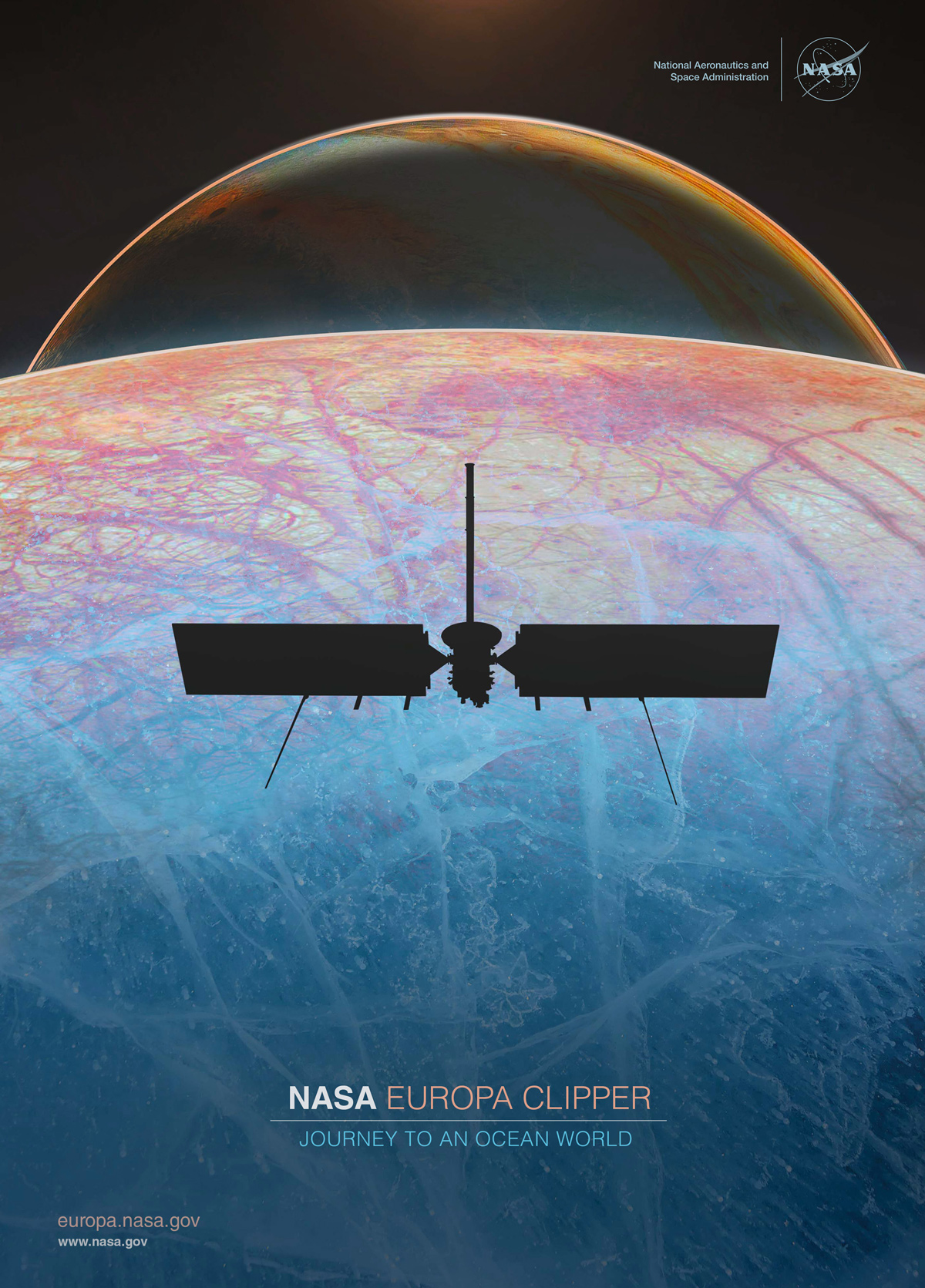
Image (Credit): NASA’s Europa Clipper poster. (NASA/ Jet Propulsion Laboratory-Caltech)
“Engineers with NASA’s Europa Clipper mission continue to conduct extensive testing of transistors that help control the flow of electricity on the spacecraft. NASA’s Jet Propulsion Laboratory in Southern California, which manages the mission, began the tests after learning that some of these parts may not withstand the radiation of the Jupiter system, which is the most intense radiation environment in the solar system.”
–NASA statement from yesterday regarding potential issues with electrical switches on the Europa Clipper spacecraft that is set to launch in October. Whether this leads to a delayed launch of the mission or a less nimble mission has yet to be determined. The preliminary findings from the current testing are expected to be released later this month.
SpaceX successfully launched its first Falcon Heavy of the year on Wednesday evening, the triple-barreled booster lifting the 11,000-pound (5,000-kilogram) Geostationary Operational Environmental Satellite (GOES-U) almost to Geostationary Earth Orbit (GEO) on behalf of the National Oceanic and Atmospheric Administration (NOAA). The Heavy—flying for the first time since November 2022 with a brand-new center core and pair of side-mounted strap-on boosters—went airborne from historic Pad 39A at Florida’s Kennedy Space Center (KSC) at 5:26 p.m. EDT, ten minutes after the opening of a two-hour “launch window”.
The Great Red Spot of Jupiter was observed by Webb’s Near-InfraRed Spectrograph (NIRSpec) in July 2022, using the instrument’s Integral Field Unit capabilities. The team’s Early Release Science observations sought to investigate if this region was in fact dull, and the region above the iconic Great Red Spot was targeted for Webb’s observations. The team was surprised to discover that the upper atmosphere hosts a variety of intricate structures, including dark arcs and bright spots, across the entire field of view. “We thought this region, perhaps naively, would be really boring,” shared team leader Henrik Melin of the University of Leicester in the United Kingdom. “It is in fact just as interesting as the northern lights, if not more so. Jupiter never ceases to surprise.”
Gravitational wave detectors, LIGO and Virgo, have detected a population of massive black holes whose origin is one of the biggest mysteries in modern astronomy. According to one hypothesis, these objects may have formed in the very early Universe and may compose dark matter, a mysterious substance filling the Universe. A team of scientists from the OGLE (Optical Gravitational Lensing Experiment) survey from the Astronomical Observatory of the University of Warsaw have announced the results of nearly 20-year-long observations indicating that such massive black holes may comprise at most a few percent of dark matter. Another explanation, therefore, is needed for gravitational wave sources. The results of the study were published in two articles, in Nature and the Astrophysical Journal Supplement Series.



 Our Awesome Universe