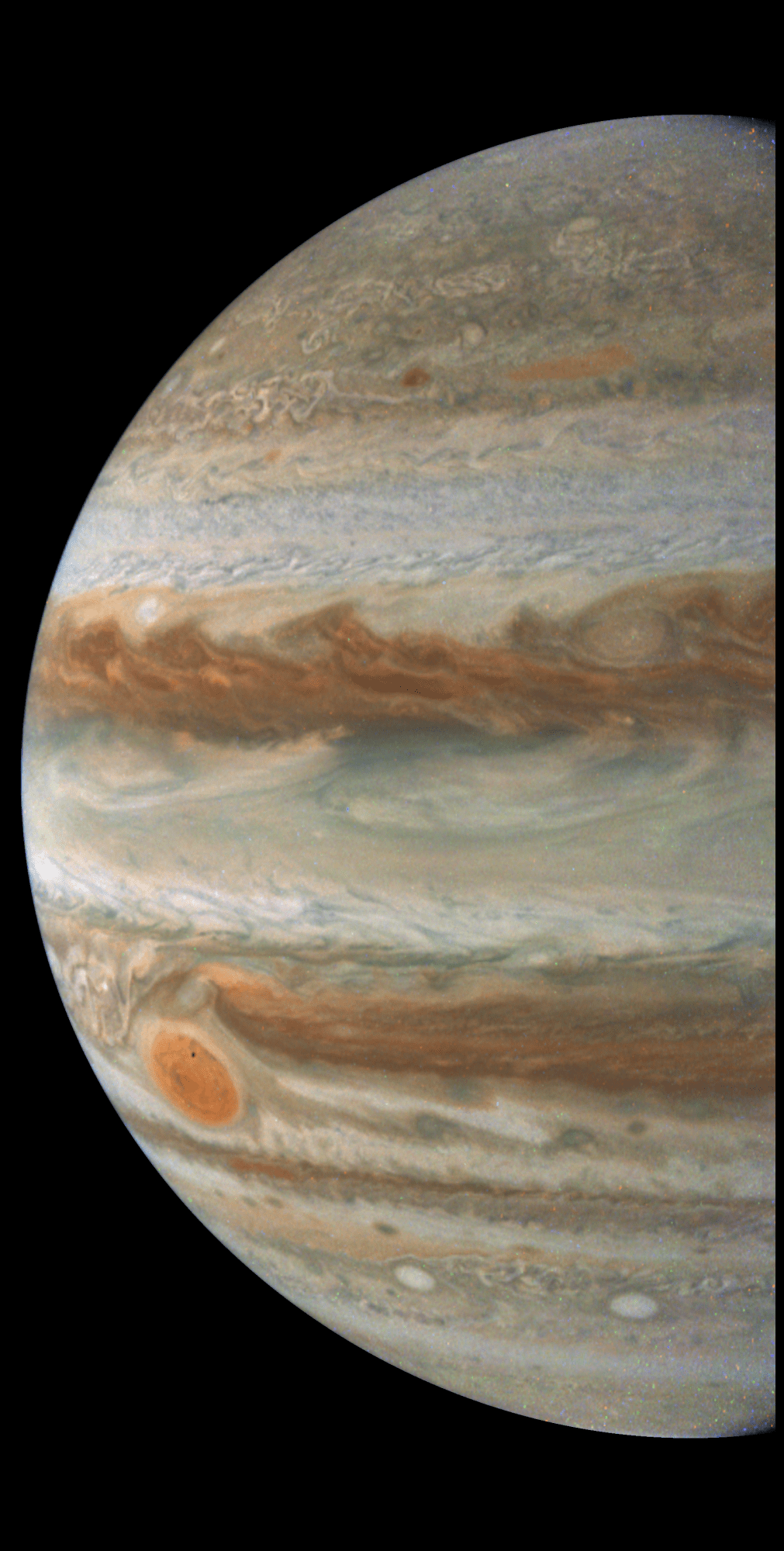
Image (Credit): Jupiter with the small moon Amalthea appearing in its Great Red Spot. (Image data: NASA/JPL-Caltech/SwRI/MSSS. Image processing by Gerald Eichstädt)
This week’s image comes from NASA’s Juno mission during a flyby back in March. It shows Jupiter’s smallest moon Amalthea orbiting Jupiter with the Great Red Spot in the background. The potato-shaped moon has a radius of 52 miles and completes an orbit of the giant planet in about half an Earth day.
You can read more about the photograph at this NASA site.
Image (Credit): Close-up of Jupiter with the small moon Amalthea appearing in its Great Red Spot. (Image data: NASA/JPL-Caltech/SwRI/MSSS. Image processing by Gerald Eichstädt)
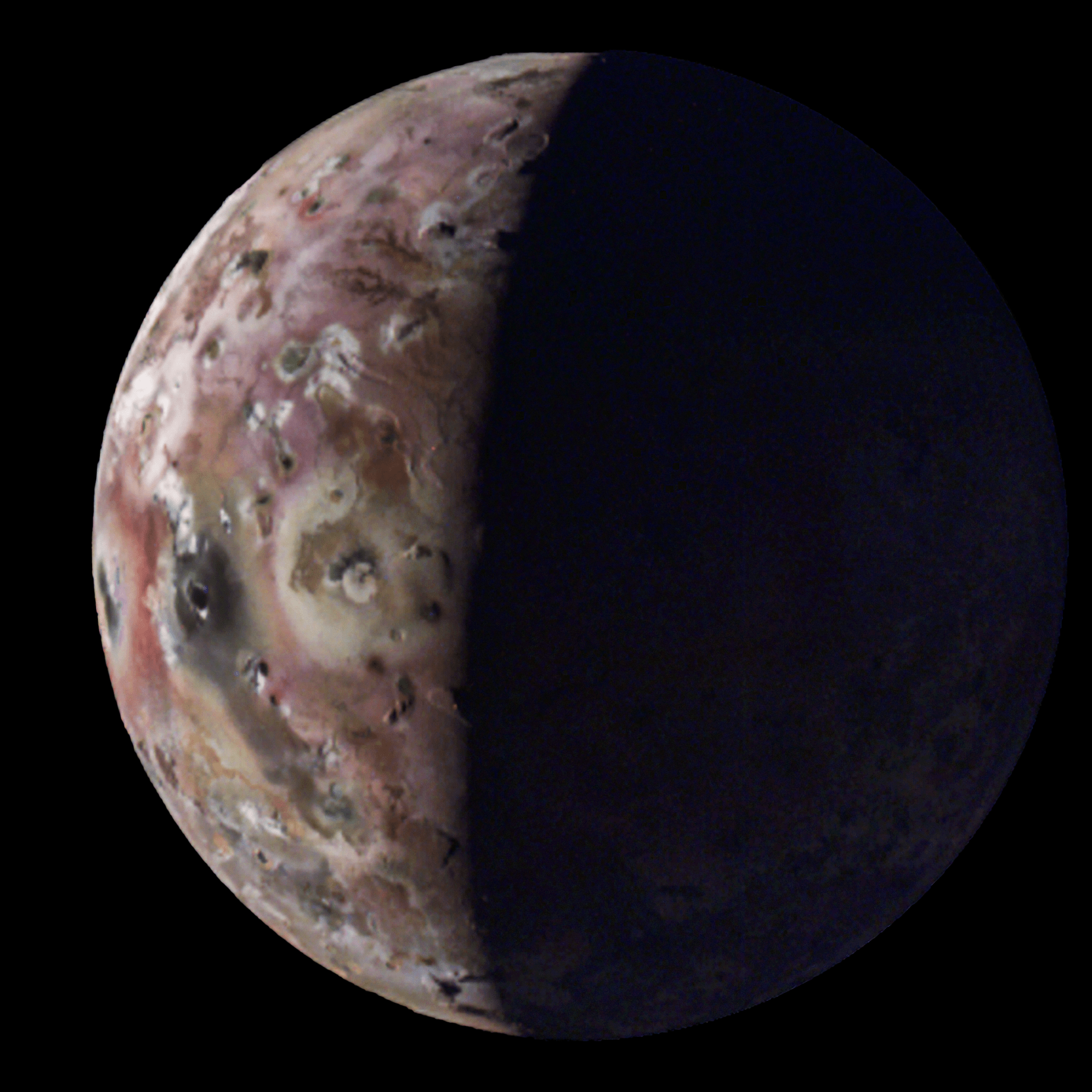
Image (Credit): View of Jupiter’s moon Io as seen by the Juno spacecraft on April 9. It was the first-ever image of the moon’s south polar region. (NASA/JPL-Caltech/SwRI/MSSS. Image processing: Gerald Eichstädt/Thomas Thomopoulos (CC BY))
The Juno spacecraft is still hard a work in the vicinity of Jupiter, with its latest mission being a flyby of the moon Io earlier this month (shown above).
Two recent flybys of the moon were also combined to create an image of a lake of cooling lava (shown below and via the video here). Juno’s principal investigator Scott Bolton explained the new image:
Io is simply littered with volcanoes, and we caught a few of them in action. We also got some great close-ups and other data on a 200-kilometer-long (127-mile-long) lava lake called Loki Patera. There is amazing detail showing these crazy islands embedded in the middle of a potentially magma lake rimmed with hot lava. The specular reflection our instruments recorded of the lake suggests parts of Io’s surface are as smooth as glass, reminiscent of volcanically created obsidian glass on Earth.
Juno has been zipping around Jupiter’s neighborhood since 2016. It’s main task is to study the origin and evolution of Jupiter, believed to be the first planet to have formed in our solar system. By doing so, NASA hopes to learn more about the solar system and the Earth as well.
Image (Credit): An artist’s rendering of Loki Patera, a lava lake on Jupiter’s moon Io, created using data from the JunoCam imager aboard NASA’s Juno spacecraft. (NASA/JPL-Caltech/SwRI/MSSS)
New research suggests there’s less oxygen on the icy surface of Jupiter’s moon Europa than thought — and that could affect what, if any, life might be lurking in the moon’s underground ocean. Even with little or no oxygen, microbes might still be bustling around in the ocean believed to exist miles beneath Europa’s frozen crust. As for what else, “who knows,” said NASA scientist Kevin Hand, who was not involved in the study published Monday in Nature Astronomy.
The best measurements from Hubble show the universe is now expanding faster than predicted based on observations of how it looked shortly after the big bang. These observations were made by the Planck satellite mapping of the cosmic microwave background radiation – sort of a blueprint for how the universe would evolve structure after it cooled down from the big bang. The simple solution to the dilemma is to say that maybe Hubble observations are wrong due to some creeping inaccuracy in its deep-space yardstick. Then along came the James Webb Space Telescope to crosscheck Hubble’s results. Webb’s sharp infrared views of Cepheids agreed with Hubble data. Webb confirmed that the Hubble telescope’s keen eye was right all along.
A trio of small rovers that will explore the Moon in sync with one another are rolling toward launch. Engineers at NASA’s Jet Propulsion Laboratory in Southern California recently finished assembling the robots, then subjected them to a punishing series of tests to ensure they’ll survive their jarring rocket ride into space and their travels in the unforgiving lunar environment.Part of a technology demonstration called CADRE (Cooperative Autonomous Distributed Robotic Exploration), each solar-powered rover is about the size of a carry-on suitcase.
Image (Credit): One side of the panel attached to the Europa Clipper showing “water” ” in 103 languages (explained below). (NASA/JPL-Caltech)
In past NASA missions to the outer planets of our solar system, we attached messages for any distant civilization that might be out there. Both the Pioneer and Voyager missions contained such messages.
So what about NASA’s Europa Clipper mission to Jupiter’s moon set to launch in October? It too will have some messages, but these appear to be for the inhabitants of the moon rather than some distant civilization.
A triangular 7″ x 11″ metal plate attached to the spacecraft destined for Europa will carry messages on both sides. The image above shows one of these sides containing features waveforms that are visual representations of the sound waves formed by the word “water” in 103 languages.
The other side of the plate (shown below) contains a variety of messages:
the Drake Equation, which estimate the possibility of finding advanced civilizations beyond Earth;
U.S. Poet Laureate Ada Limón’s handwritten “In Praise of Mystery: A Poem for Europa”;
a reference to the radio frequencies considered plausible for interstellar communication; and
a portrait Ron Greeley, whose early efforts laid the foundation for Europa Clipper.
The spacecraft will also carry a silicon microchip containing more than 2.6 million names that were submitted by the public as part of NASA’s “Message in a Bottle” campaign.
This is all interesting in itself, but not really a message to others. I expect it is not intended for anyone else but ourselves because the Europa Clipper is not expected to leave the solar system but instead crash into another of Jupiter’s moons – Ganymede.
Note: You may wonder about the message on the New Horizons spacecraft that is also travelling to the edges of our solar system. That message is somewhat controversial. I will let you read about that one in this Slate article, “Ashes and Small Change.”
Image (Credit): One side of the panel attached to the Europa Clipper showing a poem, portrait, and more (explained above). (NASA/JPL-Caltech)
Image (Credit): JunoCam image of Jupiter’s moon Io during its close encounter. The image was taken at an altitude of about 1,500 miles. (NASA JPL and Southwest Research Institute)
NASA’s spacecraft Juno just had a super-close encounter with the most volcanic world in the solar system—but its stunning first image could be among its last after 56 orbits of Jupiter. On December 30, the bus-sized spacecraft—orbiting Jupiter since 2016—got very close to Io, the giant moon of Jupiter. It reached a mere 930 miles (1,500 kilometers) from the moon’s surface. However, the spacecraft’s camera has suffered radiation damage and may not last much longer.
India began 2024 with the launch of an X-ray astronomy satellite aboard the sixtieth flight of its Polar Satellite Launch Vehicle. The PSLV C58 mission lifted off at 9:10 AM local time (03:40 UTC) on Monday, Jan. 1, from the Satish Dhawan Space Centre. XPoSat, or X-ray Polarimeter Satellite, carries a pair of instruments that will be used to study X-ray emissions from astronomical sources. After deploying XPoSat, PSLV C58’s upper stage has remained in orbit as the third flight of the PSLV Orbital Experimental Module (POEM-3), serving as a free-flying platform hosting a range of attached payloads.
The first satellite for a second planned Chinese low Earth orbit communications megaconstellation has been produced in new facilities in Shanghai. A new generation flat-panel satellite rolled off the assembly at the G60 digital satellite production factory in Shanghai’s Songjiang District Tuesday, Dec. 27, according to Chinese press reports. The satellite is the first for the G60 Starlink low Earth orbit communications megaconstellation. An initial 108 satellites of a total of around 12,000 G60 Starlink satellites are to be launched across 2024.