Space Stories: Volcanoes on Venus, Exoplanet Radio Signals, and Bright Baby Jupiter

Image (Credit): Map of volcanoes located on Venus. (Washington University in St. Louis)

Here are some recent stories of interest.

Washington University in St. Louis: “Scientists Share ‘Comprehensive’ Map of Volcanoes on Venus — all 85,000 of Them

Byrne and Hahn’s new study includes detailed analyses of where volcanoes are, where and how they’re clustered, and how their spatial distributions compare with geophysical properties of the planet such as crustal thickness. Taken together, this work provides the most comprehensive understanding of Venus’ volcanic properties — and perhaps of any world’s volcanism so far. That’s because, although we know a great deal about the volcanoes on Earth that are on land, there are still likely a great many yet to be discovered under the oceans. Lacking oceans of its own, Venus’ entire surface can be viewed with Magellan radar imagery.

CNN: “Repeating Radio Signal Leads Astronomers to an Earth-Size Exoplanet

Astronomers have detected a repeating radio signal from an exoplanet and the star that it orbits, both located 12 light-years away from Earth. The signal suggests that the Earth-size planet may have a magnetic field and perhaps even an atmosphere…Scientists noticed strong radio waves coming from the star YZ Ceti and the rocky exoplanet that orbits it, called YZ Ceti b, during observations using the Karl G. Jansky Very Large Array of telescopes in New Mexico. The researchers believe the radio signal was created by interactions between the planet’s magnetic field and the star.

ScienceNews: “Baby Jupiter Glowed so Brightly it Might have Desiccated its Moon

A young, ultrabright Jupiter may have desiccated its now hellish moon Io. The planet’s bygone brilliance could have also vaporized water on Europa and Ganymede, planetary scientist Carver Bierson reported March 17 at the Lunar and Planetary Science Conference. If true, the findings could help researchers narrow the search for icy exomoons by eliminating unlikely orbits. Jupiter is among the brightest specks in our night sky. But past studies have indicated that during its infancy, Jupiter was far more luminous. “About 10 thousand times more luminous,” said Bierson, of Arizona State University in Tempe.

Space Mission: ESA’s Juice Mission

Image (Credit): Upper stage of the Ariane 5 rocket that will launch ESA’s Juice mission. (ESA)

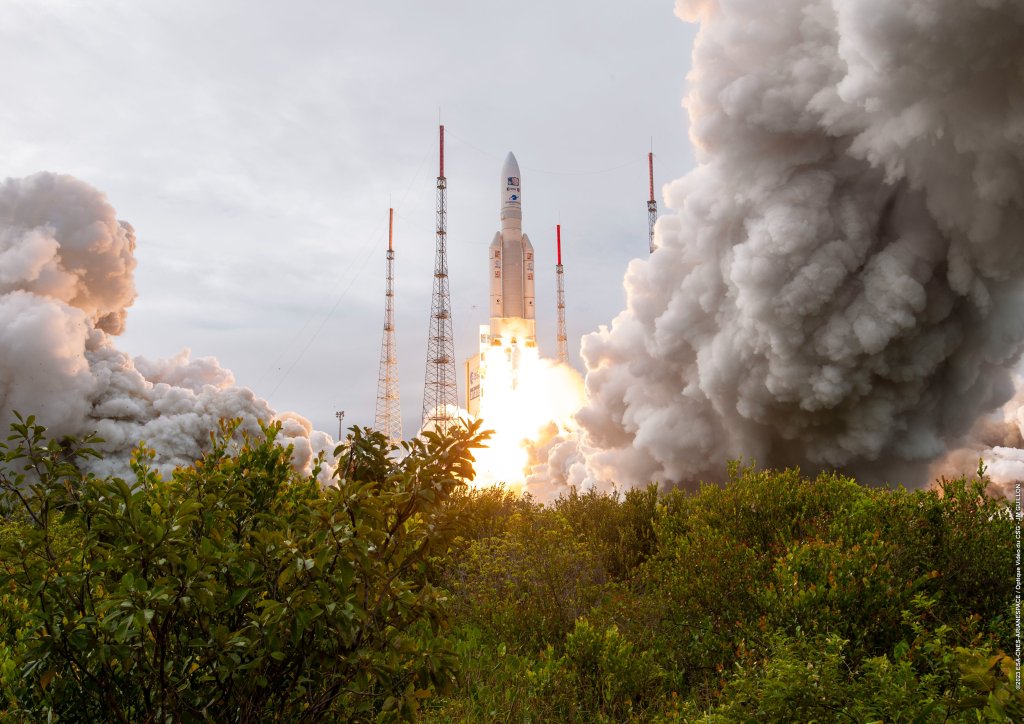
On April 13th, the European Space Agency (ESA) will launch its Jupiter Icy Moons Explorer (Juice) mission from French Guiana. The purpose of the mission is to conduct a detailed study of Jupiter as well as three of its moons (and their oceans) – Ganymede, Callisto and Europa. The spacecraft will eventually go into orbit around Ganymede, which will be the first orbit of a moon in our solar system other than Earth’s Moon.

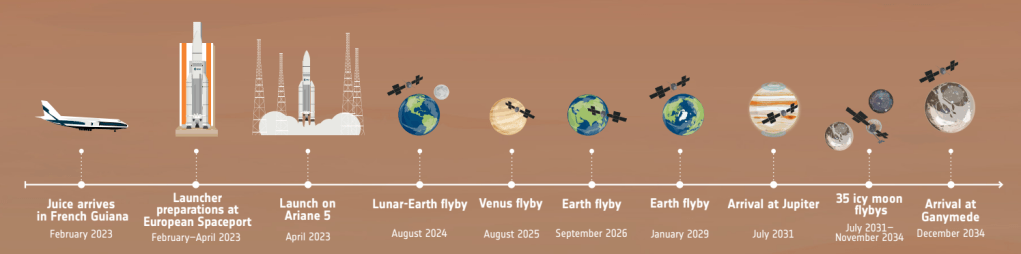
The key milestones for the mission are listed below and shown in greater detail within the graphic as well:

February 2023: Juice arrives in French Guiana

April 13, 2023: Launch on Ariane-5 rocket

July 2031: Arrival at Jupiter

-July 2031 – November 2034: 35 icy moon flybys

December 2034: Arrival at Ganymede

Image (Credit): Juice mission milestones. (ESA JUICE Launch Kit)

In addition to ESA/European scientific instruments and equipment, the spacecraft will also carry items from NASA, the Japan Aerospace Exploration Agency, and the Israel Space Agency.

The delayed arrival at Jupiter relates to the need for multiple flybys cover this great distance. In The Financial Times, Justin Byrne, head of science for lead contractor Airbus, stated, “Ariane-5 is a very powerful rocket but it can only give us about half the energy we need to get to Jupiter…We get the rest by doing planetary fly-bys, each one giving us a gravitational assist through a slingshot manoeuvre.”

The ESA put together a useful Launch Kit that answers any question you may have about the Juice mission, as well as related missions.

Space Stories: Jovian Moons, Charon’s Canyons, and a New Space Telescope

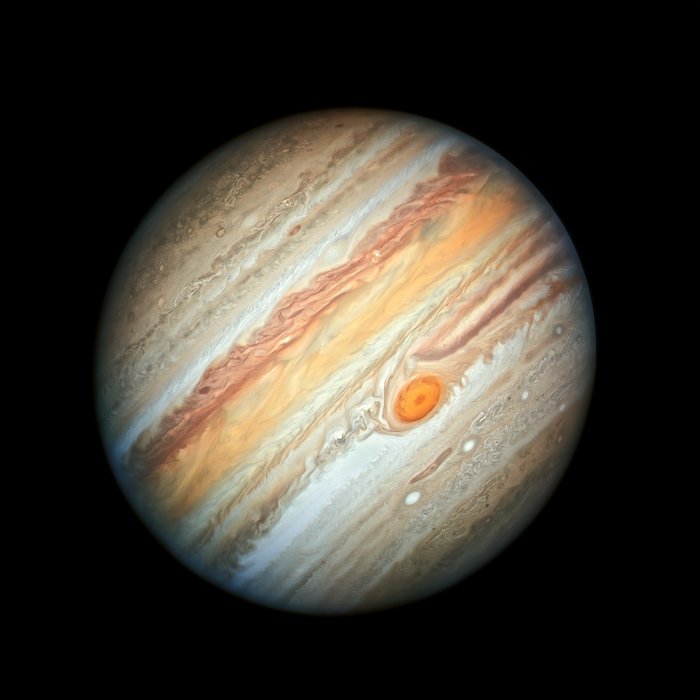
Image (Credit): Jupiter as seen by the NASA/ESA Hubble Space Telescope. (NASA, ESA, A. Simon (Goddard Space Flight Center), and M.H. Wong (University of California, Berkeley)

Here are some recent stories of interest.

Live Science: “Jupiter Officially has the Most Moons in the Solar System, Discovery of 12 New Satellites Confirms

Jupiter was already the king of the solar system, and new discoveries give the massive planet another way to reign supreme: It now has the most moons. Twelve new moons discovered orbiting Jupiter have been confirmed, bumping the count from 80 to 92, and knocking Saturn — which has 83 moons — down a peg. 

Phys.org: “Models Explain Canyons on Pluto’s Large Moon Charon

In 2015, when NASA’s New Horizons spacecraft encountered the Pluto-Charon system, the Southwest Research Institute-led science team discovered interesting, geologically active objects instead of the inert icy orbs previously envisioned. An SwRI scientist has revisited the data to explore the source of cryovolcanic flows and an obvious belt of fractures on Pluto’s large moon Charon. These new models suggest that when the moon’s internal ocean froze, it may have formed the deep, elongated depressions along its girth but was less likely to lead to cryovolcanoes erupting with ice, water and other materials in its northern hemisphere.

Big Think: “NASA’s Habitable Worlds Observatory to Finally Answer the Epic Question: “Are we Alone?”

…perhaps the biggest question of all — that of “Are we alone in the Universe?” — remains a mystery. While the current generation of ground-based and space-based telescopes can take us far into the Universe, this is a question that’s currently beyond our reach. To get there, we’ll need to directly image Earth-like exoplanets: planets with sizes and temperatures similar to Earth, but that orbit Sun-like stars, not the more common red dwarf stars like Proxima Centauri or TRAPPIST-1. Those capabilities are precisely what NASA is aiming for with its newly announced flagship mission: the Habitable Worlds Observatory. It’s an ambitious project but one that’s well worth it. After all, finding out we’re not alone in the Universe would quite possibly be the biggest revolution in all of science history.

Space Mission: What’s Up with Juno?

Image (Credit): Image from “Where is Juno” earlier today showing its approximate location in relation to other bodies in the solar system. (NASA)

Are we witnessing the slow blinding of the Juno spacecraft? NASA is having trouble receiving images from the spacecraft’s solar-powered JunoCam. As a result, of the 258 images recently obtained by NASA, only 44 were usable. NASA is still investigating this issue and hopes to come up with a way to mitigate it.

Launched in August 2011, Juno has been a reliable workhorse studying the secrets of Jupiter while also capturing amazing images of the planet and its 80+ moons since it entered into Jovian orbit on July 4, 2016. Its extended mission was supposed to last until September 2025, harvesting additional data to assist NASA’s upcoming Europa Clipper mission as well as the European Space Agency’s Jupiter Icy Moons Explorer (JUICE) mission.

While Juno has numerous scientific instruments that are still plugging away producing key data on Jupiter and its surroundings, the images were an important link between the mission and the public. The images shown below are just a small sample of what has been sent back (click here for more). It will be a sad day when we can no longer see the Jovian neighborhood in this way.

Image (Credit): The shadow of the moon Io on Jupiter. (NASA/JPL-Caltech/SwRI/MSSS)
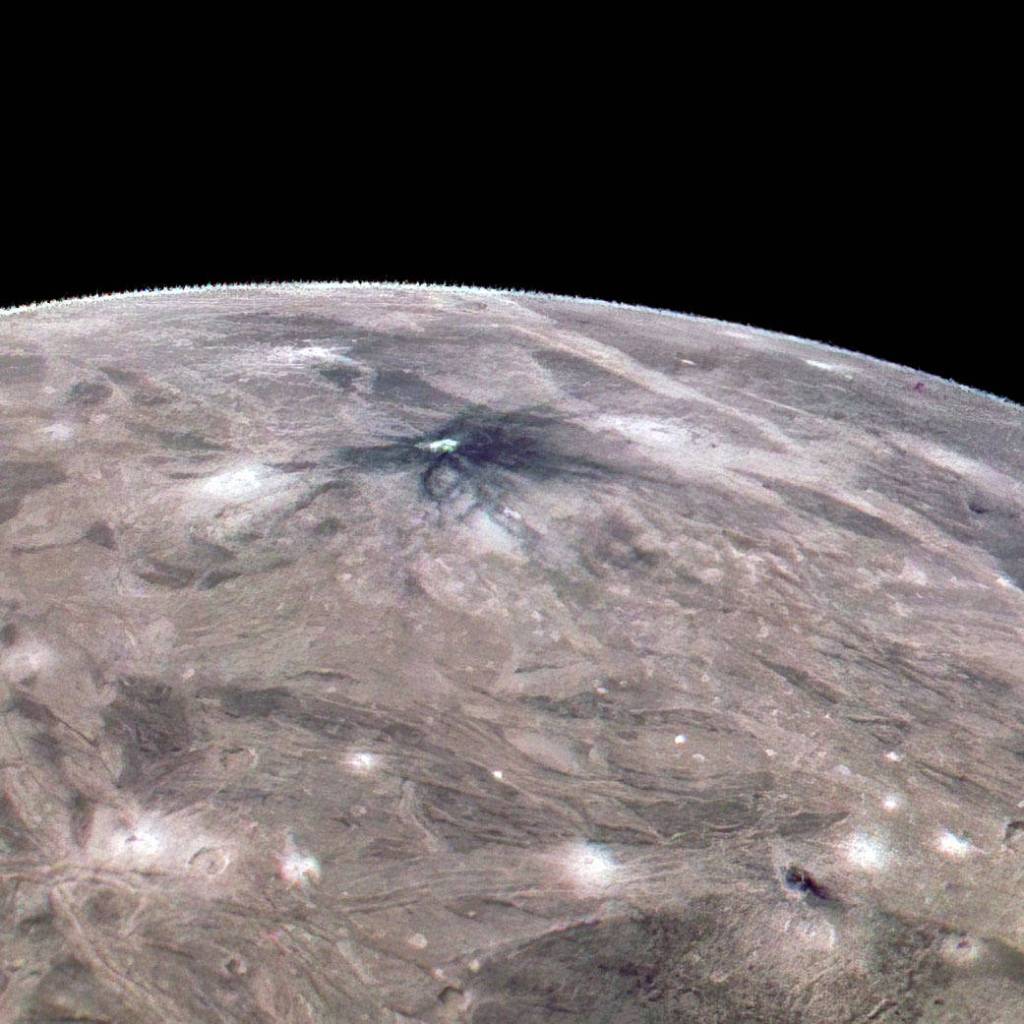
Image (Credit): The surface of Jupiter’s moon Ganymede. (NASA/JPL-Caltech/SwRI/MSSS)
Image (Credit): Jupiter’s south pole. (NASA/JPL-Caltech/SwRI/MSSS/John Landino)

Space Stories: Europeans Not Joining Chinese Space Station, the Milky Way is Odd, and Lucy has a New Target

Image (Credit): A computer rendering of China’s new Tiangong space station in orbit. (Alejandro Miranda/Alamy Stock Photo)

Here are some recent stories of interest.

Royal Astronomical Society: “European Space Agency Says it has No Plans to Send Astronauts to China’s Tiangong Space Station

A top official with the European Space Agency said it had no plans to send European astronauts to the newly completed Chinese space station, making it clear for the first time that the agency is no longer committed to working with China in human space flight in the near future. “We are very busy supporting and ensuring our commitments and activities on the International Space Station,” ESA director general Josef Aschbacher told a press conference in Paris on Monday.

Royal Astronomical Society: “Milky Way Found to be More Unique than Previously Thought

Is the Milky Way special, or, at least, is it in a special place in the Universe? An international team of astronomers has found that the answer to that question is yes, in a way not previously appreciated. A new study shows that the Milky Way is too big for its “cosmological wall”, something yet to be seen in other galaxies. The new research is published in Monthly Notices of the Royal Astronomical Society.

Southwest Research Institute: “SwRI-Led Lucy Team Announces New Asteroid Target

NASA’s Lucy spacecraft will add another asteroid encounter to its 4-billion-mile journey. On Nov. 1, 2023, the Southwest Research Institute-led Lucy mission will get a close-up view of a small main belt asteroid to conduct an engineering test of the spacecraft’s innovative asteroid-tracking navigation system. The Lucy mission was already on course to break records by its planned visit of nine asteroids during its 12-year mission to tour the Jupiter Trojan asteroids, which orbit the Sun at the same distance as Jupiter. Originally, Lucy was not expected to get a close-up view of any asteroids until 2025, when it will fly by the main belt asteroid (52246) Donaldjohanson. However, the SwRI-led Lucy team identified a small, as-yet unnamed asteroid in the inner main belt as a potential new and useful target for the Lucy spacecraft.