The New Glenn Launch to Mars Scheduled for Tomorrow

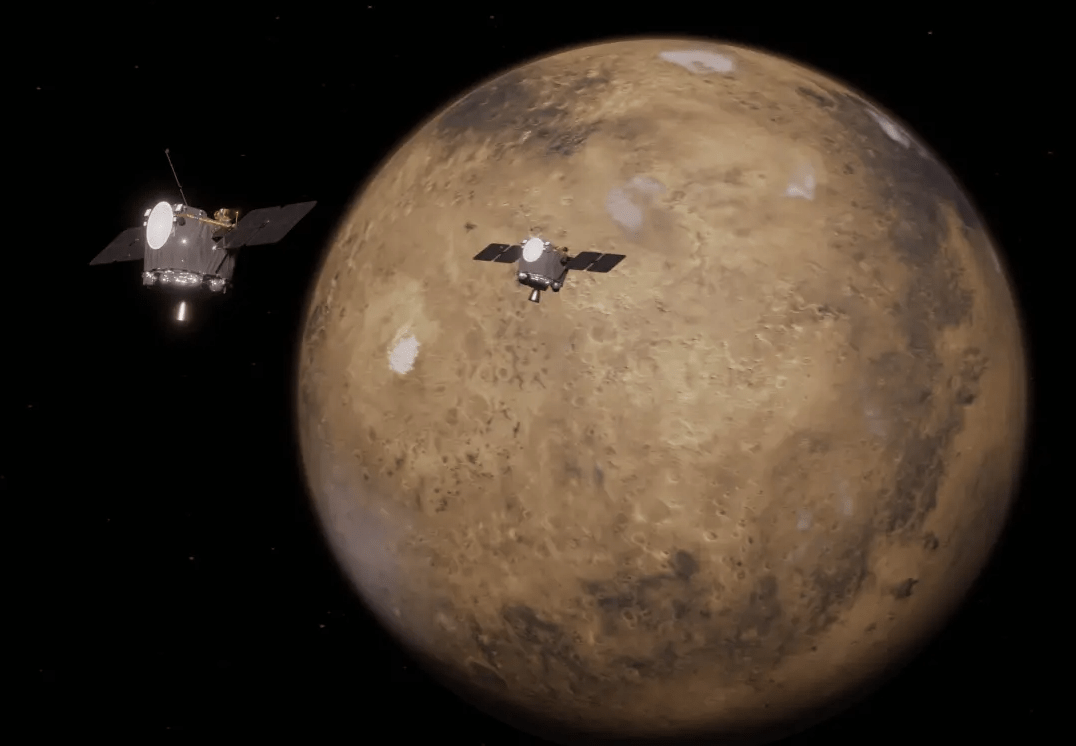
Image (Credit): Artist’s rending of the two EscaPADE probems approaching Mars. (NASA)

Blue Origin’s New Glenn rocket is scheduled to be launched tomorrow afternoon with two Martian probes on board. A lot is riding on tomorrow’s launch. The mission is important for Blue Origin, as it tests its new rocket with its first real mission. It is also important to NASA, which is using the probes to better understand the Martian atmosphere.

Blue Origin’s reusable New Glenn rocket will put it in direct competition with SpaceX for future NASA missions. This redundancy is needed, particularly with SpaceX seeming to struggle with its projects related to the Atemis lunar mission.

The $100 million Martian mission, called Escape and Plasma Acceleration and Dynamics Explorers (EscaPADE), involves a pair of identical spacecraft with a the goal of analyzing:

  1. how Mars’ magnetic field guides particle flows around the planet,
  2. how energy and momentum are transported from the solar wind through the magnetosphere, and
  3. what processes control the flow of energy and matter into and out of the Martian atmosphere.

The two probes will be launched towards Lagrange Point 2, where they will sit for more than a year before making an approach towards Mars. The probes are expected to go into orbit around Mars in September 2027.

Godspeed to Blue Origin and NASA.

Update: The launch has been delayed due to bad weather. The next attempt will be on November 12th.

Space Mission: ESA’s Euclid Telescope

To follow up on the previous post, Russia also lost out on launching the European Space Agency’s (ESA) Euclid spacecraft. Russia was supposed to launch it on a Soyuz-ST/Fregat rocket this December, but the country’s invasion of Ukraine led to a change in plans. SpaceX will now be launching the spacecraft next year.

Euclid was designed to study dark energy and dark matter, and make a 3D-map of the Universe. The project includes scientists from 14 countries: Austria, Denmark, France, Finland, Germany, Italy, Netherlands, Norway, Spain, Switzerland, Portugal, Romania, the UK, and the US.

Euclid hopes to answer the following questions:

  • How did the Universe originate? What were the conditions just after the Big Bang, and how did these give rise to the large-scale structures we see today?
  • Why is the Universe expanding at an accelerating rate today?
  • Is dark energy – a term often used to signify the mysterious force behind this cosmic acceleration – real? If so, is it a constant energy density intrinsic to and spread throughout space, or a new force of nature that slowly evolves as the Universe expands?
  • What is the nature of dark matter, and how do neutrinos possibly contribute? Are there other as-yet-undetected massive particles in the Universe?

Once launched, Euclid will operate in the Sun-Earth Lagrange point 2 (L2), which is where the James Webb Space Telescope is located as well as ESA’s Gaia spacecraft. Gaia, launched in December 2013, is currently mapping the stars in the Milky Way galaxy. It seems L2 is the place to be.

NASA is contributing infrared flight detectors for one of Euclid’s two science instruments. You can read more about the NASA contribution here.

JWST: It Can Be Dangerous in Space

Image (Credit): Artist’s image of the James Webb Space Telescope. (NASA)

NASA reports that the James Webb Space Telescope (JWST) was hit by a micrometeroid last month. The tweet from NASAWebb stated:

In late May, Webb sustained a dust-sized micrometeroid impact to a primary mirror segment. Not to worry: Webb is still performing at a level that exceeds all mission requirements.

A second story explained how NASA tested the JWST for just such instances, though the final sentence was a little more worrisome:

Webb’s mirror was engineered to withstand bombardment from the micrometeoroid environment at its orbit around Sun-Earth L2 of dust-sized particles flying at extreme velocities. While the telescope was being built, engineers used a mixture of simulations and actual test impacts on mirror samples to get a clearer idea of how to fortify the observatory for operation in orbit. This most recent impact was larger than was modeled, and beyond what the team could have tested on the ground.

And this sentence is also worrisome:

Since launch, we have had four smaller measurable micrometeoroid strikes that were consistent with expectations and this one more recently that is larger than our degradation predictions assumed. 

The $10 billion space telescope, which is still working to become operational, is not expected to share images until mid-July. Unlike the Hubble Space Telescope, NASA cannot send astronauts out to the JWST to make periodic repairs. The JWST currently sits in the L2 Lagrange point about 1 million miles away. All NASA can do now is try to compensate for the damage as best it can.

A Space Telescope Goes Dark

Image (Credit): Picture of the completely integrated mirrors and detectors before final packaging. (Max Planck Institute for Extraterrestrial Physics)

You may have heard of Germany’s black hole-hunting telescope called the extended ROentgen Survey with an Imaging Telescope Arraye (eROSITA). It was launched in 2019 as part of a larger Russian-German mission called the “Spectrum-Roentgen-Gamma” (SRG) observatory and placed in the L2 Lagrange Point.

The eROSITA has three primary goals:

  • to detect the hot intergalactic medium of 50-100 thousand galaxy clusters and groups and hot gas in filaments between clusters to map out the large scale structure in the Universe for the study of cosmic structure evolution,
  • to detect systematically all obscured accreting Black Holes in nearby galaxies and many (up to 3 Million) new, distant active galactic nuclei and
  • to study in detail the physics of galactic X-ray source populations, like pre-main sequence stars, supernova remnants and X-ray binaries.

Well, similar to other joint Russian space missions, the telescope’s work was put on hold because of continuing events in Ukraine. The German government had this to say:

[Deutsches Zentrum für Luft- und Raumfahrt (DLR)] and the German Space Agency at DLR have been cooperating with Russian institutions on a number of research projects, in some cases with the participation of other German research organisations and universities, and international partners.

Against the backdrop of the aggressive attack on Ukraine, the DLR Executive Board is taking the following measures:

  • All collaboration activities with Russian institutions on current projects or projects in the planning stage will be terminated.
  • There will be no new projects or initiatives with institutions in Russia.

Where necessary, DLR will enter into coordination with other national and international partners.

We are slowly blocking our view of the bigger universe because of the reckless actions of a few. Hopefully, we can open up our eyes again shortly.

A Second Trojan Asteroid Accompanies the Earth

Source: Graphic from NOIRLab showing where the Earth Trojan asteroid 2020 XL5 would appear in the sky from the SOAR Telescope in Chile as the asteroid orbits the Earth-Sun Lagrange point 4 (L4).

The National Science Foundation’s NSF’s National Optical-Infrared Astronomy Research Laboratory (NOIRLab) recently reported that the Southern Astrophysical Research (SOAR) Telescope in Chile confirmed asteroid 2020 XL5 is in fact a second and the largest Trojan asteroid accompanying the Earth. “Trojan” means that the asteroid orbits the Sun along the same path as the Earth. The first discovered Trojan asteroid is called 2010 TK7, which is about 400 meters in diameter. The new asteroid 2020 XL5 is about 1.2 kilometers in diameter.

The Earth may have more than just two of these Trojan asteroids, so stay tuned. But we are not unique. Jupiter has more than 5,000 of them. Trojan asteroids are found at Lagrange point 4 (L4) and L5 (see graphic below). Both the the Trojans asteroids mentioned above are located in L4.

These companion asteroids could also be useful in the future. Cesar Briceño of NOIRLab stated:

If we are able to discover more Earth Trojans, and if some of them can have orbits with lower inclinations, they might become cheaper to reach than our Moon…So they might become ideal bases for an advanced exploration of the Solar System, or they could even be a source of resources.

Source: Lagrange points pertaining to Earth and the Sun (not to scale) from NOIRLab.

Extra: To learn what else you can find at these Lagrange points, see my earlier post.