A Space Telescope Goes Dark

Image (Credit): Picture of the completely integrated mirrors and detectors before final packaging. (Max Planck Institute for Extraterrestrial Physics)

You may have heard of Germany’s black hole-hunting telescope called the extended ROentgen Survey with an Imaging Telescope Arraye (eROSITA). It was launched in 2019 as part of a larger Russian-German mission called the “Spectrum-Roentgen-Gamma” (SRG) observatory and placed in the L2 Lagrange Point.

The eROSITA has three primary goals:

  • to detect the hot intergalactic medium of 50-100 thousand galaxy clusters and groups and hot gas in filaments between clusters to map out the large scale structure in the Universe for the study of cosmic structure evolution,
  • to detect systematically all obscured accreting Black Holes in nearby galaxies and many (up to 3 Million) new, distant active galactic nuclei and
  • to study in detail the physics of galactic X-ray source populations, like pre-main sequence stars, supernova remnants and X-ray binaries.

Well, similar to other joint Russian space missions, the telescope’s work was put on hold because of continuing events in Ukraine. The German government had this to say:

[Deutsches Zentrum für Luft- und Raumfahrt (DLR)] and the German Space Agency at DLR have been cooperating with Russian institutions on a number of research projects, in some cases with the participation of other German research organisations and universities, and international partners.

Against the backdrop of the aggressive attack on Ukraine, the DLR Executive Board is taking the following measures:

  • All collaboration activities with Russian institutions on current projects or projects in the planning stage will be terminated.
  • There will be no new projects or initiatives with institutions in Russia.

Where necessary, DLR will enter into coordination with other national and international partners.

We are slowly blocking our view of the bigger universe because of the reckless actions of a few. Hopefully, we can open up our eyes again shortly.

A Second Trojan Asteroid Accompanies the Earth

Source: Graphic from NOIRLab showing where the Earth Trojan asteroid 2020 XL5 would appear in the sky from the SOAR Telescope in Chile as the asteroid orbits the Earth-Sun Lagrange point 4 (L4).

The National Science Foundation’s NSF’s National Optical-Infrared Astronomy Research Laboratory (NOIRLab) recently reported that the Southern Astrophysical Research (SOAR) Telescope in Chile confirmed asteroid 2020 XL5 is in fact a second and the largest Trojan asteroid accompanying the Earth. “Trojan” means that the asteroid orbits the Sun along the same path as the Earth. The first discovered Trojan asteroid is called 2010 TK7, which is about 400 meters in diameter. The new asteroid 2020 XL5 is about 1.2 kilometers in diameter.

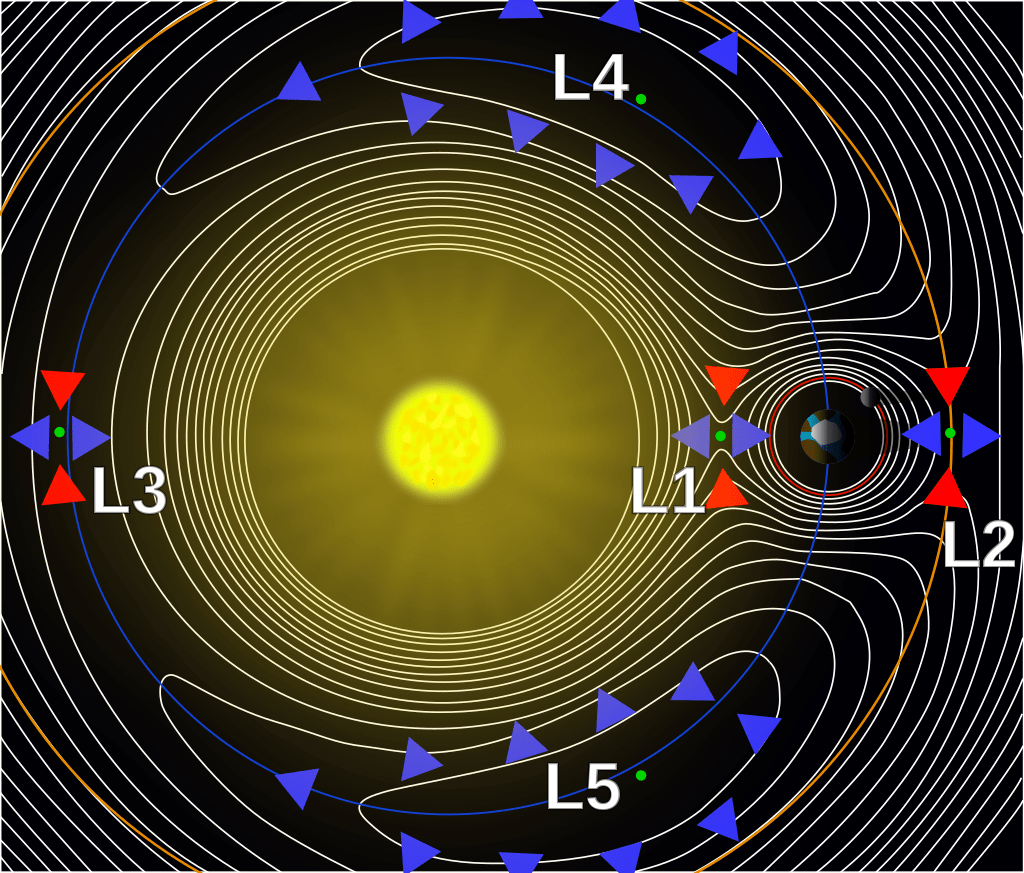
The Earth may have more than just two of these Trojan asteroids, so stay tuned. But we are not unique. Jupiter has more than 5,000 of them. Trojan asteroids are found at Lagrange point 4 (L4) and L5 (see graphic below). Both the the Trojans asteroids mentioned above are located in L4.

These companion asteroids could also be useful in the future. Cesar Briceño of NOIRLab stated:

If we are able to discover more Earth Trojans, and if some of them can have orbits with lower inclinations, they might become cheaper to reach than our Moon…So they might become ideal bases for an advanced exploration of the Solar System, or they could even be a source of resources.

Source: Lagrange points pertaining to Earth and the Sun (not to scale) from NOIRLab.

Extra: To learn what else you can find at these Lagrange points, see my earlier post.

What Else Can be Found at Lagrange 2?

Source: Lagrange Points from Wikipedia.

Now that the James Webb Space Telescope (JWSP) has deployed its 21-foot, gold-coated primary mirror, it is in good shape as it heads for the Sun-Earth’s second Lagrange point, known as L2, which is nearly 1 million miles from Earth. However, it will not be the first spacecraft to park in this spot to conduct a scientific mission.

I looked around to get a good inventory of what was operating, and will be operating, at L2 when JWST arrives and found the best listing on Wikipedia. Here is the inventory:

Past missions at L2:

  • From 2001 to 2010: NASA’s Wilkinson Microwave Anisotropy Probe (WMAP) observed the cosmic microwave background.
  • From 2003 to 2004: NASA’s WIND studied radio waves and plasma that occur in the solar wind and in the Earth’s magnetosphere (now in L1).
  • From 2009 to 2013: The European Space Agency’s (ESA) Herschel Space Observatory sifted through star-forming clouds to trace the path by which potentially life-forming molecules, such as water, form.
  • From 2009 to 2013: The ESA’s Planck spacecraft observatory mapped the anisotropies of the cosmic microwave background at microwave and infrared frequencies, with high sensitivity and small angular resolution. 
  • From 2011 to 2012: Chinese National Space Programs’s Chang’e 2 tested the Chinese tracking and control network (after first serving as a lunar probe).

Current missions at L2:

  • Since 2014: The ESA Gaia probe has been measuring the positions, distances and motions of stars, with a mission to construct a 3D space catalog containing approximately 1 billion astronomical objects (stars, planets, comets, asteroids, quasars, and more).
  • Since 2019: The joint Russian-German high-energy astrophysics observatory Spektr-RG has been conducting a seven-year X-ray survey, the first in the medium X-ray band less than 10 keV energies, and the first to map an estimated 100,000 galaxy clusters.

Of course, there are future missions planned for L2, and plenty of craft operating in L1, L4, and L5. That will be a story or two for another time.