Space Stories: Protests to Save Chandra, Problems Retrieving Martian Sample, and TESS is Getting Testy

Here are some recent stories related to NASA missions.

PhysicsWorld: US Astronomers Slam Cuts to the Chandra X-ray Observatory

X-ray astronomers in the US have begun a campaign to save the Chandra X-ray Observatory from budget cuts that would effectively end the mission. They assert that the craft, which was launched in 1999, has plenty of life left in it. Cancelling support could, they say, damage scientific efforts to understand the universe and the careers of an emerging generation of X-ray astronomers.

CNN: NASA Rethinks Plan to Return Rare Mars Samples to Earth

“Mars Sample Return will be one of the most complex missions NASA has ever undertaken. The bottom line is, an $11 billion budget is too expensive, and a 2040 return date is too far away,” Nelson said. “Safely landing and collecting the samples, launching a rocket with the samples off another planet — which has never been done before — and safely transporting the samples more than 33 million miles (53 million kilometers) back to Earth is no small task. We need to look outside the box to find a way ahead that is both affordable and returns samples in a reasonable time frame.”

NASA: NASA’s TESS Temporarily Pauses Science Observations

NASA’s TESS (Transiting Exoplanet Survey Satellite) entered into safe mode April 8, temporarily interrupting science observations. The team is investigating the root cause of the safe mode, which occurred during scheduled engineering activities. The satellite itself remains in good health. The team will continue investigating the issue and is in the process of returning TESS to science observations in the coming days.

Oops – Sorry About That, Mars

Image (Credit): Illustration of how DART’s impact altered the orbit of Dimorphos about Didymos. (https://dart.jhuapl.edu/)

You may remember how NASA’s Double Asteroid Redirection Test (DART) mission was a great success in that it demonstrated that we can divert an asteroid, should it be necessary.

Well, that’s not the whole story. A new study has found that the redirected asteroid debris may threaten Mars in the future. How far into the future? In one case, it will be 6,000 years into the future, and the second about 15,000 years into the future.

It would be nice to think that we will have habitats if not cities on Mars at that point (and maybe even a Musk Mountain looming over one of the cities), so this could be relevant. So maybe today’s practice run will be tomorrow’s disaster. Then again, I am pretty sure that such a future society will also have the ability to deflect these asteroids, possible building on what we learned from DART.

All of this does make you think about other areas where our tampering may come back to bite us.

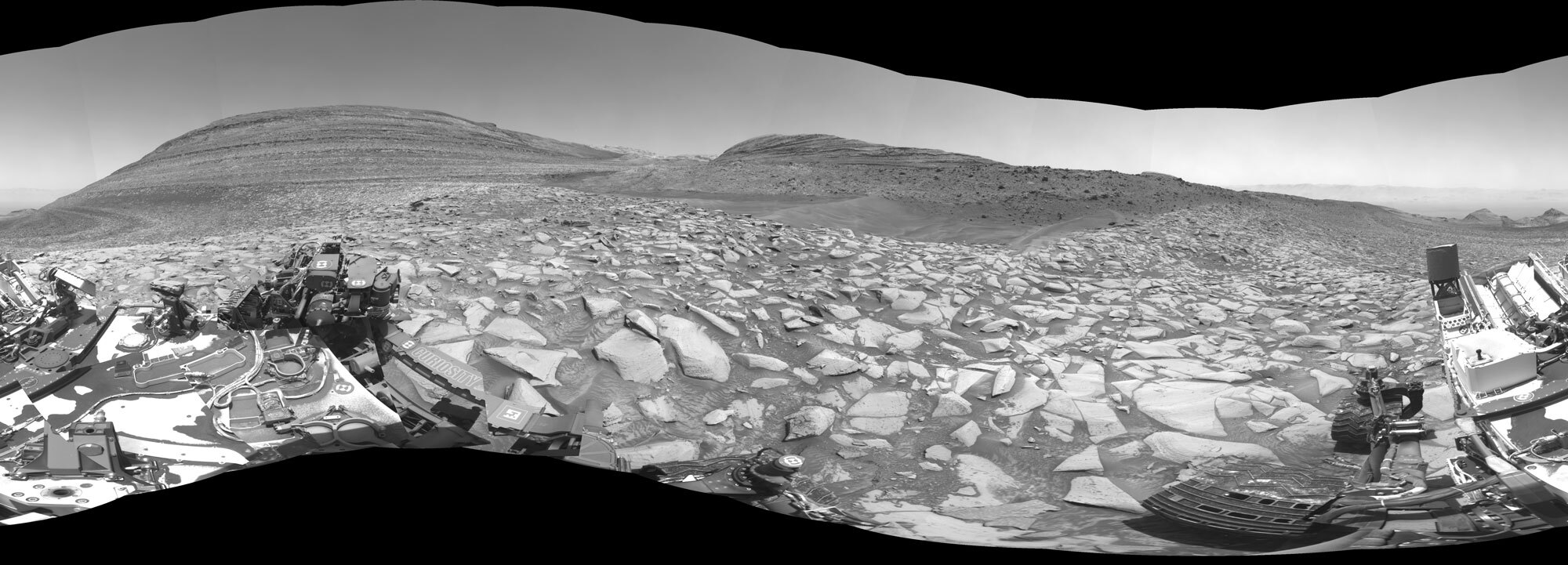
Pic of the Week: The Gediz Vallis Channel

Image (Credit): Panoramic shot of Mar’s Gediz Vallis channel taken by the Curiosity rover. (NASA/JPL-Caltech)

This week’s image comes from NASA’s Curiosity rover in the Gediz Vallis channel. It is a 360-degree panorama shot from back on February 3. The rover has diligently continued its exploration of the Martian surface since it first landed in 2012.

In terms of this latest rover location, NASA stated:

NASA’s Curiosity rover has begun exploring a new region of Mars, one that could reveal more about when liquid water disappeared once and for all from the Red Planet’s surface. Billions of years ago, Mars was much wetter and probably warmer than it is today. Curiosity is getting a new look into that more Earth-like past as it drives along and eventually crosses the Gediz Vallis channel, a winding, snake-like feature that – from space, at least – appears to have been carved by an ancient river.

That possibility has scientists intrigued. The rover team is searching for evidence that would confirm how the channel was carved into the underlying bedrock. The formation’s sides are steep enough that the team doesn’t think the channel was made by wind. However, debris flows (rapid, wet landslides) or a river carrying rocks and sediment could have had enough energy to chisel into the bedrock. After the channel formed, it was filled with boulders and other debris. Scientists are also eager to learn whether this material was transported by debris flows or dry avalanches.

Space Stories: Detailed Views of Mars, Plummeting ISS Space Junk, and Time Zones on the Moon

Image (Credit): Recent high-altitude view of Mars taken by Mars Express’s High Resolution Stereo Camera (HRSC). ( ESA)

Here are some recent stories of interest.

Astrobiology: Mars Express Celebrates 25,000 Orbits

ESA’s Mars Express recently looped around Mars for the 25,000th time – and the orbiter has captured yet another spectacular view of the Red Planet to mark the occasion. The new high-altitude view was taken by Mars Express’s High Resolution Stereo Camera (HRSC). It features many of Mars’s towering volcanoes and even includes a surprise appearance from the planet’s largest moon, Phobos.

Daily Mail: Piece of 5,800lb Battery Pallet Tossed from NASA’s ISS Crashes Through Florida Home – and Nearly Kills Homeowner’s Son

A piece of metal came crashing through a home in Florida that is believed to be from a 5,800-pound battery pallet discarded by the International Space Station (ISS). Naples homeowner Alejandro Otero was on vacation when he received a call from his son, saying he heard a ‘tremendous sound’ and there were gaping holes in the ceiling and floor – while explaining whatever fell almost hit him. The two-pound, cylinder object has since been recovered by NASA to determine its origin and if found to be space junk, the agency could be liable for damages.

Reuters: White House Directs NASA to Create Time Standard for the Moon

The White House on Tuesday directed NASA to establish a unified standard of time for the moon and other celestial bodies, as the United States aims to set international norms in space amid a growing lunar race among nations and private companies. The head of the White House Office of Science and Technology Policy (OSTP), according to a memo seen by Reuters, instructed the space agency to work with other parts of the U.S. government to devise a plan by the end of 2026 for setting what it called a Coordinated Lunar Time (LTC).

Space Stories: More Water on Mars, Senators Want Mars Sample Returned to Earth, and the ESA Considers Mission to Enceladus

Here are some recent stories of interest.

Euronews: Photos from NASA’s Curiosity Rover Suggest Mars had More Water for Longer Than Previously Thought

Scientists say Mars may have had more water and stayed wet for longer than they had previously estimated based on photos from NASA’s Curiosity rover. An international team of researchers led by Imperial College London recently found unusual formations in rock and sediment in unexpected places in the crater. The rocks allow scientists to compare the evolving geology of Mars with Earth.

U.S. Senate: Padilla, Butler Urge NASA to Fully Fund Mars Sample Return Program

Today, U.S. Senators Alex Padilla and Laphonza Butler (both D-Calif.) wrote to NASA Administrator Bill Nelson urging him to allocate the full $650 million necessary to fund the Mars Sample Return (MSR) mission in NASA’s FY24 spending plan. The Senators are issuing the letter following the passage of the FY 2024 appropriations package, which reiterated Congress’ strong commitment to the MSR mission.

European Space Agency: Saturn’s Moon Enceladus Top Target for ESA

A fresh, icy crust hides a deep, enigmatic ocean. Plumes of water burst through cracks in the ice, shooting into space. An intrepid lander collects samples and analyses them for hints of life. ESA has started to turn this scene into a reality, devising a mission to investigate an ocean world around either Jupiter or Saturn. But which moon should we choose? What should the mission do exactly? A team of expert scientists has delivered their findings...Aiming for transformational science, considering the characteristics of each moon and future planned missions to Jupiter and Saturn’s ocean worlds, the scientists identified Saturn’s moon Enceladus as the most compelling target, followed by Saturn’s moon Titan and then Jupiter’s moon Europa.