AI Images: Habitat on Mars

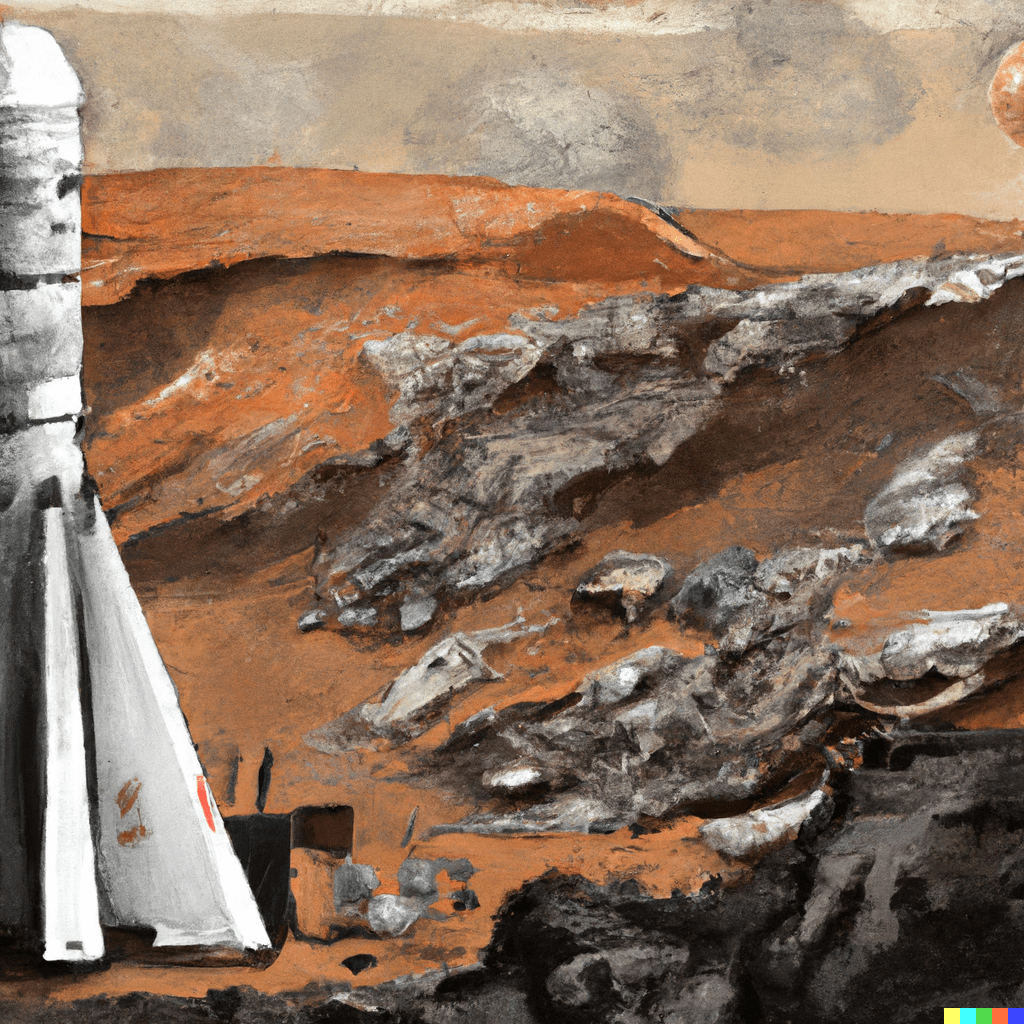
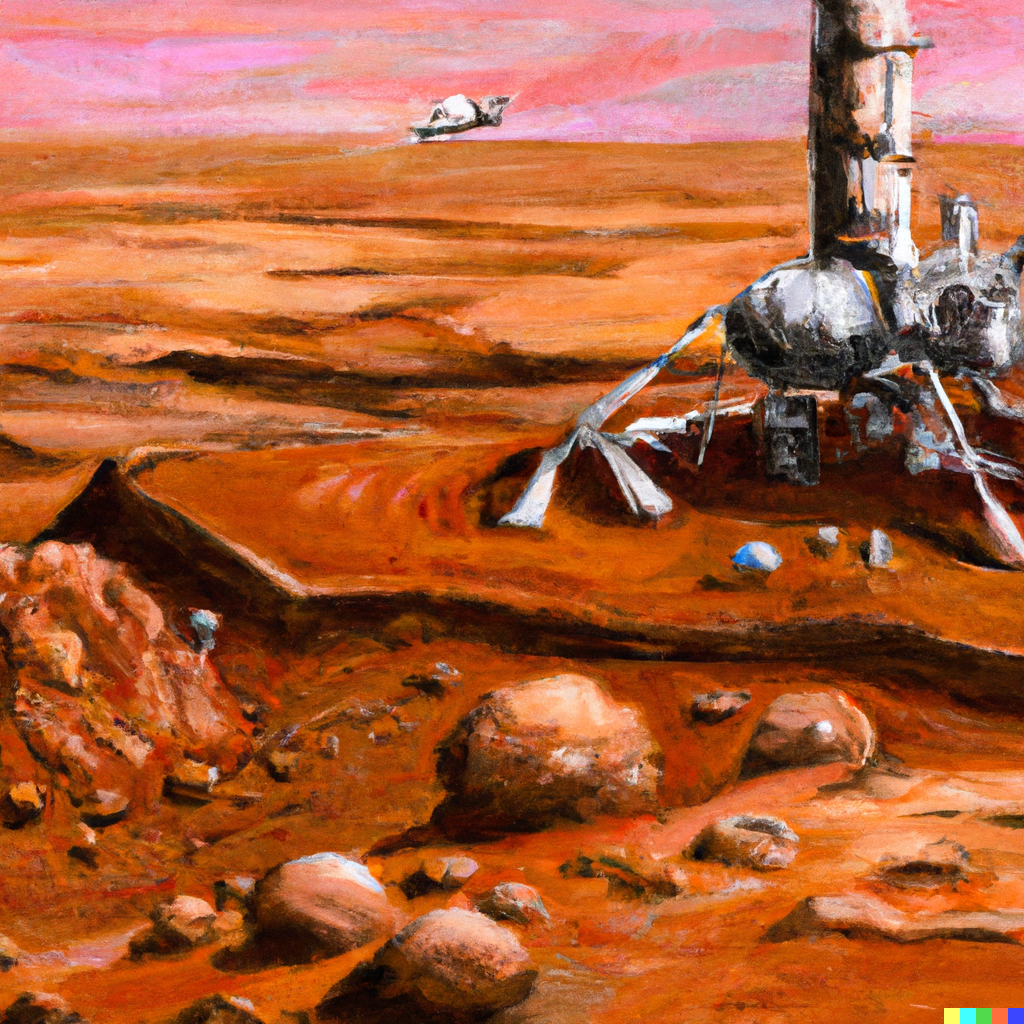
I was recently using OpenAI’s DALL-E 2 to test what it would provide if I was looking for examples of a Martian colony. I put in the following request: “Realist painting, surface of Mars, rocket and habitat in the foreground, ultra detailed.”

One of the images, shown above, clearly shows the rocket yet the habitat may be the ruins next to it. If so, this is an interesting perspective on the human endeavor. Maybe I should just assume the rocket is the habitat. Another image from DALL- E 2, shown as the next image below, is a little better with a spacecraft in the background and apparently a habitat in the foreground. Not necessarily inspirational, yet funtional.
After this I decided to see what Microsoft’s Image Creator (DALL-E 3) would produce. This was the opposite of the grainy, somewhat dismal images from the earlier version. As shown below, the updated program provided me with a colorful, sleek image that seemed more fantastical than real. Is that a Ferris wheel on the right of the structure? And since when did Mars have at least five moon orbiting it? At least the surface is reddish, but what is this craziness?
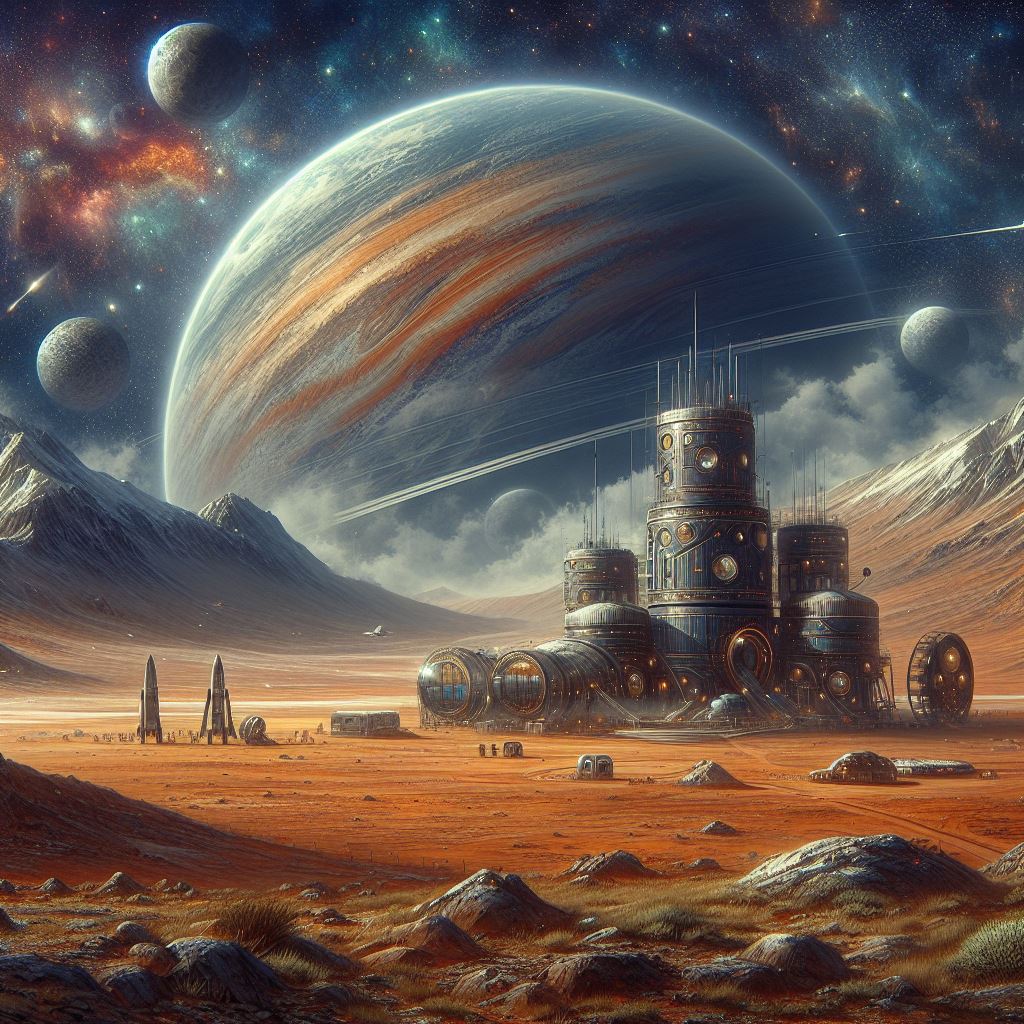
Microsoft has certainly upgraded the imagery, but what does it represent? Is it pure science fiction with little regard for the location being named. I would rather kids using AI software see the DALL-E 2 images as a starting point rather than the Microsoft Image Creator images representing nothing slightly realistic on a planet that cannot be Mars.

Maybe this is the hallucination problem cited with ChatGPT. I had not heard that the problem spread to AI imagery, but it makes sense. I will need to keep this in mind as I play with these new programs.

Space Stories: An International Astronaut for Artemis, Martian Eruptions, and Surprisingly Young Stars in Our Galaxy

Here are some recent stories of interest.

Politico: “NASA’s Moon Landing Mission will Include a Non-American, Harris Says

NASA is hoping to send a group of astronauts to the moon before the end of the decade, and at least one of them won’t be American. During a National Space Council meeting Wednesday afternoon, Vice President Kamala Harris announced that an astronaut from another country will join the U.S. team…It’s a major diplomatic move for Washington as it attempts to build an international coalition in space to counter a similar initiative being pursued by China, which the U.S. believes is gearing up for future battles in orbit. Harris didn’t specify which nation will provide the astronaut.

University of Arizona: “Recent Volcanism on Mars Reveals a Planet More Active Than Previously Thought

A vast, flat, “featureless” plain on Mars surprised researchers by revealing a much more tumultuous geologic past than expected, according to a study led by researchers at the University of Arizona. Enormous amounts of lava have erupted from numerous fissures as recently as one million years ago, blanketing an area almost as large as Alaska and interacting with water in and under the surface, resulting in large flood events that carved out deep channels...Mars has long been thought to be a geologically “dead” planet where not much is happening. Recent discoveries have researchers questioning this notion,

ScienceNews: “A Bar of Stars at the Center of the Milky Way Looks Surprisingly Young

The biography of our home galaxy may be due for some revisions. That’s because a bar-shaped collection of stars at the center of the Milky Way appears to be much younger than expected. The bar is a prominent feature of our galaxy. It spans thousands of light-years and links the galaxy’s spiraling arms of stars, making them resemble streams of water coming from a spinning lawn sprinkler.

Gift Ideas: Astronomy Items that are Fun for the Whole Family

Credit: Late for the Sky

If you are still looking around for holiday gifts, Popular Mechanics provided a nice gift guide for 2023. This includes the board game Space-opoly (above), the red Mars dust globe (below), and the Play Tent Galaxy Dome (also below).

Some other sources for helpful gift lists include:

Don’t worry. You still have time.

Credit: Humango Toys
Credit: Space World

Space Quote: JPL Struggles to Remain Fully Staffed

Image (Credit): Artist’s rendering of NASA’s Perseverance rover on the surface of Mars. (NASA/JPL-Caltech)

“It was clear that upper management expected us to push through regardless of any challenges happening outside the lab because the robot was the first priority…It resulted in incredible burnout across all the teams. Many of us are honestly still recovering from it.”

-Statement by one of the NASA Jet Propulsion Laboratory employees working on the Mars Perseverence rover mission as quoted in a Scientific American article, “NASA Lab’s Workforce Woes Threaten Major Space Missions.” The article notes that JPL is dealing with employee shortages as overworked employees depart for better pay more more life balance at private space firms.

A Day in Astronomy: First Operation of the International Space Station

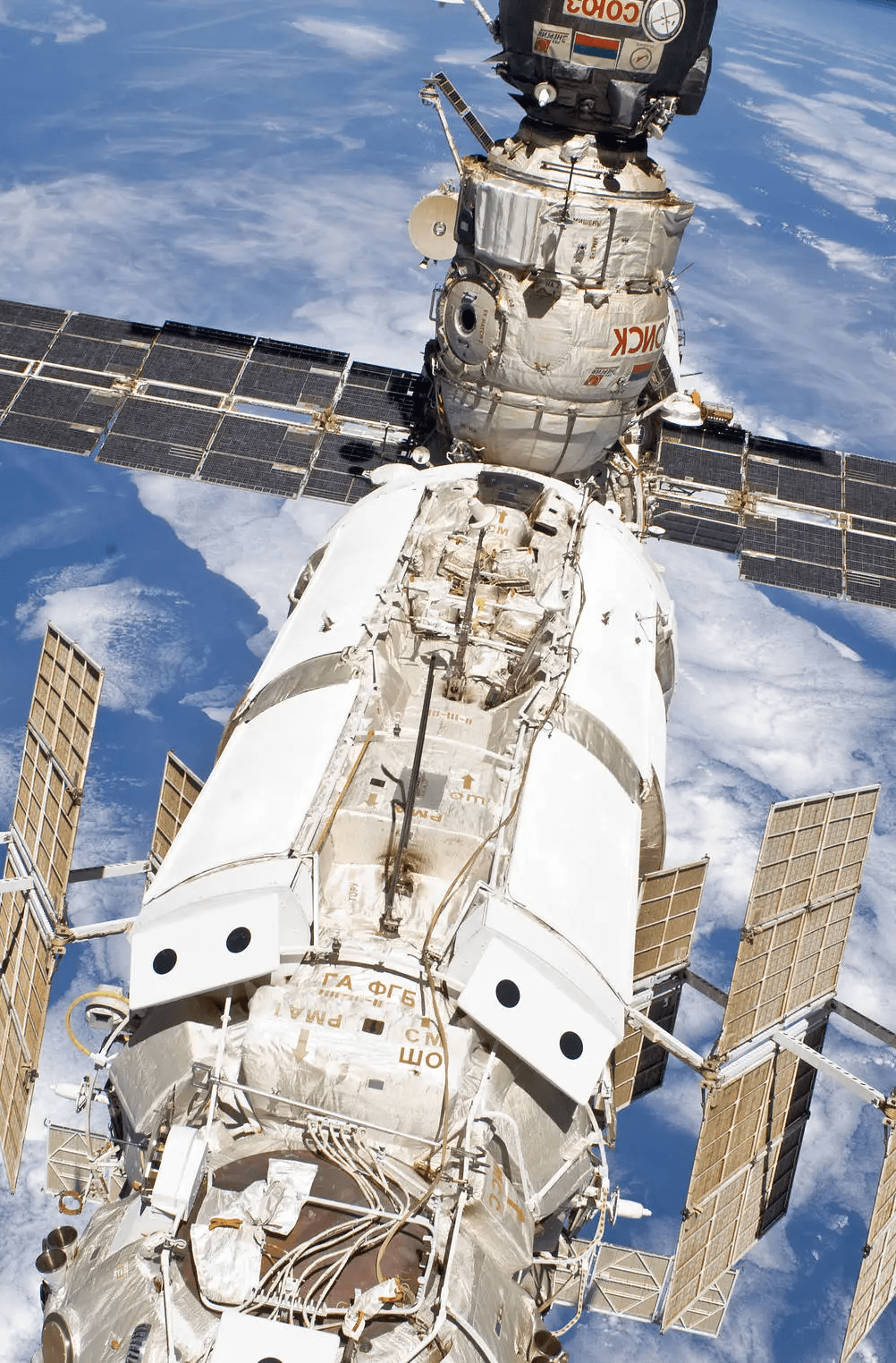
Image (Credit): The ISS’s Zarya module (in the image bottom to center). (NASA)

On this day in 1998, two modules, the Russian Zarya and American Unity, were joined in Earth orbit to create the International Space Station (ISS).

The ISS was built by five space agencies involving 15 nations. NASA notes that 273 people from 21 countries have visited the ISS over the years to assist with more than 3,300 research and educational investigations. The station has been busy, and pretty expensive at more than $150 billion to design and build.

Back in 2012, Astrophysicist Neil DeGrasse Tyson stated:

If the United States commits to the goal of reaching Mars, it will almost certainly do so in reaction to the progress of other nations – as was the case with NASA, the Apollo program, and the project that became the International Space Station.

Eleven years later, the ISS continues to orbit the Earth while plans are still being made to return to the Moon and visit Mars. Maybe Dr. Tyson was right given our current race with China to the Moon. We sometimes need that extra push to move towards the stars (as least in terms of crewed flights).