Study Findings: Which Caves on Mars are Safe to Live In?

Image (Credit): A region in Chryse Planitia where Tiu, Ares, and Kasei Valles end, which is pockmarked by impact craters large and small. (HiRISE/The University of Arizona)

Here are some highlights from the paper presented at the 55th Lunar and Planetary Science Conference:

For reliable protection against cosmic radiation, living and working spaces for colonists are best built below the surface. These colonies also need to be provided with energy. And solar panels are not the best option because the solar radiation flux is much lower on Mars and the panels will be constantly dusted with dust due to frequent dust storms. A nuclear reactor may be the best option.

Humans also need constant access to water resources. From the point of view of the reliability of the future housing, a lava tube with strong walls best meets these requirements. It is a hollow formation in the crust, formed as a result of the release of volcanic lava. And based on the need to provide settlements with water, a more suitable case should be considered underground caves in glacial cracks with a gentle horizontal entrance. After all, there are already significant deposits of water ice under the surface. But the walls of such settlements will be less strong, and they will require more careful preparatory work.

Publication: 55th Lunar and Planetary Science Conference, held 11-15 March, 2024 at The Woodlands, Texas/Virtual. LPI Contribution No. 3040, id.1028

Contact Info: A. P. Vidmachenko, National University of Life and Environmental Sciences of Ukraine, Str. Heroyiv Oborony, 12, Kyiv, 03041, Ukraine, avidmachenko@gmail.com.

Link to paper: https://www.hou.usra.edu/meetings/lpsc2024/pdf/1028.pdf

Study-related stories:

Space Stories: Moss for Mars, Martian Space Rocks, and a Red Planet Practice Habitat

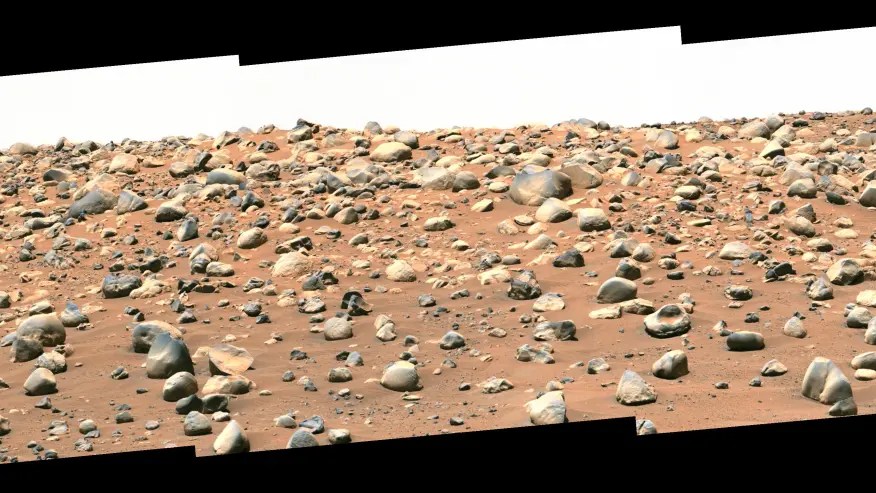
Image (Credit): A detailed view of the Martian surface. (ESA/DLR/FU Berlin)

Here are some recent Mars-related stories of interest.

The Guardian: Scientists Find Desert Moss ‘That Can Survive on Mars’”

While Matt Damon relied on potatoes cultivated in crew biowaste to survive in the hit film The Martian, researchers say it is a humble desert moss that might prove pivotal to establishing life on Mars. Scientists in China say they have found Syntrichia caninervis – a moss found in regions including Antarctica and the Mojave desert – is able to withstand Mars-like conditions, including drought, high levels of radiation and extreme cold.

CNN: Mars Gets Hit by Hundreds of Basketball-size Space Rocks Every Year

Hundreds of basketball-size space rocks slam into Mars each year, leaving behind impact craters and causing rumblings across the red planet, according to new research. Mission planners could use the revelations, recorded in data collected by a now-retired NASA mission, as they determine where to land future robotic missions as well as astronaut crews on the red planet. NASA’s InSight mission ended when the stationary lander lost a battle to an accumulation of Martian dust on its solar panels in December 2022, but the wealth of data the spacecraft collected is still fueling new research.

UPI: Crew Inside NASA’s Mars Habitat Simulator to Exit After More Than a Year

The first volunteer crew, to live for more than a year inside NASA’s Mars habitat at the Johnson Space Center in Houston, will exit the simulated Red Planet ground mission on Saturday…The crew entered CHAPEA on June 25, 2023, and enacted Mars mission operations, including virtual reality “Mars-walks” while growing and harvesting vegetables to supplement their shelf food. They also spent their time maintaining equipment while being tested with stressors, including isolation and communication delays with Earth.

Podcast: Getting to Mars and Staying Alive

If you are interested in the future of humanity on Mars, you may want to tune into Red Planet Radio from The Mars Society. A recent podcast, as well as an upcoming podcast, highlight some things to consider before you pack your bags.

Back on June 15, in the podcast titled “Dr. Antonio Paris, Astrophysicist, Author “Mars: Your Personal 3-D Journey!,” we heard from Dr. Antonio Paris, who is the Chief Scientist at the Center for Planetary Science as well as an Assistant Professor of Astronomy and Astrophysics at St. Petersburg College, Florida. In this podcast, Dr. Paris discussed the difficulties of traveling in space as well as the types of structures one might need to build to live safely on Mars. He also discussed his recent book, Mar: Your Personal 3D Journey to the Red Planet.

Tomorrow (July 2) another podcast episode will include a three-person NASA panel discussing topics such as general Mars exploration, strategies for sample returns from the Red Planet, and the architecture supporting Moon to Mars missions.

The three panelists are:

  • Nujoud Merancy: Deputy Associate Administrator, Strategy and Architecture Office, in the Exploration Systems Development Mission Directorate for NASA Headquarters.
  • Eric Ianson: Deputy Director, Planetary Science Division, and Director, Mars Exploration Program and Radioisotope Power Systems Program at NASA Headquarters. 
  • Dr. Lindsay Hays: Program Scientist in the Planetary Science Division at NASA Headquarters and Deputy Program Scientist for the Mars Sample Return Mission. 

I enjoyed the first episode and look forward to tomorrow’s discussion.

And don’t forget that from August 8-11 The Mars Society will hold its 27th Annual International Mars Society Convention at the University of Washington in Seattle, Washington. You can see videos from prior conventions here.

Credit: The Center for Planetary Science, Inc.

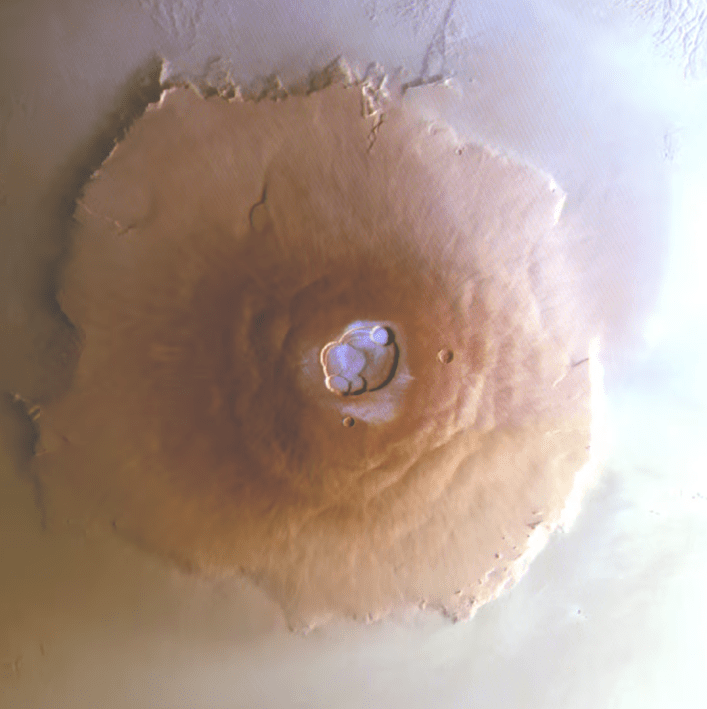
Pic of the Week: Frost on Olympus Mons

Image (Credit): Frosty summit of Mar’s Olympus Mons. (ESA/DLR/FU Berlin)

This week’s image is from the European Space Agency (ESA) and shows Olympus Mons on Mars, the tallest volcano in the solar system. Captured by ESA’s Mars Express, it shows water frost close to the planet’s equator, which was unexpected.

Colin Wilson, ESA project scientist for both ExoMars Trace Gas Orbiter and Mars Express, stated:

Finding water on the surface of Mars is always exciting, both for scientific interest and for its implications for human and robotic exploration…Even so, this discovery is particularly fascinating. Mars’s low atmospheric pressure creates an unfamiliar situation where the planet’s mountaintops aren’t usually colder than its plains – but it seems that moist air blowing up mountain slopes can still condense into frost, a decidedly Earth-like phenomenon.

NASA Exploring Mars Sample Return Options

Image (Credit): One of the sample return canisters on the surface of Mars. (NASA)

With the pending budget cuts at NASA, the space agency is exploring new options for getting soil and rock samples back to Earth from MARs. To do this, NASA is setting it sights on 10 studies to identify new approaches to accomplish this mission, 7 of which come from private contractors and the other 3 from NASA centers, the Jet Propulsion Laboratory in Southern California, and Johns Hopkins’ Applied Physics Laboratory.

The seven private sector parties of interest and related proposals from earlier this year are as follows:

  • Lockheed Martin in Littleton, Colorado: “Lockheed Martin Rapid Mission Design Studies for Mars Sample Return”
  • SpaceX in Hawthorne, California: “Enabling Mars Sample Return With Starship”
  • Aerojet Rocketdyne in Huntsville, Alabama: “A High-Performance Liquid Mars Ascent Vehicle, Using Highly Reliable and Mature Propulsion Technologies, to Improve Program Affordability and Schedule”
  • Blue Origin in Kent, Washington: “Leveraging Artemis for Mars Sample Return”
  • Quantum Space in Rockville, Maryland: “Quantum Anchor Leg Mars Sample Return Study”
  • Northrop Grumman in Elkton, Maryland: “High TRL MAV Propulsion Trades and Concept Design for MSR Rapid Mission Design”
  • Whittinghill Aerospace in Camarillo, California: “A Rapid Design Study for the MSR Single Stage Mars Ascent Vehicle”

It is not clear why such a review needed to wait until so late in the game. NASA is always facing budget crunches. Maybe this can be a model for other ventures in the future as well.