Image (Credit): Preview for the new television series Stars on Mars. (Fox)
The silly reality shows are now reaching for the stars, or at least a distant planet, with William Shatner leading the way. Fox’s new program Stars on Mars, premiering on June 5th, will feature numerous celebrities trying to survive in a “Mars-like” atmosphere. Planned guests include Lance Armstrong, Olympic figure skater Adam Rippon, professional football player Richard Sherman, and others.
I have no plans to watch this show, but I expect it may encourage support for space travel given that many of those who do watch the show will want to quickly leave this planet in the hopes of finding intelligent life somewhere.
NASA may be having funding problems, but bad TV always seems to find someone with deep pockets.
Image (Credit): Martian base for Stars on Mars. (Fox)
NASA has pulled the plug on its Lunar Flashlight project, which was designed to look for sources of ice on our nearest neighbor. The agency spent the last few months trying, and failing, to get the craft to generate the necessary amount of thrust to get the small satellite to its intended destination. Officials say that the issue was likely caused by debris buildup in the fuel lines, which prevented the CubeSat from working to its full potential.
NASA’s Mars Perseverance rover has taken new images that reveal that some of the red planet’s ancient rivers were much wilder than scientists previously thought. “It’s the first time we’re seeing environments like this on Mars,” Katie Stack Morgan, Perseverance’s deputy project scientist, said in a NASA release. Scientists studying rock formations, features, and valleys on Mars, so far, have found evidence to suggest Mars was once covered by water.
Rocket Lab USA, Inc., a leading launch and space systems company, is preparing for the second of two dedicated Electron launches to deploy a constellation of storm monitoring satellites for NASA. The launch, called ‘Coming To A Storm Near You,’ is scheduled for lift-off no earlier than 17:30 on May 22nd NZST from Rocket Lab Launch Complex 1 on New Zealand’s Mahia Peninsula. The launch follows on from the successful ‘Rocket Like a Hurricane’ Electron launch on May 8th 2023, which deployed the first two CubeSats of NASA’s TROPICS constellation. The ‘Coming To A Storm Near You’ launch will deploy the final two TROPICS CubeSats, completing the constellation.
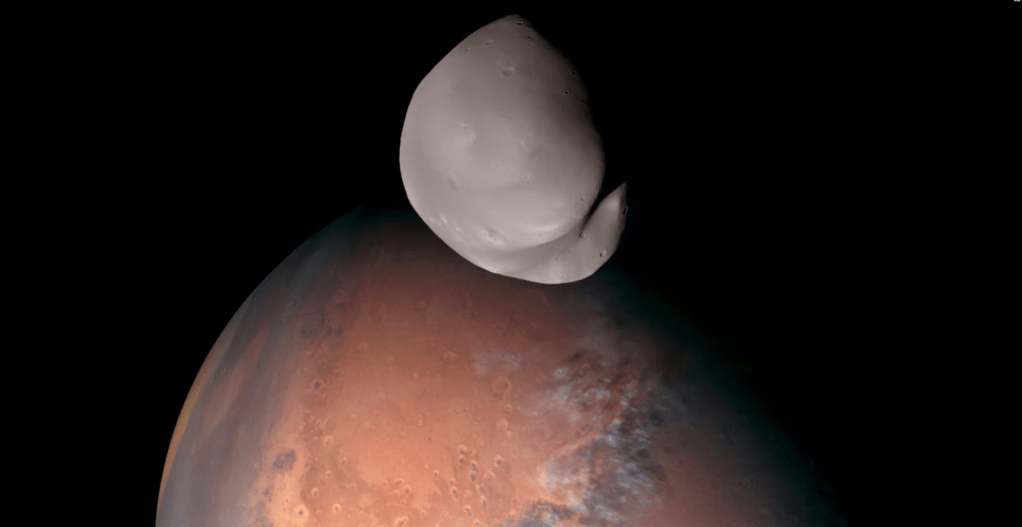
Image (Credit): Mars and its moon Deimos. (UAE Space Agency)
I should have used the image above as the Pic of the Week yesterday. The image was captured by the United Arab Emerates’ (UEA) Amal spacecraft orbiting Mars. It shows the Red Planet as well as one of its moons – Deimos. The spacecraft came as close as 62 miles from the moon.
In a European Geosciences Union press release, we read about another finding related to the UAE mission from Emirates Mars Mission Science Lead Hessa Al Matroushi:
We are unsure of the origins of both Phobos and Deimos…One long-standing theory is that they are captured asteroids, but there are unresolved questions about their composition. How exactly they came to be in their current orbits is also an active area of study, and so any new information we can gain on the two moons, especially the more rarely observed Deimos, has the potential to unlock new understanding of Mars’ satellites. Our close observations of Deimos so far point to a planetary origin rather than reflecting the composition of a type D asteroid as has been postulated.
Hence, we have a new discussion about the origin of the Martian moons that should keep scientists busy for some time.
The Japanese start-up ispace attempted to become the first private company to successfully soft-land a commercial spacecraft on the Moon today (Tuesday, April 25). However, it now appears that the landing attempt — like several other such attempts in recent years — has failed…Ispace currently plans to attempt at least two more lunar landings over the next few years, applying lessons learned during today’s landing attempt to increase their odds of success.
The rare metal terbium has been found in an exoplanet’s atmosphere for the first time. The researchers at Lund University in Sweden have also developed a new method for analyzing exoplanets, making it possible to study them in more detail…”Detecting heavy elements in the atmospheres of ultra-hot exoplanets is another step towards learning how the atmospheres of planets work. The better we get to know these planets, the greater chance we have of finding Earth 2.0 in the future,” concludes Nicholas Borsato.
While NASA retired its InSight Mars lander in December, the trove of data from its seismometer will be pored over for decades to come. By looking at seismic waves the instrument detected from a pair of temblors in 2021, scientists have been able to deduce that Mars’ liquid iron core is smaller and denser than previously thought.
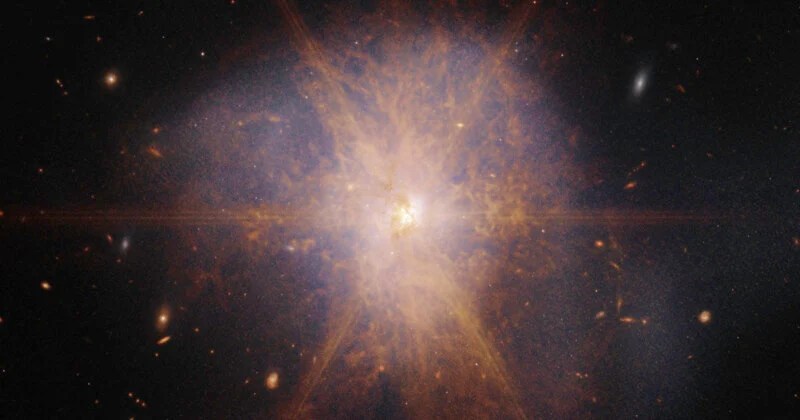
NASA’s James Webb Space Telescope has captured a stunning “smash-up” of two spiral galaxies. Collectively called Arp 220, the collision of the pair of galaxies has facilitated massive star formation. Arp 220 is located within the constellation Serpens, about 250 million light-years from Earth. Arp 220 gets its namesake because it is the 220th object in Hallton Art’s Atlas of Peculiar Galaxies. Arp 220 is “peculiar” because it’s an ultra-luminous infrared galaxy (ULIRG), and the nearest ULIRG to Earth.
Now in its fifth year in space, NASA’s TESS (Transiting Exoplanet Survey Satellite) remains a rousing success. TESS’s cameras have mapped more than 93% of the entire sky, discovered 329 new worlds and thousands more candidates, and provided new insights into a wide array of cosmic phenomena, from stellar pulsations and exploding stars to supermassive black holes.
NASA’s Ingenuity Mars Helicopter has completed its 50th flight on Mars. The first aircraft on another world reached the half-century mark on April 13, traveling over 1,057.09 feet (322.2 meters) in 145.7 seconds. The helicopter also achieved a new altitude record of 59 feet (18 meters) before alighting near the half-mile-wide (800-meter-wide) “Belva Crater.”



 Our Awesome Universe