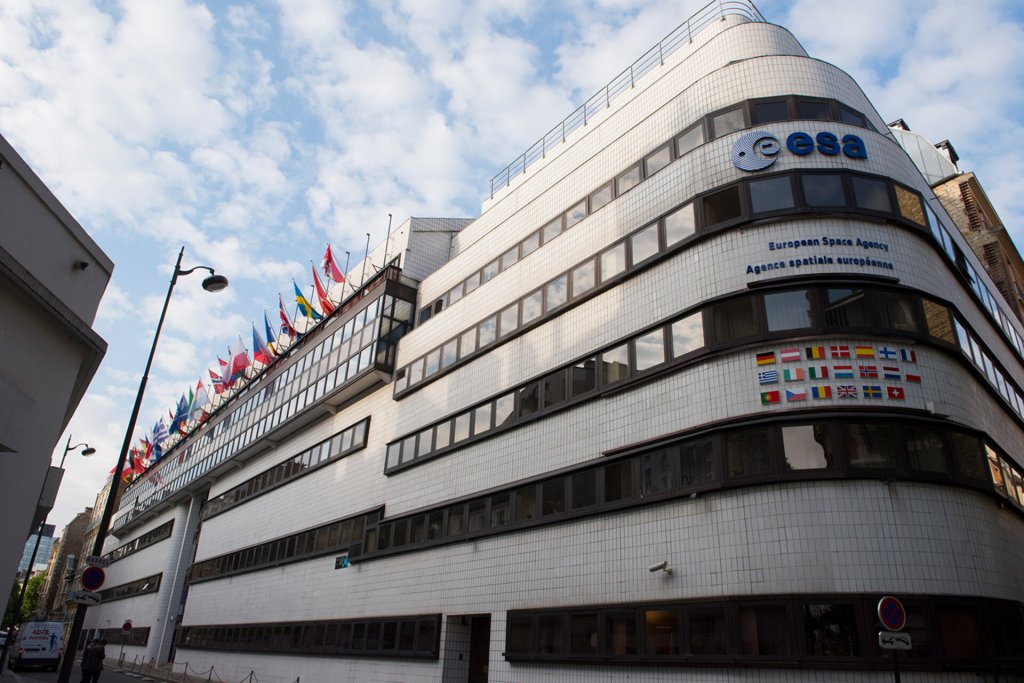
Image (Credit): European Space Agency (ESA) headquarters in Paris. (ESA)
“From understanding our changing planet to exploring Mars, I hugely value the cooperation we have with NASA…By contributing key European hardware and services to exciting programmes such as Artemis and Mars Sample Return, we are building Europe’s autonomy while also being a reliable partner.”
So what else did NASA Administrator Bill Nelson share with the Senate Committee on Appropriations last week (beyond his comments about the International Space Station)? In his prepared statement regarding NASA’s $26 billion budget request, he highlighted a number of priorities for his agency, including:
the Artemis Program to bring astronauts back to the Moon and related exploration costs – $7.5 billion;
continued support for the ISS – $4.3 billion;
the space technology research and development portfolio for the Moon, Mars, and other areas, such as sending the CAPSTONE CubeSat to the Moon as a pathfinder for the Artemis program – $1.44 billion;
greater science funding for projects such as exploring solutions for bringing the samples of Martian rock and soil collected by the Perseverance rover to Earth through the Mars Sample Return mission – $8 billion; and
supporting the civil aviation manufacturing sector with test flights on its Low Boom Flight Demonstrator, which will enable environmentally and socially acceptable supersonic passenger flights, as well as continued work on the X-57 Maxwell, an all-electric aircraft – $971 million.
NASA certainly has a lot on its place, and I did not even highlight the focus on Earth iteself, such as the planned Earth System Observatory, which is an array of satellites, instruments, and missions designed to generate a 3D, holistic view of the entire planet.
We just provided a $40 billion aid package to Ukraine so that it can defend itself and have a better future. This $26 billion will take us out of the realm of Earth-bound conflicts and allow us to find our future in the stars, or at least the solar system. It is money well spent.
Image (Credit): Gypsum dunes on Mars. (NASA, Univ. of Arizona’s Lunar & Planetary Laboratory)
This week’s amazing image was taken by the High Resolution Imaging Science Experiment (HiRISE) camera onboard NASA’s Mars Reconnaissance Orbiter launched in 2005. The University of Arizona’s Lunar & Planetary Laboratory, which operates HiRISE, described the image in this way:
This image suggestion outlines a contact between gypsum-rich dunes in Olympia Undae and flat-lying layers of the basal (or bottom) unit. Our goal is to look for a stratigraphic and compositional comparison between the dunes and the basal unit.
Olympia Undae, the largest continuous dune field on Mars, is in the northern polar region of Mars.
An earlier post noted the anniversary of NASA’s Mariner 9 spacecraft to Mars, launched on May 30, 1971, but what about Mariner 8? What happened to that Mars bound spacecraft?
Both Mariner 8 and 9 we developed together so one could replace the other if needed, which was pretty smart. The Russians did the same thing with their first trip to Mars in 1971, successfully sending Mars 2 (launched May 19) and Mars 3 (launched May 28).
Mariner 8 was supposed to be the first U.S. spacecraft to orbit Mars. It was launched on May 8, 1971 but never achieved Earth orbit due to a launch vehicle failure. Instead, it fell into the Atlantic Ocean.
Of the 10 Mariner missions, 7 were successfully took space craft to Mars, Venus, and Mercury. Unfortunately, like Mariner 8, Mariner 1 failed after launch. Fortunately, like Mariner 9, Mariner 2 was a back up spacecraft that ensure mission success. Mariner 3 failed after launch because of a battery issue, but its double Mariner 4 was successful. Here are the 10 missions (you can find more about them here):
Mariner 1: Venus mission launched on July 22, 1962. — Failed
Mariner 2: Venus mission launched on August 27, 1962. — Success
Mariner 3: Mars mission launched on November 5, 1964. — Failed
Mariner 4: Mars mission launched on November 28, 1964. — Success
Mariner 5: Venus mission launched on June 14, 1967. — Success
Mariner 6: Mars mission launched on February 25, 1969. — Success
Mariner 7: Mars mission launched on February 25, 1969. — Success
Mariner 8: Mars mission launched on May 8, 1971. — Failed
Mariner 9: Mars mission launched on May 30, 1971. — Success
Mariner 10: Mercury and Venue mission launched on November 3, 1973. — Success
While three spacecraft failed, all of the missions were successful because of the redundancy built into the system. We do not seem to have such luxuries anymore, though NASA’s Mars Exploration Rover (MER) mission had two Mars rovers, Spirit and Opportunity, to increase the chances of success.
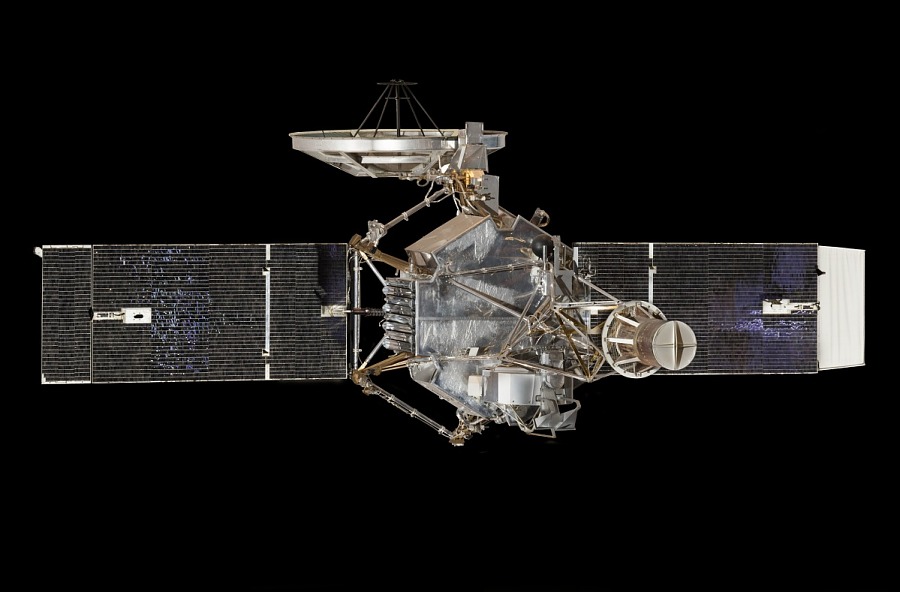
Image (Credit): Mariner 2 spacecraft. (Smithsonian National Air and Space Museum)
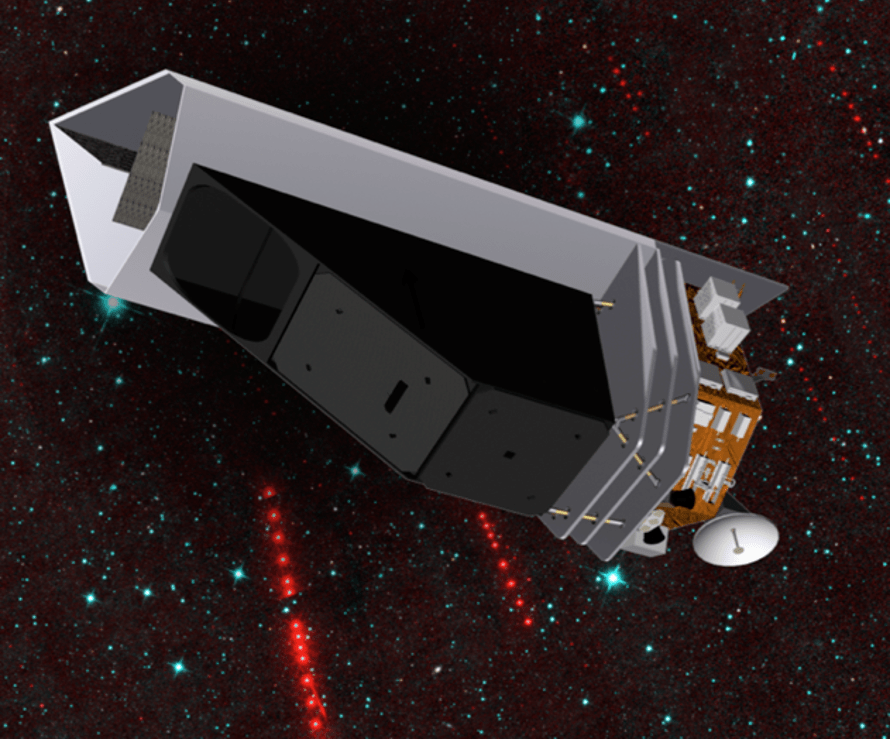
Image (Credit): he NEO Surveyor infrared space telescope is optimized for finding, tracking and characterizing potentially hazardous asteroids and comets. (NASA/JPL)
Members of the House Science Committee used a hearing about the planetary science decadal survey to criticize a proposal in NASA’s budget request to delay work on a space telescope to track near Earth objects (NEOs).
The Ingenuity Mars Helicopter’s black-and-white navigation camera has provided dramatic video of its record-breaking 25th flight, which took place on April 8. Covering a distance of 2,310 feet (704 meters) at a speed of 12 mph (5.5 meters per second), it was the Red Planet rotorcraft’s longest and fastest flight to date. (Ingenuity is currently preparing for its 29th flight.)
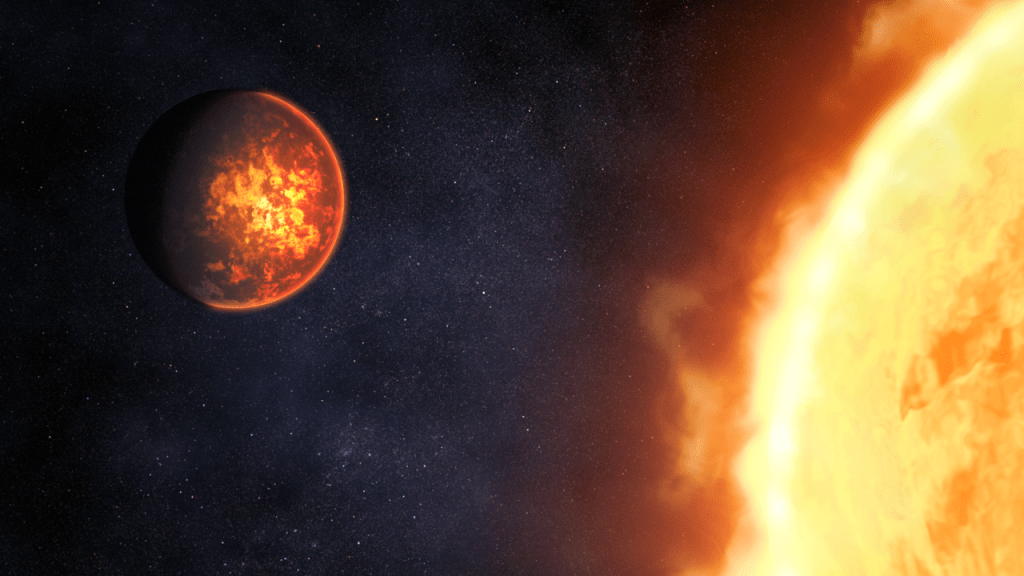
The James Webb Space Telescope plans to explore strange, new rocky worlds in unprecedented detail...Rocky planets are more difficult to sight than gas giants in current telescope technology, due to the smaller planets’ relative brightness next to a star, and their relatively tiny size. But Webb’s powerful mirror and deep-space location should allow it to examine two planets slightly larger than Earth, known as “super-Earths.”
Image (Credit): Illustration showing what exoplanet 55 Cancri e could look like, based on current understanding of the planet. (webbtelescope.org)



 Our Awesome Universe