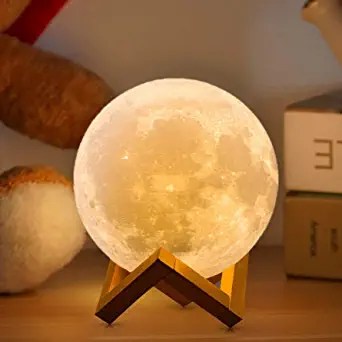
If you are looking for a fun gift that will encourage kids to learn more about the universe around them, then you cannot go wrong with a nightlight that illustrates the beauty of the nighttime objects above us. For instance, the Moon lamp shown above (there are many others like it on Amazon and elsewhere) allows an up-close view of this amazing orb. As with the Earth globes of old, seeing a world in three-dimensions and being able to touch it assists with understanding. Besides, in the case of the Moon, a youngster looking out the bedroom window will only see one side of the Moon, whereas the lamp provides the entire surface.
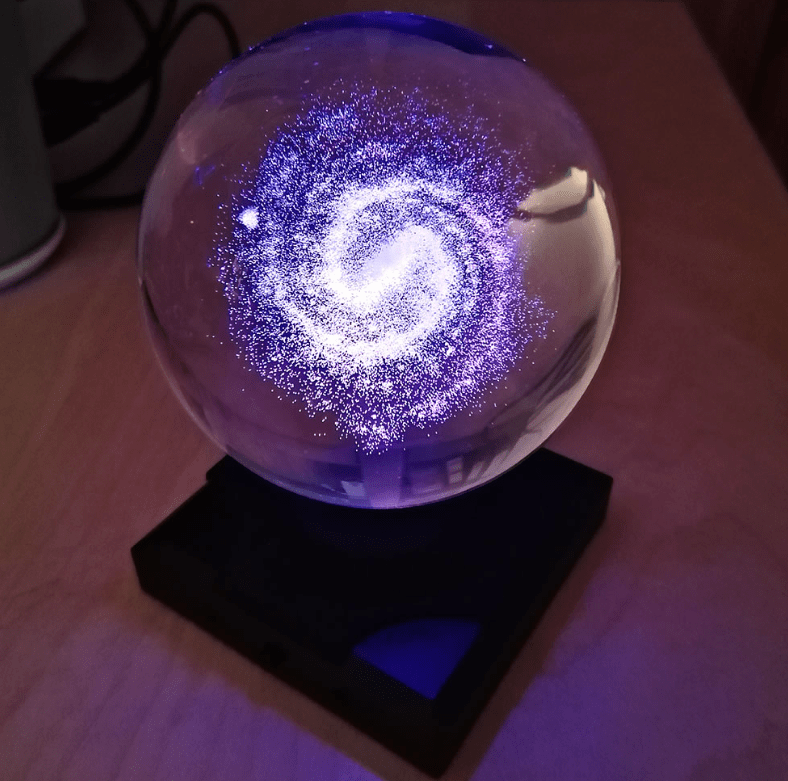
You can find similar lamps and nightlights showing Mars, Jupiter, and even the Milky Way (see below).
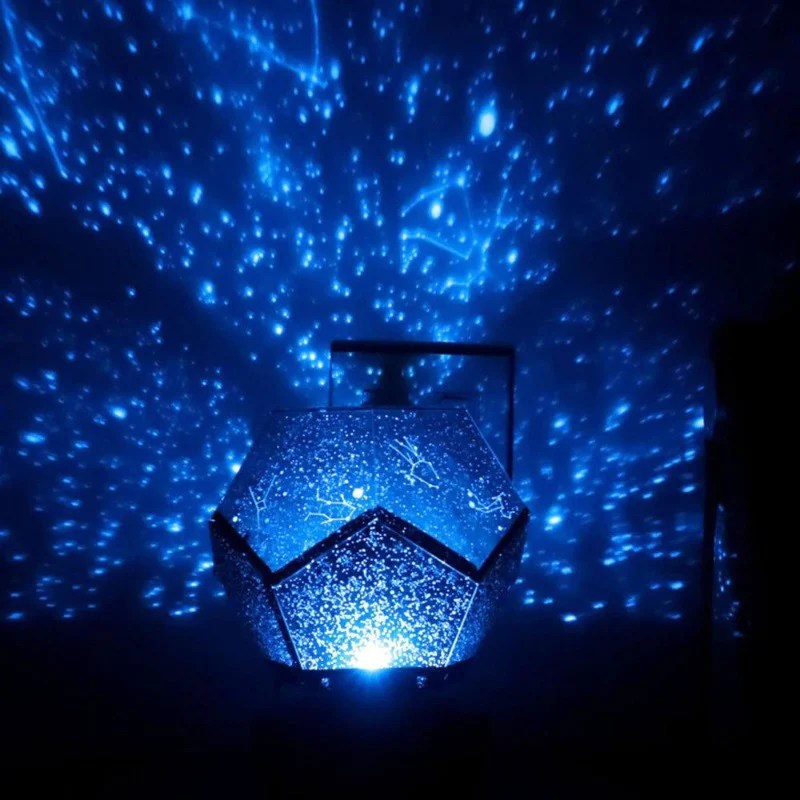
Or why not simply project the constellations onto the bedroom ceiling so kids can learn about the night sky even when it is cloudy outside? There is nothing like a personal planetarium.
Mind you, these gifts are not only for children, but it’s a good place to start. I may yet get one of those Moon lamps for my desk. Why should the kids have all the fun?
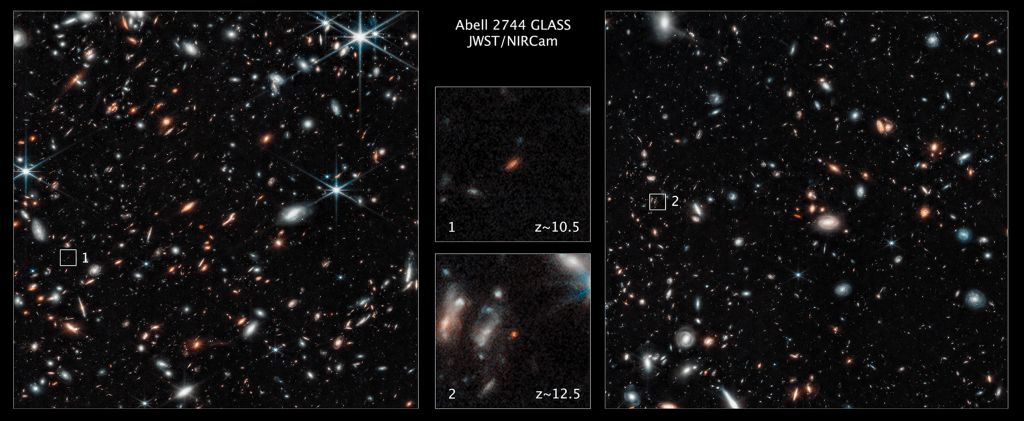
Image (Credit): Two of the farthest galaxies seen to date are captured in these Webb Space Telescope pictures of the outer regions of the giant galaxy cluster Abell 2744. The galaxies are not inside the cluster, but many billions of light-years farther behind it. The galaxy labeled (1) existed only 450 million years after the big bang. The galaxy labeled (2) existed 350 million years after the big bang. Both are seen really close in time to the big bang which occurred 13.8 billion years ago. These galaxies are tiny compared to our Milky Way, being just a few percent of its size, even the unexpectedly elongated galaxy labeled (1). (NASA, ESA, CSA, Tommaso Treu (UCLA), Zolt G. Levay (STScI))
With just four days of analysis, researchers found two exceptionally bright galaxies in the GLASS-JWST images. These galaxies existed approximately 450 and 350 million years after the big bang (with a redshift of approximately 10.5 and 12.5, respectively), though future spectroscopic measurements with Webb will help confirm…“These observations just make your head explode. This is a whole new chapter in astronomy. It’s like an archaeological dig, and suddenly you find a lost city or something you didn’t know about. It’s just staggering,” added Paola Santini, fourth author of the Castellano et al. GLASS-JWST paper.
When Mars was a young planet, it was bombarded by ice asteroids delivering water and organic molecules necessary for life to emerge. According to the professor behind a new study, this means that the first life in our solar system may have been on Mars.
Recently, hundreds of gold-rich stars have been detected by state-of-the-art telescopes worldwide. New simulations of galaxy formation, with the highest resolution in both time and mass, show that these gold-rich stars formed in progenitor galaxies, small galaxies which merged to create the Milky Way…According to the research, most gold-rich stars formed over 10 billion years ago in small, building-block galaxies―known as progenitor galaxies. Some but not all progenitor galaxies experience a neutron star merger, where large amounts of heavy r-process elements are produced and released, enriching that particular small galaxy. The predicted abundance of gold-enriched stars in the final Milky-Way-sized galaxy matches what is actually observed.
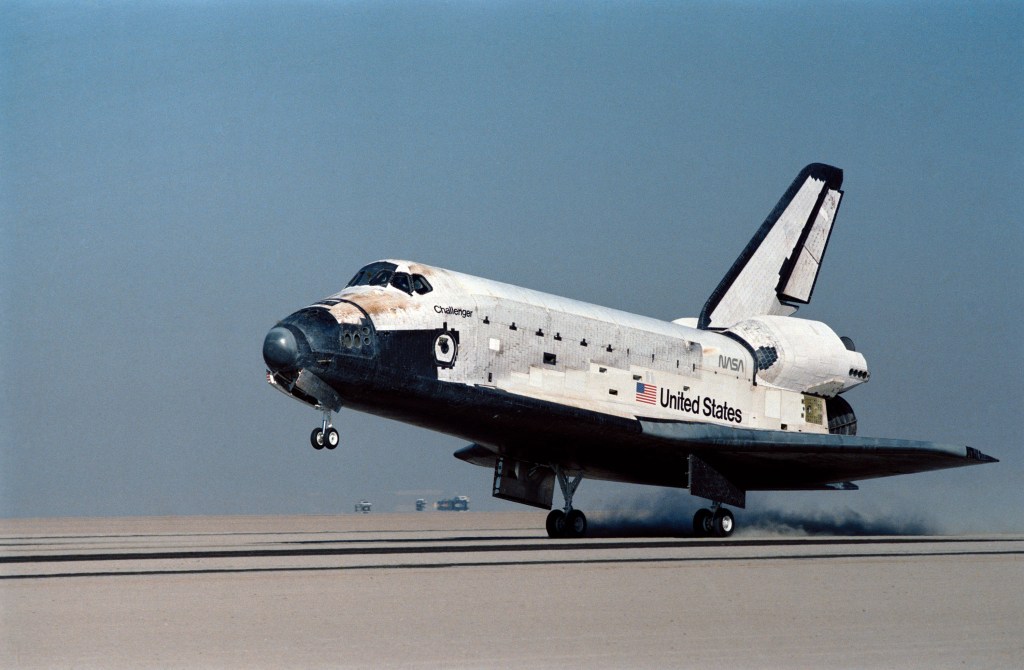
NASA leaders recently viewed footage of an underwater dive off the East coast of Florida, and they confirm it depicts an artifact from the space shuttle Challenger. The artifact was discovered by a TV documentary crew seeking the wreckage of a World War II-era aircraft. Divers noticed a large humanmade object covered partially by sand on the seafloor. The proximity to the Florida Space Coast, along with the item’s modern construction and presence of 8-inch square tiles, led the documentary team to contact NASA.
China has completed a first hot fire test of a fully-assembled powerful new engine that could power new launch vehicles and boost the country’s space capabilities. The full system test of the 500-ton-thrust, dual nozzle kerosene-liquid oxygen staged combustion cycle engine took place on Nov. 5, marking a milestone for the rocket engine.
A Northrop Grumman capsule delivered several tons of supplies to the International Space Station on Wednesday despite a jammed solar panel. The shipment arrived two days after launching from Virginia. Only one of the cargo ship’s two round solar panels opened following liftoff. Flight controllers tried in vain to open the stuck panel, but managed to draw enough power for the flight with just one.
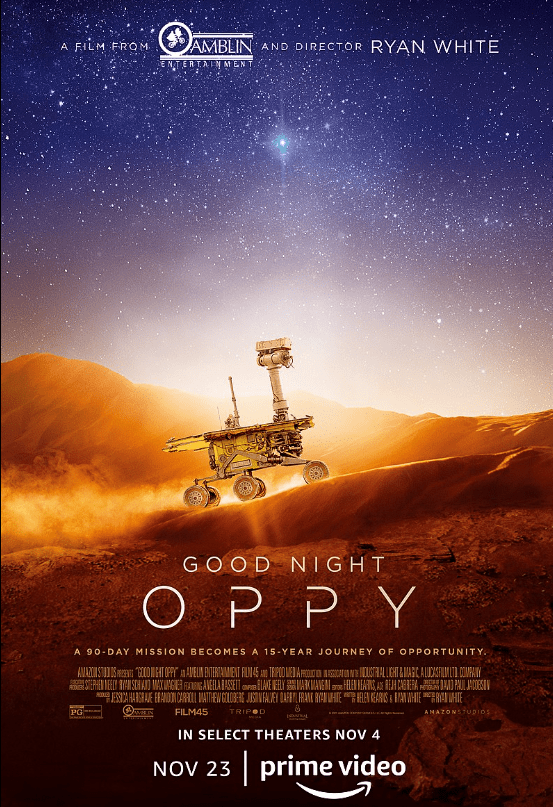
Image (Credit): Movie poster for Good Night Oppy. (Amazon Studies)
Here is a new space movie that should keep the crowds happy, and it is based on a true success – our mission to Mars. Good Night Oppy, produced by Amazon Studios, is the story of NASA’s Opportunity Mars rover. You can watch a preview here.
Good Night Oppy tells the inspirational true story of Opportunity, a rover that was sent to Mars for a 90-day mission but ended up surviving for 15 years. The film follows Opportunity’s groundbreaking journey on Mars and the remarkable bond forged between a robot and her humans millions of miles away.
The film, narrated by Angela Bassett, has the same feel as the 1985 film The Dream is Alive, which was narrated by Walter Cronkite and covered the space shuttle missions. While one might claim these are simple feel good movies, I say spread the word about the space missions far and wide. We should be proud of what we have done as well as where we plan to go.
The film will be available in selected theaters today and on Amazon Prime November 23, 2022.
You can learn more about the Opportunity rover here, and its sister rover Spirit here.
Image (Credit): DVD cover of the firm The Dream is Alive. (Threshold Corporation)
Image (Credit): Dust devils swirling across Jezero Crater, as viewed by NASA’s Perseverance Mars rover. (NASA/JPL-Caltech/SSI)
This week’s image is from earlier this year when NASA’s Perseverance Mars rover captured whirling dust on the Red Planet’s surface. Here is more on the dust devils from NASA:
During its first couple hundred days in Jezero Crater, NASA’s Perseverance Mars rover saw some of the most intense dust activity ever witnessed by a mission sent to the Red Planet’s surface. Not only did the rover detect hundreds of dust-bearing whirlwinds called dust devils, Perseverance captured the first video ever recorded of wind gusts lifting a massive Martian dust cloud.
A paper recently published in Science Advances chronicles the trove of weather phenomena observed in the first 216 Martian days, or sols. The new findings enable scientists to better understand dust processes on Mars and contribute to a body of knowledge that could one day help them predict the dust storms that Mars is famous for – and that pose a threat to future robotic and human explorers.
“Every time we land in a new place on Mars, it’s an opportunity to better understand the planet’s weather,” said the paper’s lead author, Claire Newman of Aeolis Research, a research company focused on planetary atmospheres. She added there may be more exciting weather on the way: “We had a regional dust storm right on top of us in January, but we’re still in the middle of dust season, so we’re very likely to see more dust storms.”