A Day in Astronomy: Mariner 9 Launched Towards Mars

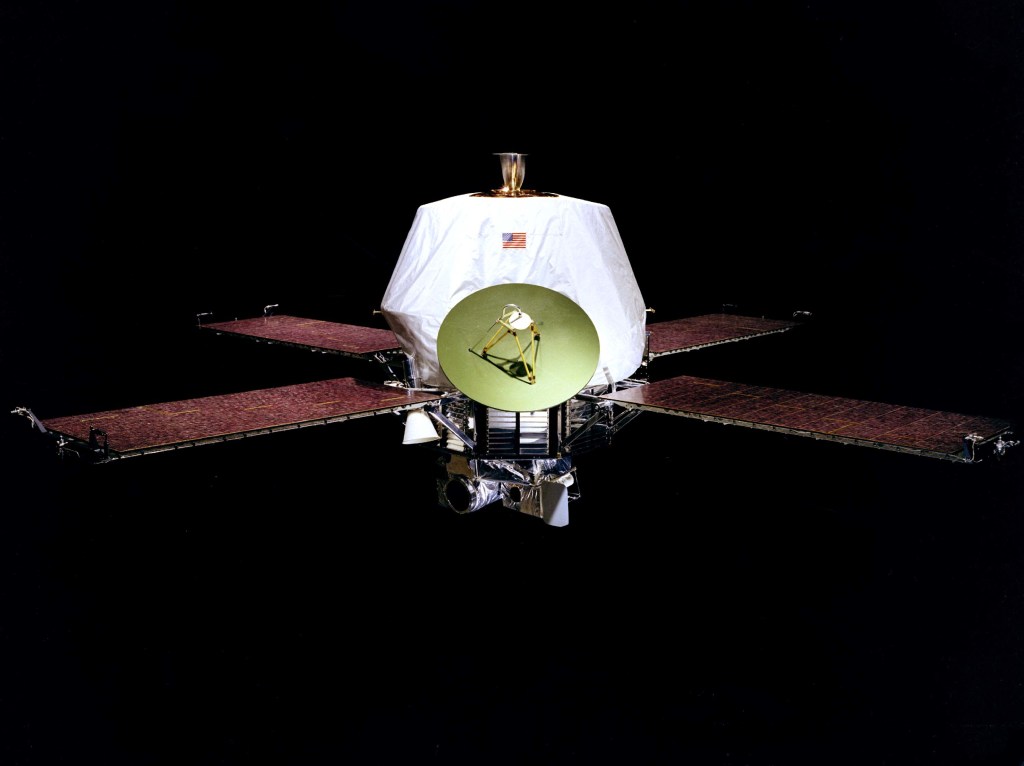
Image (Credit): NASA’s Mariner 9 spacecraft. (NASA)

On this day in 1971, the Mariner 9 spacecraft was launched from Cape Canaveral Air Force Station, Florida. It would become the first spacecraft from Earth to orbit Mars (or any other planet). It arrived at Mars on November 14, 1971. The Soviets were also working on their own program, launching their two Mars-bound spacecraft even earlier in May, but both arrived at Mars after Mariner 9.

The Mariner 9 spacecraft successfully mapped 85 percent of the Martian surface and also sent back thousands of images detailing the Martian surface as well as the two Martian moon, Deimos and Phobos. NASA’s last contact with the spacecraft was on October 27, 1972. The spacecraft was expected to remain in orbit until 2020, when it would crash onto the Martian surface.

You can read more about the Mariner 9 mission here.
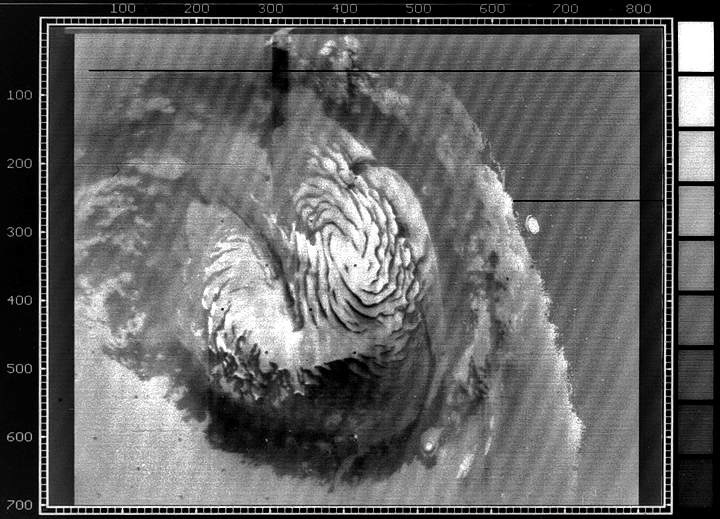
Image (Credit): Mariner 9 image of the north polar cap of Mars. The image was taken on 12 October 1972, about one-half Martian month after summer solstice, at which time the cap had reached its minimal extent. The cap is about 1000 kilometers across. (NASA)

Pic of the Week: Eerie Crater Marks the Spot

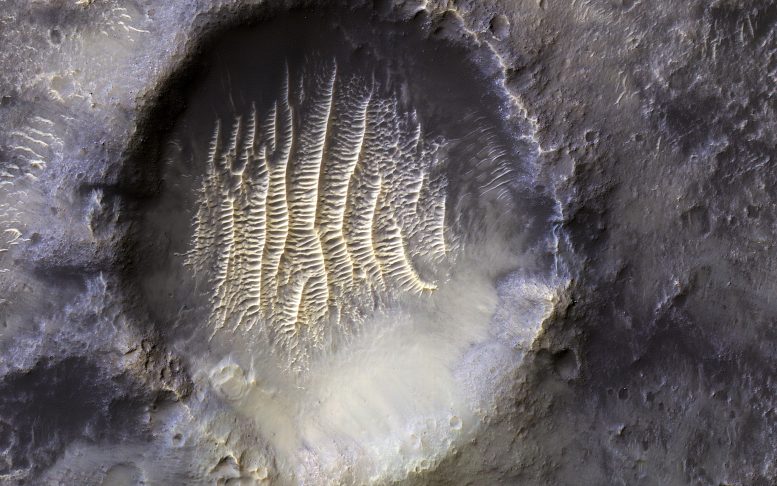
Image (Credit): Martian crater Airy-0. (NASA/JPL-Caltech/University of Arizona)

This week’s pic is an eerie crater within the Airy Crater on Mars that marks an important spot – 0° longitude on Mars. You can see this position of this smaller crater, Airy-0, within the larger crater below. NASA posted this image on Instagram with a few more details:

The larger crater that sits within this crater, called the Airy Crater, originally defined zero longitude for Mars, but as higher resolution photos became available, a smaller feature was needed. This crater, called Airy-0 (zero) was selected because it did not need to adjust existing maps.

This image was captured by the High-Resolution Imaging Science Experiment (HiRISE), on the Mars Reconnaissance Orbiter. The map is projected here at a scale of 50 centimeters (19.7 inches) per pixel.

The Airy Crater is names after Sir George Biddell Airy, the 7th Astronomer Royal, in 1850.

Image (Credit): Martian crater Airy. (Wikimedia Commons)

Pic of the Week: Mars InSight Lander

Image (Credit): Mars InSight lander on the Martian surface. (NASA)

NASA recently shared an image showing the accumulation of Martian dust on the solar panels of the Interior exploration using Seismic Investigations, Geodesy, and Heat Transport (InSight) Mars lander. The photo above was taken on April 24, 2022.

The Mars Insight lander was launched May 5, 2018 to study the interior of Mars. The lander already accomplished its primary mission and has been on extended mission. It has detected more than 1,300 marsquakes. However, as a result of the dust buildup, the mission is expected to end this summer.

In the NASA news release, Lori Glaze, director of NASA’s Planetary Science Division, stated:

InSight has transformed our understanding of the interiors of rocky planets and set the stage for future missions…We can apply what we’ve learned about Mars’ inner structure to Earth, the Moon, Venus, and even rocky planets in other solar systems.

You may recall an earlier posting about Martian dust and its impact on another mission.

The Little Martian Helicopter that Could

Image (Credit): The Martian Ingenuity helicopter. (NASA)

The Washington Post recently posted a story about the great success and potential demise of NASA’s Ingenuity helicopter that accompanied the Perseverance Rover to the surface of Mars last year. It has already lasted for more than a year flying multiple missions, yet it may not make it through the Martian winter given the accumulation of dust on its solar panels.

The article, “NASA’s Mars helicopter was supposed to fly five times. It’s flown 28,” quotes Lori Glaze, the director of NASA’s planetary science division, who states, “We built it as an experiment…So it didn’t necessarily have the flight-qualified parts that we use on the big missions like Perseverance.” What an experiment it has been, setting the stage for bigger and bolder missions in the future to help us better understand the Martian surface.

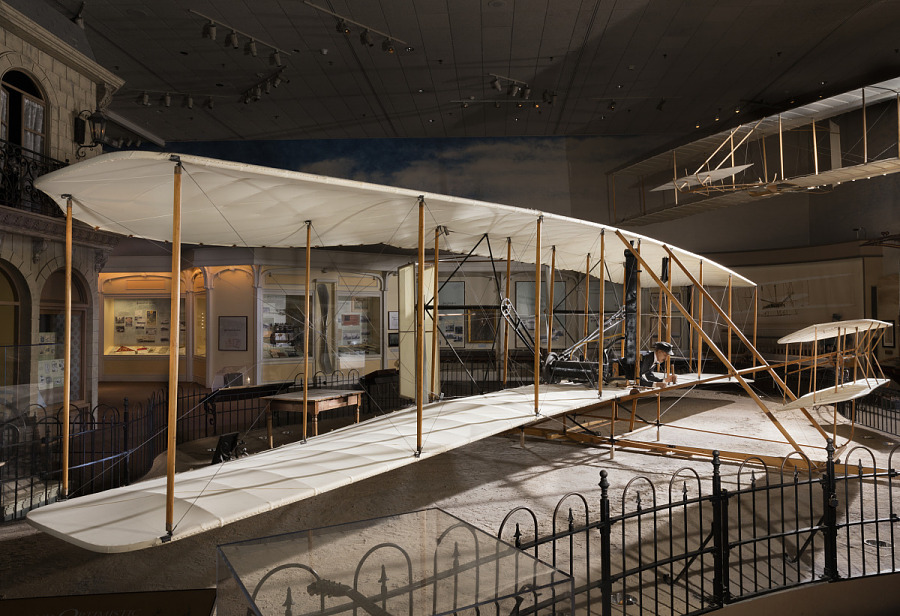
You will also read about one symbolic piece of material that is part of the little helicopter – a postage-size piece of fabric from the Wright Brothers’ aircraft the Flyer (see below). I wonder what the Wright Brothers would think of this first flight on a distant planet?

You can read much more about Ingenuity’s adventures here

Image (Credit): 1903 Wright Flyer at the Smithsonian Institution National Air and Space Museum. (Smithsonian photo by Eric Long)

Growing Options in Moon Dust

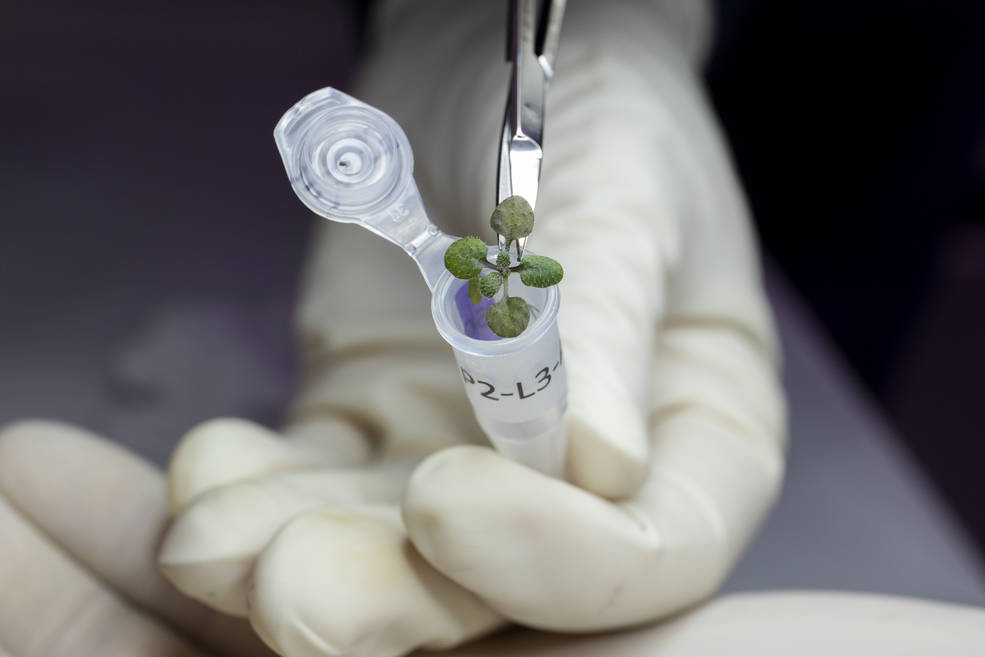
Image (Credit): Placing a plant grown during the experiment in a vial for eventual genetic analysis. (UF/IFAS photo by Tyler Jones)

Speaking of moon dust, it seems scientists have found that they can grow plants in lunar soil. This is quite a surprise given the nature of moon dust. It would seem to be an even greater feat than growing plants in Martian soil.

NASA has reported that scientists at the University of Florida have successfully grown plants in actual lunar soil from the Apollo 11, 12, and 17 missions. Only water and a nutrient solution were added to the soil before seeds were planted. Plants started to sprout in two days. After 20 days the plants were harvested and studied before they had started to flower. While the lunar soil plants were somewhat stunted and stressed, the experiment was a success.

NASA noted:

This research opens the door not only to someday growing plants in habitats on the Moon, but to a wide range of additional questions. Can understanding which genes plants need to adjust to growing in regolith help us understand how to reduce the stressful nature of lunar soil? Are materials from different areas of the Moon more conducive to growing plants than others? Could studying lunar regolith help us understand more about the Mars regolith and potentially growing plants in that material as well? All of these are questions that the team hopes to study next, in support of the future astronauts traveling to the Moon.

This is a fascinating finding if it will allow us to use the lunar surface to feed astronauts rather than bringing more material from the Earth. It is also very timely as NASA is preparing the way for human habitation on the Moon under the Artemis Program.

We wanted to learn from the Moon before pushing onto Mars. This is a clear sign that we are doing so.