Mars Sample Return: Do You Have Comments?

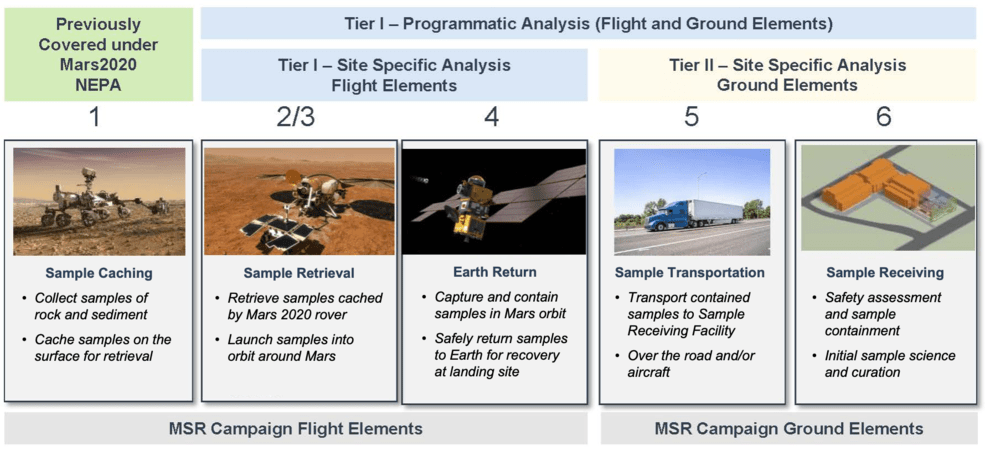
Image (Credit): Mars Sample Return campaign poster. (NASA)

NASA and the European Space Agency are still looking for comments on the process to return Martian rock samples to Earth. Of the six steps needed to collect and return the samples (see graphic above), only the first step is currently underway with the Perseverance Rover exploring Mars. Now we need to get those samples home. You have until May 15th to get comments back to NASA on this.

And what is the time frame for getting these samples back to Earth? The current goal is 2033, assuming all goes well. You may recall that China also wants to collect and return Martian samples by 2030. I expect more delays on both sides. When you add this to the race back to the Moon, the space race is getting more interesting every day.

Space Quote: The End of Astronauts?

Credit: Belknap Press/Harvard University Press

“We should not have publicly funded programmes to send people to the moon, still less to Mars…It’s hugely risky, hugely expensive, and there’s no practical or scientific benefit to sending humans. It’s a pretty bad bargain for the taxpayer.”

-Statement by Lord Martin Rees, co-author of the book The End of Astronauts, speaking to the The Guardian. He argues that private sector humans and government robots are the future of space exploration. In other words, let billionaires die space, while the government avoids this risk. Harvard University Press states:

In The End of Astronauts, Goldsmith and Rees weigh the benefits and risks of human exploration across the solar system. In space humans require air, food, and water, along with protection from potentially deadly radiation and high-energy particles, at a cost of more than ten times that of robotic exploration. Meanwhile, automated explorers have demonstrated the ability to investigate planetary surfaces efficiently and effectively, operating autonomously or under direction from Earth. Although Goldsmith and Rees are alert to the limits of artificial intelligence, they know that our robots steadily improve, while our bodies do not. Today a robot cannot equal a geologist’s expertise, but by the time we land a geologist on Mars, this advantage will diminish significantly.

You can read an excerpt from the book at Slate.

Not the Remains of a UFO (Really!)

Image (Credit): Remains of the parachute and backshell used to get NASA’s Perseverance rover on Mars. (NASA/JPL-Caltech)

If you came across the wreckage above if your back yard you might think of a UFO or even Martians. Yet instead it is the remains of Earthlings on Mars.

The image comes from a little helicopter launched from NASA’s Perseverance rover on Mars. The Ingenuity Helicopter spotted the remains of the components used to bring the Perseverance rover to a safe landing on Mars last year. Here is more from NASA:

In the images of the upright backshell and the debris field that resulted from it impacting the surface at about 78 mph (126 kph), the backshell’s protective coating appears to have remained intact during Mars atmospheric entry. Many of the 80 high-strength suspension lines connecting the backshell to the parachute are visible and also appear intact. Spread out and covered in dust, only about a third of the orange-and-white parachute – at 70.5 feet (21.5 meters) wide, it was the biggest ever deployed on Mars – can be seen, but the canopy shows no signs of damage from the supersonic airflow during inflation. Several weeks of analysis will be needed for a more final verdict.

It makes me wonder about all the other debris spread across the martian surface. Martian winds will most likely cover much of the debris with time, unlike the surface of our Moon where the artifacts are likely to be apparent for a long time. You can see the impact of dusk on the Chinese Martial rover in an earlier story.

Image (Credit): Another view of the parachute and backshell used to get NASA’s Perseverance rover on Mars. (NASA/JPL-Caltech)

Pic of the Week: Martian Eclipse

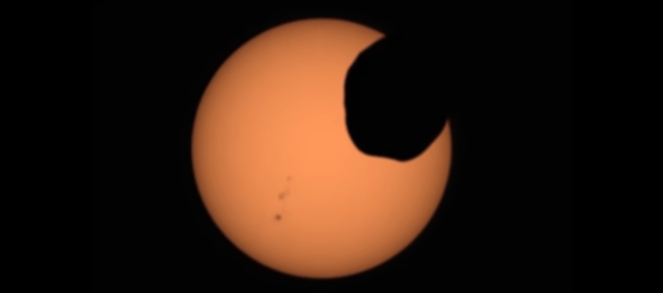
Image (Credit): Eclipse of the Sun by Phobos from the surface of Mars. (NASA/JPL-Caltech/ASU/MSSS/SSI)

This week’s pic is actually a video from NASA’s Perseverance Mars rover capturing Phobos as it partially blocks out the sun. You can see the video here and read more from NASA here.

It is certainly more dramatic than the two shots below from the Martian rover Opportunity in 2004. Deimos is just a speck within the image on the left.

Image (Credit): Eclipse of the Sun by Deimos (left) and Phobos (right) from the surface of Mars. (NASA/JPL/Cornell)

Canada Wants its Own Space Force

Credit: Canadian Space Agency.

It was only a matter of time. Canada wants to develop its own version of the US Space Force later this year. According to media reports, the Canadian Space Division would eventually employ about 270 people, versus about 16,000 in the US program.

The two nations are not alone. A quick check on Wikipedia shows space forces in numerous countries, from Italy to Peru, though the definition of “space force” is pretty wide.

Even with their growth, not everyone is a fan. The Cato Institute had this to say in its 2020 report, Space Force: Ahead of Its Time, or Dreadfully Premature?:

This investigation determines that the Space Force’s establishment is hobbled by unclear goals and uncertain effects, contending that the Space Force lacks a clearly defined organizational culture and a clear strategic purpose, both core elements of organizational success, and that the decision to create the service is premature at best and irresponsible at worst.

Not a ringing endorsement, but maybe a sign that some more thinking needs to go into the role of these new organizations. Yet just as the air force was a natural break away from the army, the space force is a natural offspring of the air force. What comes after that? Maybe a Lunar Force or a Martian Force when we start to occupy space. I would love to see those recruitment videos.

Image (Credit): Image from a US Space Force recruitment video. (USSF)