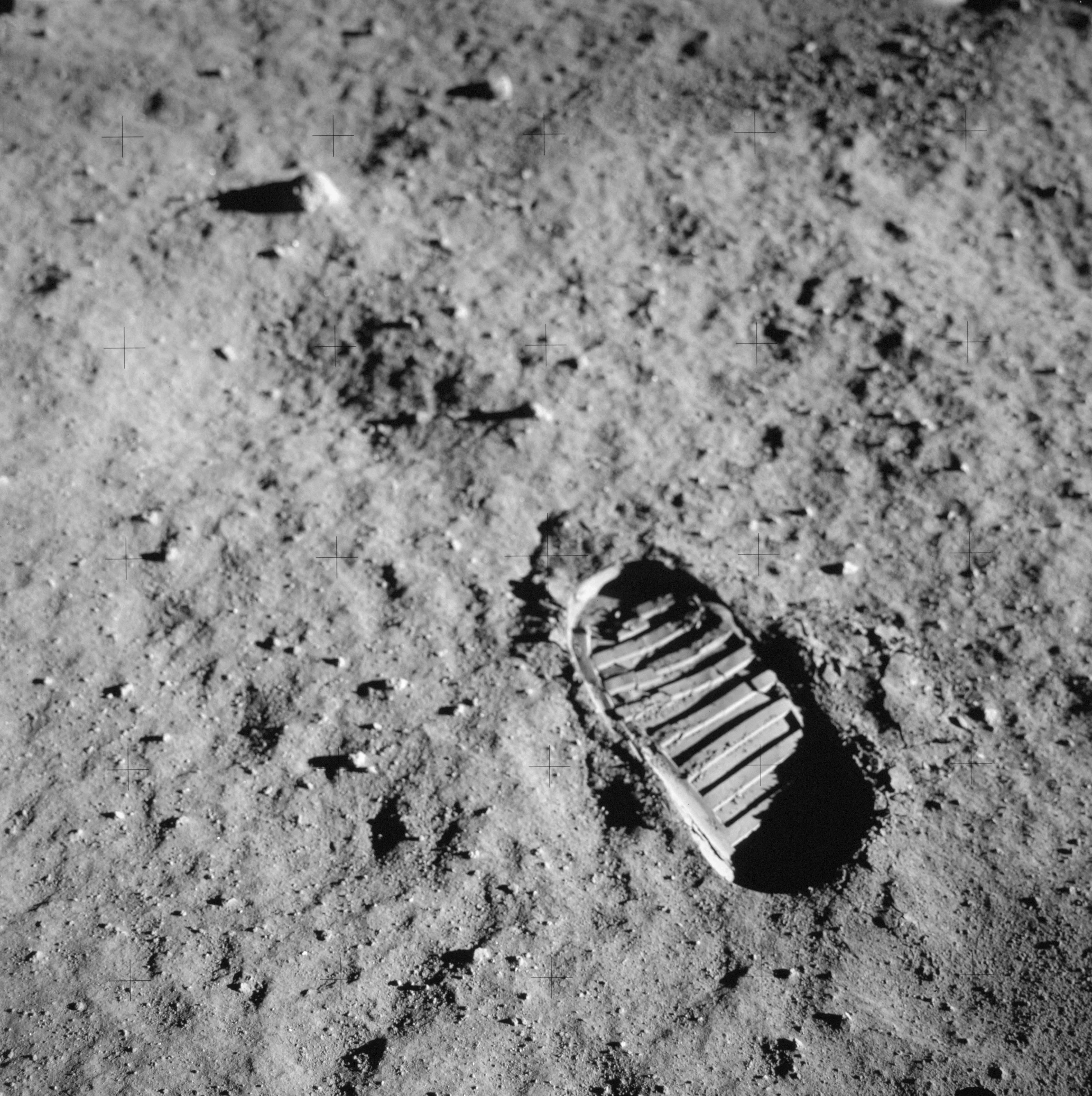
Image (Credit): An astronaut’s bootprint in the lunar soil from the Apollo 11 mission.(NASA)
Multiple Choice: Which statement below is NOT TRUE about the Moon?
A. Lunar dust smells like a chemical solvent. B. Some craters on the Moon are colder than the surface of Pluto. C. The Moon has an atmosphere. D. The Moon orbits the Sun rather than the Earth.
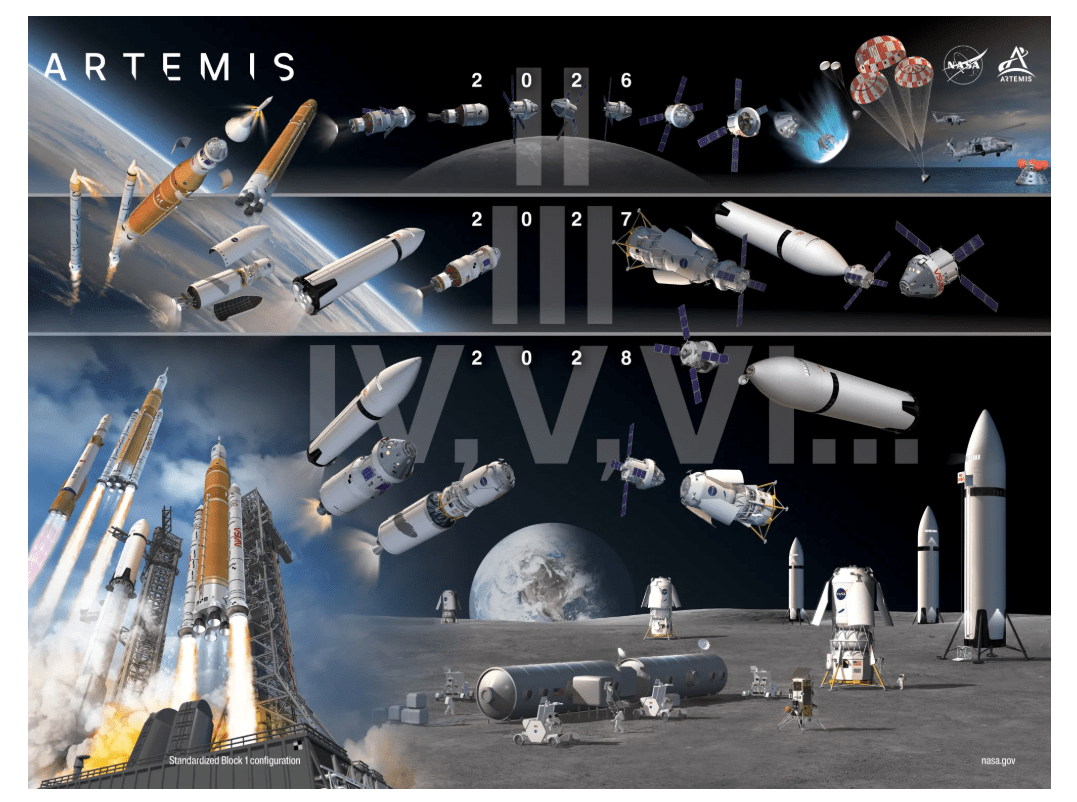
Image (Credit): NASA’s February 2026 somewhat confusing graphic that seems to indicate we will either be on the Moon by 2028 or simply orbiting around the Moon and thinking about it for years to come. (NASA)
So what is the latest? Let’s start with the Moon mission in today’s post. According to a new set of initiatives released this week, the idea of a permanently crewed lunar base, or even a base that can be used for two months at a time, is moving further into the future. The whole theme appears to be “ignition,” but not “arrival,” mind you.
Here are the new plans:
Phase One: Build, Test, Learn: NASA shifts from bespoke, infrequent missions to a repeatable, modular approach. Through CLPS (Commercial Lunar Payload Services) deliveries and the LTV (Lunar Terrain Vehicle) program, the agency will increase the tempo of lunar activity, sending rovers, instruments, and technology demonstrations that advance mobility, power generation (including radioisotope heater units and radioisotope thermoelectric generators), communications, navigation, surface operations, and a wide range of scientific investigations.
Phase Two: Establish Early Infrastructure: With lessons from early missions in hand, NASA moves toward semi‑habitable infrastructure and regular logistics. This phase supports recurring astronaut operations on the surface and incorporates major international contributions, including JAXA’s (Japan Aerospace Exploration Agency) pressurized rover, and potentially other partner scientific payloads, rovers, and infrastructure/transportation capabilities.
Phase Three: Enable Long‑Duration Human Presence: As cargo‑capable human landing systems (HLS) come online, NASA will deliver heavier infrastructure needed for a continuous human foothold on the Moon, marking the transition from periodic expeditions to a permanent lunar base. This will include ASI’s (Italian Space Agency) Multi-purpose Habitats (MPH), CSA’s (Canadian Space Agency) Lunar Utility Vehicle, and opportunities for additional contributions in habitation, surface
Phase One makes sense – let’s keep trying. You may remember the various commercial lunar missions in recent years that have faced severe issues on or around the Moon. For instance, we had:
The Peregrine Mission One mission never made it to the Moon due to a propellant leak, so it just floated off into space.
The Odysseus lunar landertipped over upon landing on the lunar surface, preventing it from completing its mission.
What worries me is that the past could be a predictor for the future. Other than Blue Ghost, NASA and the commercial sector have little to brag about. If this continues, how long do we wait? Is the commercial sector even ready for this new work and expected pace?
Phase Two is talking about agreements with Japan at a time that NASA’s credibility with any of its partnerships is questionable given the attitude in the White House. For instance, since 2022 Japan has been a partner in the Lunar Gateway project that the White House tried to kill last year and NASA has now paused (or more likely killed) this week. Such actions do not build confidence between the two space programs, nor the space programs of other nations also assisting with the Lunar Gateway. Also, what does it mean to live in semi‑habitable infrastructure? That is a semi-scary term. Do they mean “semi-permanent” infrastructure?
Phase Three assumes the successful creation of a HLS by SpaceX and Blue Origin, but the companies do not have a lot of time to create simpler landing craft for Artemis III, iron out their bugs, and maybe even completely scrap their current multiple rocket refueling design. Moreover, these simpler models are expected to expand into the full HLS models. So what does that mean in terms of getting actual astronauts on the Moon for Artemis IV and cargo thereafter?
NASA notes that the simpler landing systems will not only need to be created for the Artemis III low Earth orbit test in 2027, but then those companies have to also prove that they can safely land whatever they create on the lunar surface without a crew before Artemis IV in early 2028. We are asking this of two companies that have never done anything like this. SpaceX is still playing with its Starship after all of his promises that it would be much further ahead by now. SpaceX has not even had a launch test in the past six months. Again, is it any surprise if the public’s confidence is waning?
Finally, a new timeline interlaced with the Artemis timeline would be nice. My fear is that all of this complexity and busy work means we will be arriving on the Moon after the Chinese have set up camp. Having some clear dates aligned with the phases above would help to alleviate this concern.
If you thought last season of For All Mankind was hair-raising with the disasters and battles on Mars, wait until you see what happens this season.
This trailer from Apple TV gives you a taste of the drama coming to your television on March 27th. We see the return of many of our favorite characters (those who survived) as well as a few new ones.
The season picks up years after the “Martians” hijack an asteroid intended for Earth, thereby giving the Martian economy plenty of mining revenue. Apple TV states:
Happy Valley has grown into a thriving colony with thousands of residents and a base for new missions that will take us even further into the solar system. But with the nations of Earth now demanding law and order on the Red Planet, friction continues to build between the people who live on Mars and their former home.
It did not take long for the new Martians to seek independence. We may want to keep that in mind as we continue to allow Mr. Musk to be the spokesperson for the colonization of Mars. He does not play well with others on this planet, so good luck with him running the show on Mars.
Anyway, the series offered plenty of ideas regarding a space race for a lunar base followed by a space race for Mars. The only odd part of this series is that while the USSR and North Korea are present on Mars, we hear almost nothing about China and its space program.
As NASA contemplates a whole new approach to the Moon and Mars (as highlighted just today), it’s fun to watch a show where the space travel timetable is faster and the private sector is more engaged with its own separate mission to Mars. Again, I can picture this happening with SpaceX, where Blue Origin takes the lead on the Moon and Musk takes all of his marbles so he can proceed to Mars on his own.
One thing we can bet on with our expansion into space, regardless of the timetable, is that mankind’s foibles will be front and center in any of these space missions. The hardware issues will be easy to solve compared to dealing with the egos and emotions of space-bound humanity.
In the meantime, while we await the real thing, sit back and enjoy Apple TV’s version of our future in space.
Note: Apple TV announced earlier today that the sixth season of the series will be the last.
“Rimae Bode is a high-priority ‘sweet spot…Think of it as a prime piece of lunar real estate: its location near the equator provides much flatter, safer terrain for landing, along with constant sunlight for power [during the lunar day] and a direct line of sight to Earth for easy communication.”
-Statement by Jun Huang, a planetary geologist at the China University of Geosciences in Wuhan, discussing a potential landing site for the Chinese crewed Moon mission, as quoted by Scientific American magazine. He is co-author of a new study, Geology of Rimae Bode Region as Priority Site Candidate for China’s First Crewed Lunar Mission, published in Nature Astronomy.



 Our Awesome Universe