“It’s not like they’re writing the show and then having to come up with, ‘Oh, how to end this?’…This is a 40 episode story. So the ending… is very satisfying because it’s the end of a novel.”
–Statement by actor Ashley Zukerman, who plays Daniel Keene in the Silo television series, regarding the fourth and final season of the series coming out on July 9, 2027. If you missed the series, particularly season three, it is a show you need to watch. We talk about living in lava tubes on the Moon or Mars, but this show is about living in an underground silo for generations here on Earth after some pretty horrible terra-forming above. You can catch it on Apple TV.
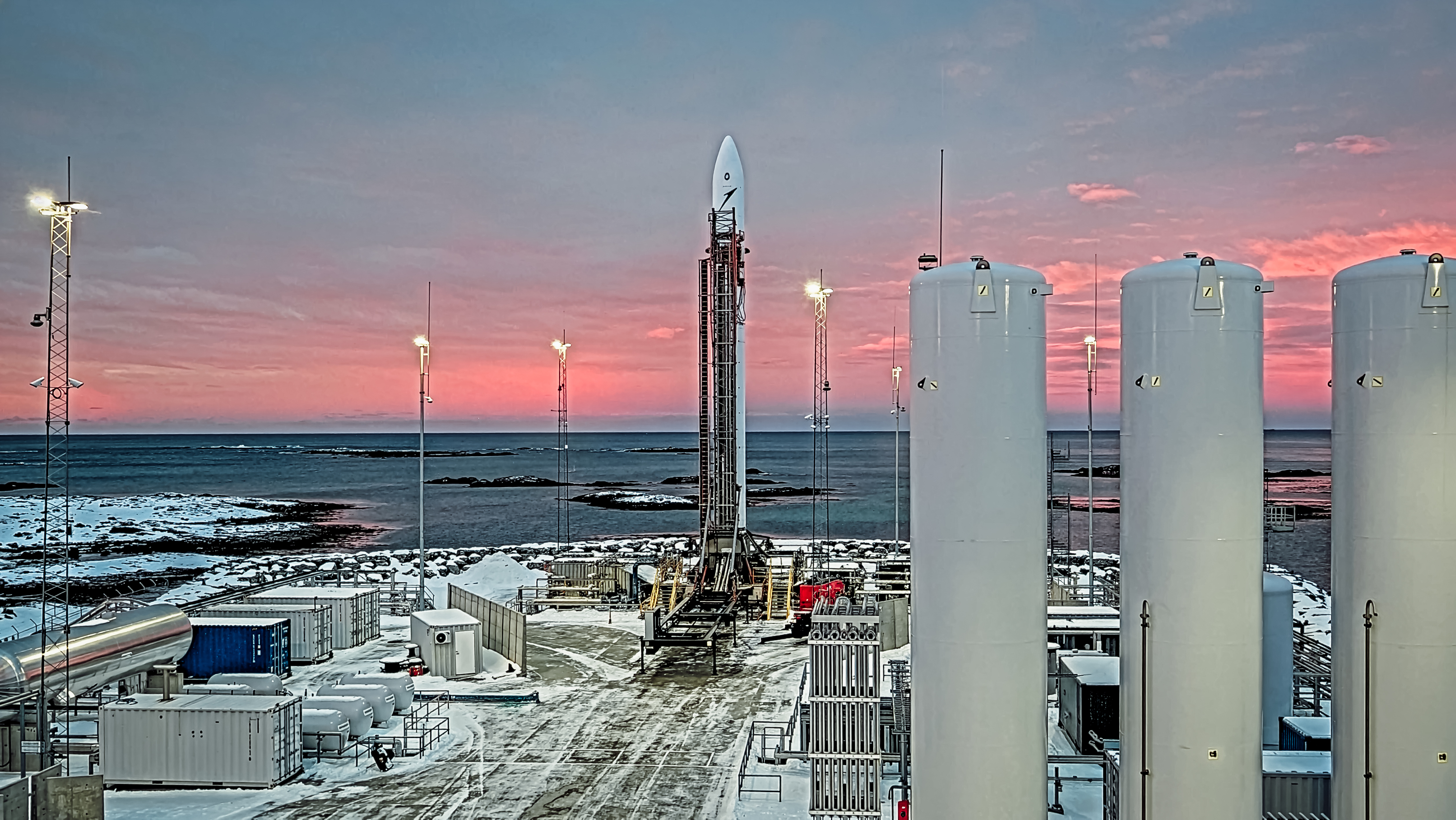
German rocket maker Isar Aerospace successfully reached orbit for the first time over the weekend, marking a milestone for Europe’s commercial space industry as the company looks to ramp up launches to meet what it says is booming demand. The Munich-based company’s Spectrum rocket reached orbit on Saturday and successfully deployed its payloads in low Earth orbit, an achievement that came on only its second test flight. Chief Commercial Officer Stella Guillen told CNBC on Monday that the company was now focused on scaling production, saying the space industry was “desperate” for additional launch capacity and that Isar had a pipeline worth more than 10 billion euros ($11.6 billion).
It is thought the Sun may have engulfed a super-Earth-sized planet early in its history. Now a new study has gone a step further by suggesting that such an event may have left behind detectable clues inside our star which could still be visible today. This idea of a measurable signature or ‘fingerprints’ in the present-day solar interior was explored by research published today in Monthly Notices of the Royal Astronomical Society. Professor Mutlu Yildiz, of Ege University in Turkey, said: “Our new study suggests that a planet several times more massive than Earth may have fallen into the young Sun and left a lasting chemical imprint deep inside it.
Some countries and even wealthy individuals are setting their sights on the Moon with ambitious plans to create a lunar colony. That would require a lot of resources launched from Earth, but how much water and power would be required to keep a lunar city going?…Even assuming one billion tonnes of water on the Moon, if nothing was recycled then a city of a million would last only a few years while a population of 100 000 would run for 20 years before running dry. Even when recycling the water with an efficiency of 98% – as performed on the International Space Station – a city of a million would only have enough water for around a century.
Image (Credit): The Artemis II crew with (from left) NASA Astronauts Christina Koch, Victor Glover, Reid Wiseman, Canadian Space Agency Astronaut Jeremy Hansen. (NASA)
Four astronauts circled the Moon earlier this year, more than 50 years after the final lunar landing, but only one of them will remain an astronaut going forward. Canadian astronaut Jeremy Hansen (age 50), who served as mission specialist on the Moon mission, retired from his position with the Canadian Space Agency in July. And now we learn that NASA astronauts Reid Wiseman (age 50), who served as commander on the mission, and Victor Glover (age 50), who served as pilot, have also announced their plans to depart as well.
Either there is something in the water, or age 50 is a good time to step away from an astronaut gig.
Hansen said he was pursuing new professional opportunities, Glover said he has a new job at California Polytechnic State University, and Wiseman provided no additional information. However, both Glover and Wiseman will transition to emeritus status. It is not clear if that is just a thank you role that gives them a discount at the agency cafe, or will entail some real duties.
NASA defines the emeritus role this way:
In an emeritus role, individuals with a high degree of technical and professional knowledge can continue to support the agency by donating their time to train and mentor the current workforce. This allows the agency to maintain access to top talent in a specialized consultant role, while simultaneously providing the individual with the flexibility to pursue other opportunities.
That leaves one Artemis II astronaut still standing – Christina Koch (age 47).
Back in August, all four were awarded the Congressional Space Medal of Honor at Houston’s Johnson Space Center. It is just unfortunate the they are leaving at a time that a lunar program is starting to grow.
All we can do is wish them well in their post-astronaut careers. They have plenty of stories that will hopefully encourage a new generation of astronauts.
Note: I want to make it clear that NASA astronauts do not need to retire at a certain age. For example, NASA astronaut Don Pettit was heading back to Earth from his latest space mission on his 70th birthday.
NASA has decided to use a simpler spacesuit for its initial missions to the lunar surface, Ars has learned. The agency announced the decision during an internal meeting this week as it seeks to accelerate its program to land humans at the south pole of the Moon as early as 2028. At the direction of Artemis Program Manager Jeremy Parsons, NASA will work with Axiom Space to develop a “Sortie Suit” variant of the planned spacesuit for the lunar surface. Sources said the Sortie Suit will be used for the initial landing missions flown on landers developed both by SpaceX and Blue Origin. Among the goals of the initiative are to lower the mass of the spacesuit, reduce its complexity, and simplify interfaces between the spacesuits and lunar landers.
The driving force behind our universe’s accelerated expansion remains one of the greatest mysteries in astronomy. While this force, which scientists refer to as dark energy, pervades our universe, we know almost nothing about it. Located on a remote mountain in Arizona’s Sonoran Desert, the Dark Energy Spectroscopic Instrument (DESI) has spent the past five years mapping the cosmos with the goal of unraveling this mystery. The result is the largest three-dimensional map of the universe ever created. And now—with the release of the latest version of the DESI Legacy Imaging Surveys, a free online tool for exploring the vast imaging data—you too can poke around the universe.
Over the past three decades, computer models of planetary system formation have gone from fairly crude representations to sophisticated simulations using thousands of different starting points. A paper presented at the Origins 2026 conference in Paris details innovative simulations of how our solar system might have formed without making assumptions about the planetary architecture with which we are so familiar. In his paper, Nader Haghighipour, a planetary scientist at the University of Hawaii in Manoa, argued that his models, unlike previous models, incorporate many completely random starting points and, in turn, let physics drive the models’ ultimate evolution. As a result, these new models are much more complete and allow physics to dictate their outcomes.
The US Department of Justice (DOJ) has reported that the Chinese have been hacking into US government agencies since as early as 2018. One of the targets of the Chinese hacker group, known as QTFY, was NASA.
Among the victims of QTFY computer intrusion activity are the National Aeronautics and Space Administration, Federal Reserve, Department of Energy, Department of Justice, Department of Health and Human Services, National Institutes of Health, and the U.S. Senate.
At this time, the nature of what was taken from NASA and other government agencies was not provided. However, given the importance of the Artemis mission for both national and commercial purposes, it is not hard to believe that Artemis information was part of the hack.
It may be to NASA’s advantage that it has been operating by the seat of its pants for more than a year now. There was no Artemis strategy to steal. In addition, much of NASA’s work is in the hands of the private sector, so that extra layer of protection may have helped.
It is worth noting that many federal agencies were spending last year fighting off internal hackers from the US Department of Government Efficiency (DOGE), which did great damage across the federal government.
The Chinese efforts have been detected and ended. I am not sure you can say the same thing about DOGE.