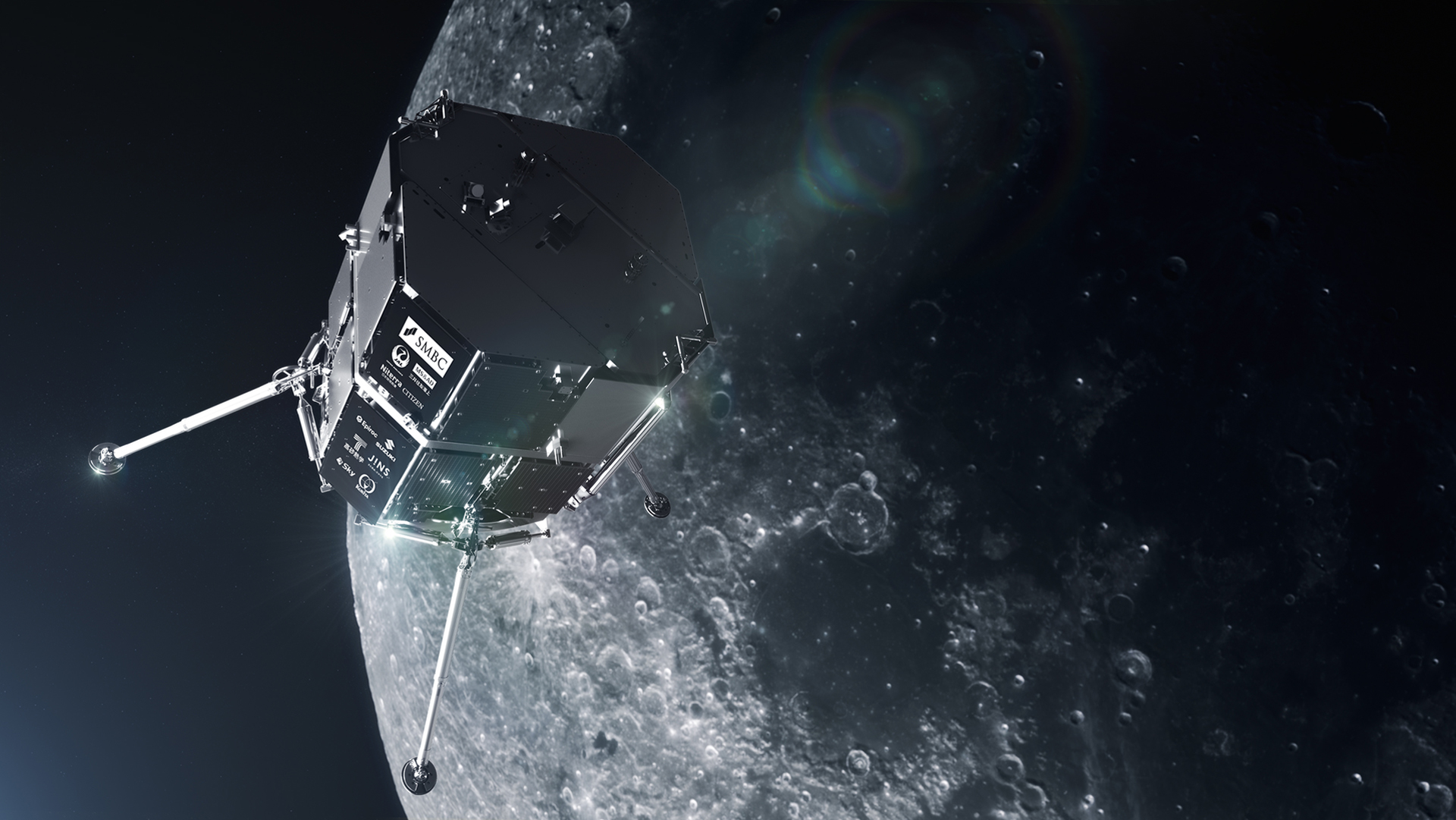
Image (Credit): Artist’s rendering of the Resilience lunar lander approaching the moon. (ispace)
“Given that there is currently no prospect of a successful lunar landing, our top priority is to swiftly analyze the telemetry data we have obtained thus far and work diligently to identify the cause.”
-Statement by Takeshi Hakamada, CEO and founder of Japan’s private space company ispace, in a press release following the failure of the company’s second lunar lander mission to the Moon. The company noted that the lander experienced a “hard landing” when it failed to sufficiently decrease its speed on approach. The mission started back in January when a SpaceX Falcon 9 rocket carried both this mission as well as Firefly Aerospace’s Blue Ghost, which had a successful landing on the lunar surface. The ispace lander was named Resilience – something it will need more of to stay in the space race.
A total of 41 science projects would get the ax under the proposal, which would be NASA’s biggest single-year cut in the agency’s history, according to the Planetary Society. Many of the science missions President Donald Trump looks to cancel are still in development, while others are extended operations with uncrewed vehicles already deployed to orbit. Here’s a look at six different types of space missions, from Mars exploration to future moon landings, that could be under threat if Trump’s budget were to go into effect.
President Donald Trump wants to decimate NASA’s climate research capacity. That could ultimately disrupt multiple sectors of the economy, writes Scott Waldman. In the White House budget documents released last week, Trump proposed slashing a quarter of NASA’s funding, specifically targeting the agency’s research on climate change. But many of NASA’s instruments that track human-caused climate change provide other critical data. The agriculture industry, for example, relies on satellites and instruments that not only track climate change but also keep tabs on shifts in climatic zones that affect plant growth. Trump wants to eliminate funding that keeps those tools operational.
NASA is being directed to phase out multibillion-dollar programs, managed from its flagship center in Huntsville, that are designed to ferry people to and from the moon…Eliminating SLS and Orion will, “[pave] the way for more cost-effective, next-generation commercial systems that will support subsequent NASA lunar missions,” according to budget documents. Both are key programs for Marshall Space Flight Center, one of the largest of NASA’s 10 field centers, which employs nearly 7,000 federal workers and contractors in Huntsville and manages a multibillion-dollar budget related to human spaceflight.
If you have not heard of the Atlantic Council you are not alone.
The Atlantic Council defines itself defines itself as a nonpartisan organization that is “…an essential forum for navigating the dramatic economic and political changes defining the twenty-first century by informing and galvanizing its uniquely influential network of global leaders.”
So what does it have to say about the current state of the US space program? It seems to want more robots, artificial intelligence, and virtual reality. It also claims China is moving in this direction.
In a recent article, the Atlantic Council proposed the following to improve the space program for this century:
Modernize NASA’s organizational structure by integrating the robotic and human initiatives;
Reformulate NASA’s Artemis campaign by changing its plan so that early flights are robotic, with work and preparations being performed by intelligent machines ahead of crewed missions; and
Equip lunar robots with virtual reality so intelligent space exploration machines could enable scientists, engineers, and others on Earth to become active participants in the exploration of the Moon, distant planets, and beyond.
Fortunately, the article is not recommending the removal of humans from space flight, but rather the use of technology to enhance these missions, reduce overall costs, and broaden public and scientific support. This would include the expansion of private sector involvement. It’s not a bad idea as NASA struggles with the Artemis mission and potentially other missions due to budget cuts.
Of course, the amazing telescopes that we are trying to maintain and expand upon are already top of the line technology that have expanded public support for astronomy, but this has come at great cost (exceeding cost projections) and has not been protected from budget cuts.
A mix of approaches sounds fine, but a reliable flow of funds with clear expectations also sound nice. We are not going to get that with this White House based upon what we have seen so far. Just finding a leader for NASA that is palatable to the White House is proving impossible.
New ideas should always be welcome, but what is really essential at the moment is stable leadership. Without that all other efforts will go nowhere.
Image (Credit): Side-by-side illustrations of the SpaceX Starship lunar lander and the Blue Origin Blue Moon lunar lander. (SpaceX/Blue Origin)
Elon Musk may be in a rush to get to Mars, if only to escape all of the chaos he is causing here on Earth, but he is going nowhere fast with his Starship. Today’s ninth test launch of the rocket ended with the explosion of its first-stage booster as well as the rocket itself during re-entry. While this is better than the last two launches, it still demonstrates that the rocket has a ways to go before it can be used for Moon missions, leaving aside any talk about Mars.
SpaceX loves to play with language (particularly when regulators are around), so it called this a “rapid unscheduled disassembly” once again. That said, the humor is getting thin.
Mr. Musk said he is back to his jobs at Tesla and SpaceX, so let’s hope he can get a handle on this rocket. I don’t really care about the cars – Tesla has already been superseded by other car companies – but SpaceX is important to the US space industry.
It is also time for Mr. Musk to stop over-promising on everything (though I am glad he was dead wrong about DOGE savings). The focus needs to be the Moon. Forget Mars for now.
By the way, DOGE has also done damage to future Mars missions by cutting funding and staffing at the Astrogeology Science Center in Flagstaff, Arizona. The Center would be critical to finding a safe landing site on Mars for one of Musk’s rockets.
You don’t poke out your eyes and then hope to make progress, but that is what is happening these days.
Note: It seems the term “rapid unscheduled disassembly” precedes Mr. Musk, as this link explains.
Image (Credit): Former NASA engineer Ed Smylie. (Bill Stafford/NASA)
Last month, former NASA engineer Ed Smylie passed away at the age of 95. He is best known for his efforts leading a NASA team that saved the Apollo 13 crew after the capsule experienced the onboard explosion of an oxygen canister. His quick efforts saved the crew, allowing them to return home safely. You can see it all in color by watching the film Apollo 13.
Mr. Smylie left Douglas Aircraft Company and joined NASA after President Kennedy made it clear that the nation would put a man on the Moon. Luckily, he was there at NASA when he was needed.
In a 1999 interview about his efforts to save the Apollo 13 mission, he was very self-effacing about his role in the entire effort:
It was pretty straightforward, even though we got a lot of publicity for it and [President Richard M.] Nixon even mentioned our names. I always argued that that was because that was one you could understand nobody really understood the hard things they were doing. Everybody could understand a filter. I said a mechanical engineering sophomore in college could have come up with it. It was pretty straightforward. But it was important.
You can also read more on Mr. Smylie’s life and career at these sites:





 Our Awesome Universe