Image (Credit): The arrow indicates the impact site for ispace’s Resilience lunar lander, as seen by the Lunar Reconnaissance Orbiter Camera on June 11, 2025. (NASA/Goddard/Arizona State University)
It doesn’t look like much, but NASA’s Lunar Reconnaissance Orbiter recently spotted the small crater made by the crashed ispace lunar lander named Resilience. The Japanese lander crashed on the Moon’s surface earlier this month after the company’s second try at a lunar landing.
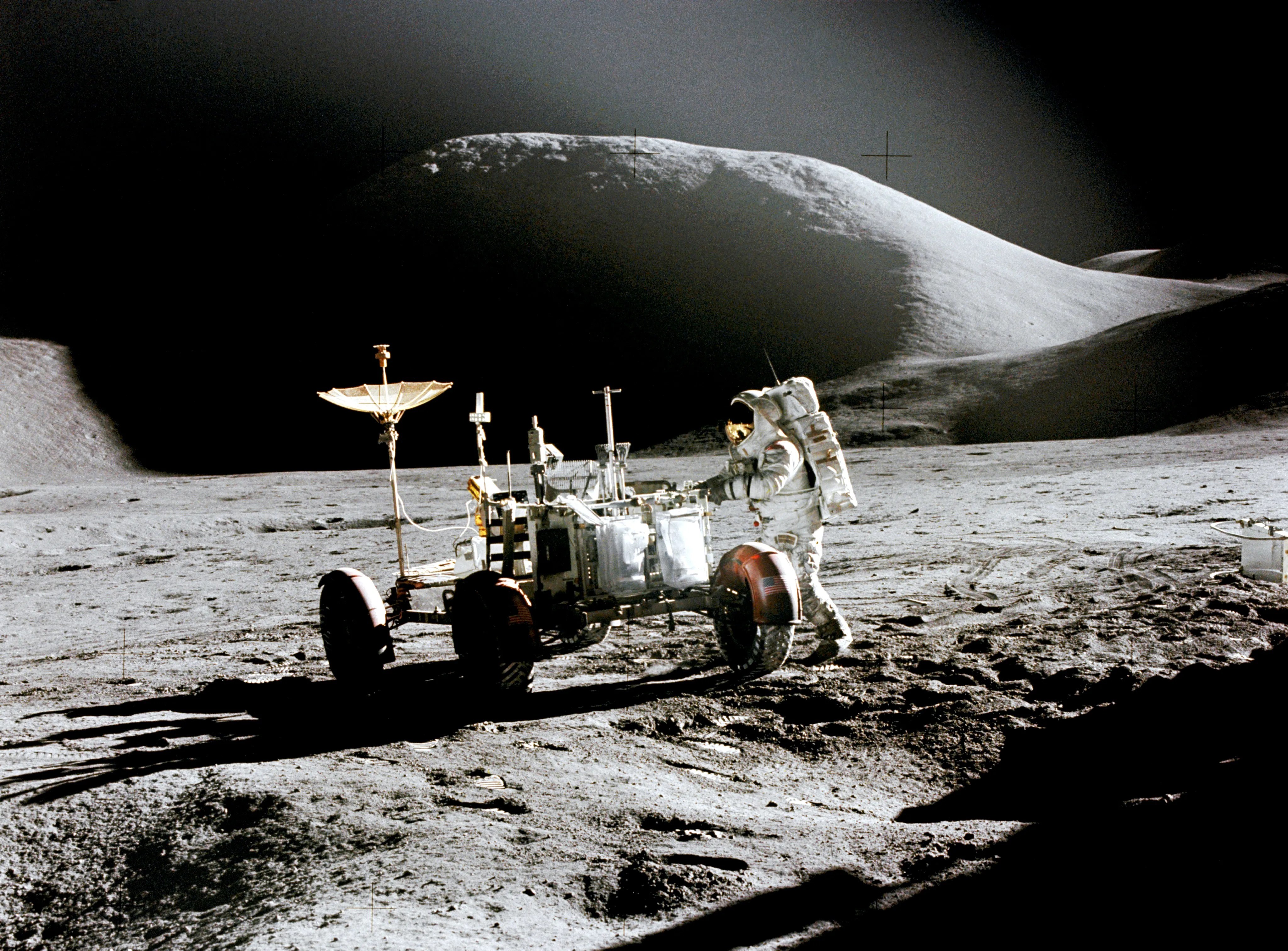
The Moon is littered with debris and pockmarks from various successful and failed missions. The Apollo crew alone left enormous amounts of trash, debris, and space equipment scattered around the Moon. The Russians also left quite a bit of space equipment on the Moon many years ago, as well as its most recent Luna-25 mission, which crash-landed.
We can only hope that the Artemis mission will soon enough be adding to the equipment on the Moon without the drama of crash landings.
Image (Credit): The explosion of a Starship rocket during testing at the Brownsville, Texas Starbase on June 18, 2025. (LabPadre Space)
As shown in the image above, SpaceX lost one of its Starships yesterday in a massive explosion at the Brownsville, Texas Starbase, making the Moon and Mars seem even farther away. Fortunately, no one was injured during this failed test firing of the Starship 36 rocket engines.
We should expect some problems along the way, but the trend is going backwards for Mr. Musk.
Engineering teams are actively investigating the incident and will follow established procedures to determine root cause. Initial analysis indicates the potential failure of a pressurized tank known as a COPV, or composite overwrapped pressure vessel, containing gaseous nitrogen in Starship’s nosecone area, but the full data review is ongoing. There is no commonality between the COPVs used on Starship and SpaceX’s Falcon rockets.
Image (Credit): ValentinaTereshkova just before boarding her Vostok 6 capsule. (NASA)
On this day in 1963, Valentina Vladimirovna Tereshkova from the USSR became the first woman in space. She flew solo on the Vostok 6 for three days. It was her first and last time in space. Her importance as a symbol for women and the USSR meant she would never fly again lest something happen to her.
They forbade me from flying, despite all my protests and arguments. After being once in space, I was desperately keen to go back there. But it didn’t happen.
On this same day in 1977, German-American Wernher von Braun passed away. As the chief designer of the Saturn rockets that took men to the Moon, he was to see all of the Apollo missions before his death.
He is also quoted as saying:
I’m convinced that before the year 2000 is over, the first child will have been born on the moon.
It is unlikely he would have believed that it would be another 50 years before we found our way back to the Moon.
Image (Credit): Braun standing next to the first stage of the Saturn V booster he helped design. (NASA)
Scientists have long assumed the Oort Cloud, one of the most mysterious structures in our solar system, to be spherical. But during the pre-production of their new space show, “Encounters in the Milky Way,” they noticed a strange spiral pattern in the middle of the cloud. The show, which premiered on Monday at New York City’s Hayden Planetarium, featured a computer-generated visualisation of the Oort Cloud on the dome. The team was reviewing the animation when they noticed what appeared to be a spiral structure inside the typically spherical cloud shape.
The ‘city killer’ asteroid 2024 YR4 may not be on a collision course with Earth anymore. But NASA has raised the odds of it hitting the moon in just seven years’ time. According to the space agency, there’s now a 4.3 per cent chance that 2024 YR4 will smash into the moon on December 22, 2032…The impact event would be the first time scientists could watch a known asteroid create a lunar crater in real-time.
SpaceX’s Starlink satellites are leaking radio waves to such an extent that it could threaten our ability to study and understand the early universe, say astronomers. Interference from the thousands of Starlink satellites in orbit, where they provide a global internet service, has been a continuing concern for astronomers, who say that the radio emissions from the craft could affect sensitive telescopes that observe distant, and faint, radio sources. SpaceX has worked with astronomers to try to prevent this interference, by switching off their internet-transmitting beams when they fly over key telescopes, but it turns out that this isn’t enough.
According to the Washington Post, the leaders at NASA and the Department of Defense (DOD) have finally figured out that Mr. Musk is a potential threat to our space program and national security. Now where did they get that idea?
NASA and Pentagon officials moved swiftly this past week to urge competitors to Elon Musk’s SpaceX to more quickly develop alternative rockets and spacecraft after President Donald Trump threatened to cancel Space X’s contracts and Musk’s defiant response.
Why did it take so long? And maybe instead of nagging SpaceX’s competitors, NASA and the DOD need to do more.
Boeing’s Starliner may need some propping up at the moment as an alternative to getting humans to the International Space Station (ISS), and other parties that can assist with the ISS and military satellite launches may need help as well.
Such careful planning should have been done long ago. Compromising NASA is one thing, but putting our nation’s defense in the hands of one unreliable man was foolish from the start. David killed the Goliath represented by the large aerospace companies, but now David has gone mad. Great plan, everyone.
It may be time to consider nationalizing SpaceX if it become an Achilles heel to our nation, particularly if Mr. Musk decides to take all of his marbles and go home (or simply loses all of his marbles).
This reminds me of Russia where President Putin put so much power into the hands of one of his warlords only to see that warlord turn his weapons on Moscow.
I expect things will settle down, but the risk remains. It is time for NASA and DOD to make some clear plans to expand the procurement base and rapidly fund alternatives to SpaceX.
As far as the future of NASA, which is the focus of this website, this is another wrench in the machinery. The White House budget already guts much of NASA’s programs, leaving most of the focus on Artemis, which needs a SpaceX Human Landing System, and Mars, which has been pushed to the front of the line only because of Musk’s influence at the White House.
So now what?
It seems Mr. Musk is not the only party undergoing a rapid unscheduled disassembly.