Bookshelf: The Giant Leap by Caleb Scharf

Credit: Basic Books

If you are looking for a new book to read, you might want to check out The Giant Leap by Caleb Scharf, who is director of astrobiology at Columbia University and the senior scientist for astrobiology at NASA’s Ames Research Center.

Here is a quick blurb from the publisher:

The story of life has always been one of great transitions, of crossing new frontiers. The dawn of life itself is one; so, too, is the first time two cells stuck together rather than drifting apart. And perhaps most dramatic were the moves from the sea to land, land to air. Each transition has witnessed wild storms of innovation, opportunity, and hazard. It might seem that there are no more realms for life to venture. But there is one: space.

In The Giant Leap, astrobiologist Caleb Scharf argues that our journey into space isn’t simply a giant leap for humankind—it’s life’s next great transition, an evolution of evolution itself. Humans and our technology are catalysts for an interplanetary transformation, marking a disruption in the story of life as fundamental as life’s movement from sea to land, and land to sky.

Inspired by Darwin’s account of his journey on the Beagle, and packed with stories from the past, present, and future of space travel, The Giant Leap thrills at both life’s creativity and the marvels of technology that have propelled us into the cosmos. And it offers an awesome glimpse of the grander vistas that wait in the great beyond.

Scientific American magazine interviewed the author to learn more about his views. One of the questions related to settling on Mars, which the author did not view as a best option for expanding outward into our Solar System:

We definitely need to study Mars and the moon, and maybe some of us should even try to live there. I mean, there’s all sorts of genuine reasons for doing that. But in the long term, it’s far better to engineer what you really need—to create environments that place fewer stressors on life that evolved on Earth over four billion years. Even if you build fabulous habitats on the moon or Mars, you’ll never have Earth-normal gravity in those places, for example.

Whether you make use of a natural object such as an asteroid or just construct an entirely artificial habitat out there, both would give you far more options than a planetary surface. You can spin your habitat to get Earth-like artificial gravity; you can engineer a lovely atmosphere that precisely fits our biological needs. You can set up seasons, choose where to orbit and have robust protection from cosmic radiation.

The interview covers a range of questions that delve into parts of the book. You may want to start with the interview before deciding to go further. It is a great launching point.

If at First You Don’t Succeed: Jared Isaacman is Really Back

Image (Credit): Artist’s rendering of Blue Origin’s Blue Moon Mark 1, which is a single-launch, lunar cargo lander. (Blue Origin)

President Trump has had a change of heart on Jared Isaacman, his initial nominee for NASA administrator until he withdrew that nomination earlier this year.

Earlier today, the President posted the following:

Jared’s passion for Space, astronaut experience, and dedication to pushing the boundaries of exploration, unlocking the mysteries of the universe, and advancing the new space economy, make him ideally suited to lead NASA into a bold new era.

So what has changed in the last few months to make Mr. Isaacman “ideally suited” to lead NASA as compared to when he was determine unsuitable? I cannot think of anything other than the end of the President’s feud with Elon Musk. Of course, that was recently replaced with Elon Musk’s feud with acting NASA Administrator Sean Duffy, who proposed reopening competition for the first manned Moon landing this century due to delays with SpaceX’s Starship.

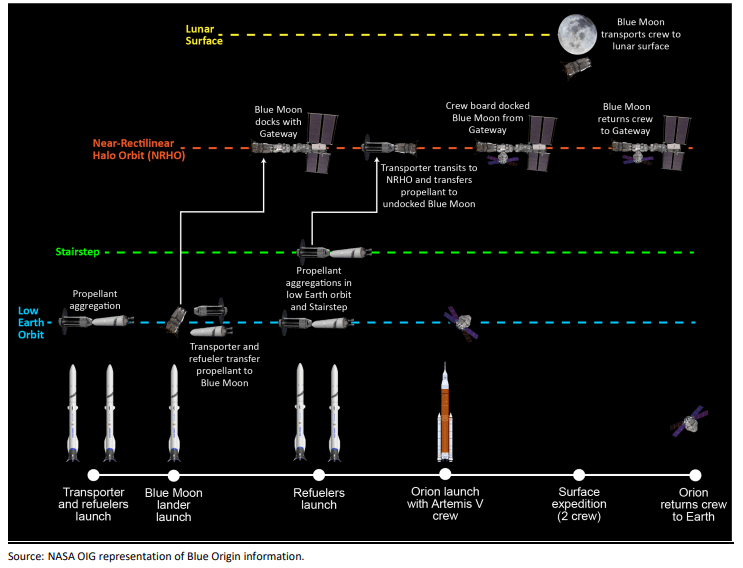
Will Mr. Isaacman save Musk’s Moon mission? He may calm some of the acrimony for the time being, but any new NASA administrator had better have a solid plan to get Americans back on the Moon before China does. Mr. Isaacman may be friends with Mr. Musk, but should he be confirmed he will head a weakened space agency that is struggling with a complex Moon mission that may be much less complex without the Starship refueling plans. In fact, Blue Origin just submitted a new Moon mission plan that drops this refueling altogether.

It is not impossible the winds will shift again, leaving Mr. Isaacman adrift once more. That is how it is in Washington these days. Fickle leadership leads to fickle decision-making and fickle planning.

The Chinese are not having these issues at the moment as they aim to be on the Moon by 2030.

This Should Not Be Necessary: The Acting NASA Administrator Responds

Image (Credit): Apollo 17 commander Eugene Cernan on the surface of the Moon. He was the last US astronaut to walk on the Moon. (NASA)

Acting NASA Administrator had to time time out of his day (or at least a staff member had to) to respond to a dumb comment by, let us say, a less-than-scientifically minded Kim Kardashian. She had earlier shared her doubts about whether the United States ever placed astronauts on the Moon. Of course, it is not an original sentiment, but it does gain traction in this social media age where dumb comments are golden.

Acting NASA Administrator Sean Duffy tweeted out:

Yes, @KimKardashian, we’ve been to the Moon before… 6 times!

And even better: @NASAArtemis is going back under the leadership of @POTUS.

We won the last space race and we will win this one too

I left out the little cartoons of a rocket and an American flag from the tweet, but you get the point.

We can all certainly agree with Mr. Duffy’s first point about the Moon landings, but the matter of the new space race is still up in the air. In that regard, he and NASA still have much more to do.

Maybe Ms. Kardashian can use her influence in a more helpful way by pushing for more NASA funding. If she really believes we missed the mark last time, maybe she can help ensure this new space race is a success. Hell, we can even put her name on the side of one of the rocket boosters.

Space Stories: Earth’s Second Moon, Organic Molecules on Enceladus, and Mysterious Gullies on Mars

Image (Credit): Earth as observed by the Apollo 11 spacecraft. (NASA/JSC)

Here are some recent space-related stories of interest.

The Economic Times: NASA Confirms Earth Has a Second Moon, And It Will Stay With Us Until 2083

Earth has received a new cosmic partner, a small asteroid designated as 2025 PN7. NASA confirmed this week that the object, initially found by the University of Hawaii, qualifies as a “quasi-moon” , an uncommon type of celestial body that moves almost similarly in sync with Earth. While not a real moon, it has a similar orbit surrounding the Sun, seeming to shadow our planet as it travels through space. Researchers estimate the asteroid measures 18 to 36 meters wide, approximately the height of a small building, making it small by cosmic standards but noteworthy for Earth’s extended neighborhood.

Sky&Telescope: New Study Identifies Organic Molecules Spewing from Saturn’s Icy Moon Enceladus

Twenty years after the Cassini spacecraft discovered an ocean under the icy surface of Saturn’s moon Enceladus, a new study of previously collected data hints at a much better chance for habitability. The change comes from recording how a plume of ice grains hit Cassini just minutes after it erupted from the moon. The close encounter exposed organic compounds not previously seen on Enceladus.

Utrecht University: “Mysterious Gullies on Mars Appear to Have Been Dug, But by Whom or What?

Did life really exist on Mars after all? Unfortunately, there is no conclusive evidence for this yet. Nevertheless, it would seem that some form of life was the driving force behind the mysterious Martian dune gullies. Earth scientist Dr Lonneke Roelofs from Utrecht University has investigated how these gullies were formed. In a test setup, she observed that blocks of CO2 ice ‘dug’ these gullies in a unique way. “It felt like I was watching the sandworms in the film Dune.”

Space Quote: SpaceX May Lose the Moon

Credit: Image by Gordon Johnson from Pixabay.

“If SpaceX is behind, but Blue Origin can do it before them, good on Blue Origin…But … we’re not going to wait for one company. We’re going to push this forward and win the second space race against the Chinese.”

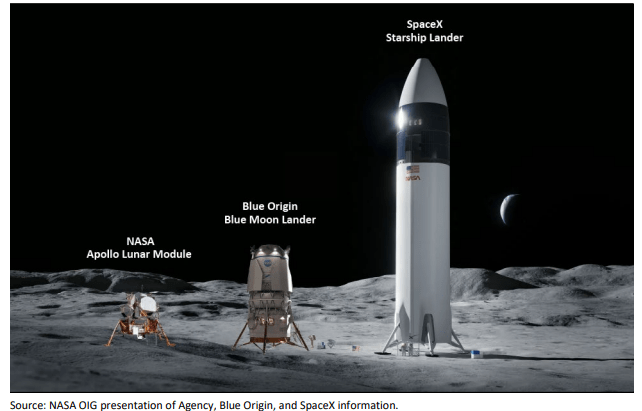
Statement by acting NASA Administrator Sean Duffy regarding ongoing delays with SpaceX’s Starship, which was given a $2.9 billion contract in 2021 for a lunar landing vehicle as part of Artemis III. As a result, NASA may reopen to lunar lander contract. Blue Origin is working on its own lunar lander called Blue Moon. As noted in yesterday’s post, Mr. Musk has been distracted this year, so it may make sense to have a solid back up.

Update: Mr. Musk was not pleased with the news. In reference to acting NASA Administrator Duffy, Mr. Musk commented, “The person responsible for America’s space program can’t have a 2 digit IQ.” The man certainly knows how to make friends.