Artemis II Was a Success

Image (Credit): NASA’s Orion spacecraft splashing down in the Pacific Ocean off the coast of California, Friday, April 10, 2026. (NASA/Joel Kowsky)

We are now one step closer to putting astronauts on the Moon, again.

The Artemis II crew safely landed off the coast of California earlier today after a 10-day, 694,481 mile trip around the Moon. Now NASA needs to spend some time reviewing the results, including the 7,000 images taken of the Moon and surroundings.

NASA Administrator Jared Isaacman stated:

Artemis II demonstrated extraordinary skill, courage, and dedication as the crew pushed Orion, SLS (Space Launch System), and human exploration farther than ever before. As the first astronauts to fly this rocket and spacecraft, the crew accepted significant risk in service of the knowledge gained and the future we are determined to build. NASA also acknowledges the contributions of the entire NASA workforce, along with our international partners, whose expertise and commitment were essential to this mission’s success. With Artemis II complete, focus now turns confidently toward assembling Artemis III and preparing to return to the lunar surface, build the base, and never give up the Moon again.

I like that part about never giving up the Moon again, though I doubt anyone in the 1970s thought it would be so easy to walk away from the lunar accomplishments and shut down the Apollo program. We were dealing with a war-torn world and a troubled presidency then, and little has changed today.

We shall see if we have changed at all.

Pic of the Week: Earthset from Orion

Image (Credit): The Earth as seen by the Artemis II astronauts on April 6, 2026. (NASA)

This week’s image was captured by the Orion spacecraft Integrity during its Moon flyby on April 6, 2026. It puts a lot of today’s politics into perspective.

As the Earth was setting, NASA pilot Victor Glover stated:

And to all of you down there on Earth and around Earth, we love you, from the Moon. We will see you on the other side.

The photo above can be found with many other photos in NASA’s Astronomy Pictures of the Day Archive.

Note: As Carl Sagan said of Earth, in part, many years ago:

That’s home. That’s us. On it everyone you love, everyone you know, everyone you ever heard of, every human being who ever was, lived out their lives. The aggregate of our joy and suffering, thousands of confident religions, ideologies, and economic doctrines, every hunter and forager, every hero and coward, every creator and destroyer of civilization, every king and peasant, every young couple in love, every mother and father, hopeful child, inventor and explorer, every teacher of morals, every corrupt politician, every “superstar,” every “supreme leader,” every saint and sinner in the history of our species lived there…

Artemis Quote: A New Feat for Humanity

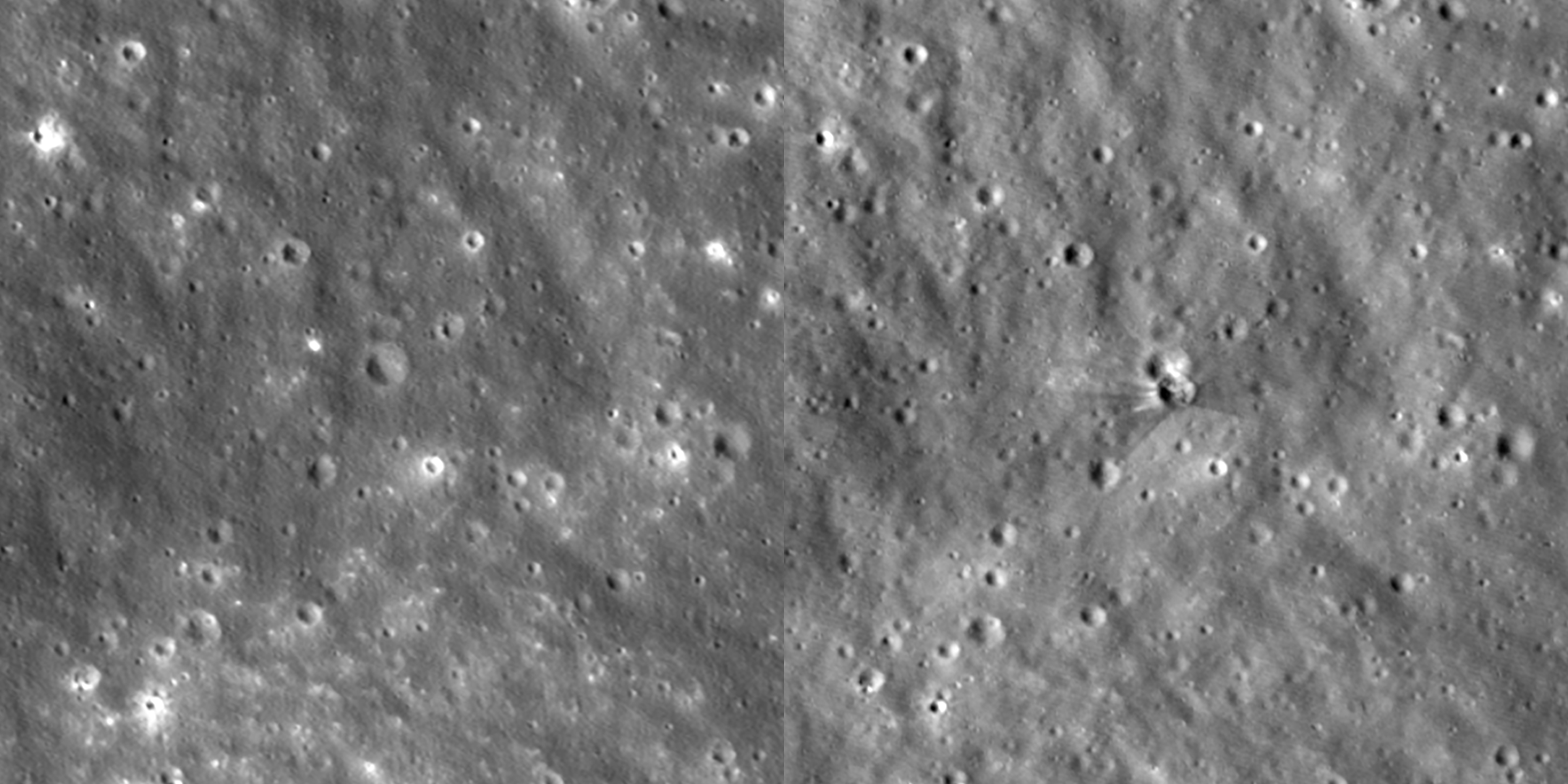
Image (Credit): An image showing three new unnamed craters located on the Moon, two of which were noted by the Artemis II crew. The crew is proposing names for both of these unnamed craters. (NASA)

“From the cabin of Integrity here, as we surpass the furthest distance humans have ever traveled from planet Earth, we do so in honoring the extraordinary efforts and feats of our predecessors in human space exploration. We will continue our journey even further into space before Mother Earth succeeds in pulling us back to everything that we hold dear. But we most importantly choose this moment to challenge this generation and the next to make sure this record is not long-lived.”

Statement by Canadian Space Agency astronaut Jeremy Hansen after the Orion capsule traveled 248,655 miles from Earth earlier today, breaking the record of Apollo 13. The capsule, named Integrity, continued on its mission to fly past the Moon before starting its trip back to Earth.

Where are the Chinese in this Moon Race?

Image (Credit): China’s Long March 10 rocket. (South China Morning Post)

Now that Artemis II is well underway as NASA prepares for an eventual crewed landing on the Moon, one might ask where the Chinese are in their own race for the Moon.

The answer is that the Chinese are moving along with their program as well, as noted in a recent Ars Technica article that highlighted China’s test in February of its new reusable booster and crew capsule. The test of the Long March 10 rocket and Mengzhou spacecraft (“dream vessel”) was considered a success, moving China closer to its own lunar mission. The next test will be to put the Mengzhou spacecraft into orbit later this year.

At the same time, the Chinese are testing a lunar lander to bring the taikonauts to the lunar surface.The lunar lander is called Lanyue, which means “embrace ​the moon.”

China is still aiming for a crewed landing on the Moon before 2030, followed by an International Lunar Research Station by 2035. The country is also planning to have a station orbiting the Moon by 2045, similar to the Gateway that NASA has decided to drop from its plans for now. The Chinese orbiting station would assist with scientific work on the Moon as well as a future trip to Mars.

Neither NASA nor China have the luxury of any detours over the next few years as each plans to be the first to return to the surface of the Moon. The current Artemis II mission puts the US in a good position to meet its own goal to land on the Moon before China assuming everything goes as planned with the mission and any technical issues can be easily resolved.

The Artemis II Mission is Underway

Image (Credit): NASA’s Artemis II mission lifting off from Launch Complex 39B at NASA’s Kennedy Space Center in Florida on Wednesday, April 1, 2026. (NASA/Joel Kowsky)

The second phase of our return to the Moon, Artemis II, is underway after a successful launch from the Kennedy Space Center earlier today. Three American astronauts as well as one Canadian astronaut will circle the Moon in a 10-day mission to iron out any bugs in the Orion spacecraft.

Here is a day-by-day schedule for the 10-day mission, with a graphic version below (provided on the Planetary Society’s website):

  • Day 1: Over 24 hours in Earth orbit, the astronauts perform a proximity operations demo with the ICPS and make sure various spacecraft systems are working (water, toilet, carbon dioxide removal, communications). The crew sleeps in two four-hour periods.
  • Day 2: Orion engines fire for several minutes, accelerating the spacecraft to escape velocity and sending the crew toward the Moon on their free-return trajectory. The crew also works out on a flywheel and do video calls with people on the ground.
  • Days 3-5: Orion performs three trajectory corrections to fine-tune its approach to the Moon. The crew tests the medical kit and performs a CPR demo. On day 5, they test their spacesuits.
  • Day 6: The crew flies by the Moon, coming within 6,400-9,600 kilometers (4,000-6,000 miles) of its far side. Their maximum distance from Earth is between 370,000-450,000 kilometers (230,000-280,000 miles), depending on their launch date. This may exceed the current human record set by Apollo 13. The crew takes photographs and videos of the Moon’s far side.
  • Days 7-9: Orion performs three trajectory corrections to fine-tune its return to Earth. On day 7, the crew rests off-duty, and on day 8, the crew demonstrates the construction of a radiation shelter construction demo and performs manual piloting tests.
  • Day 10: The crew dons spacesuits and compression garments to prepare for reentry. About 122,000 meters (400,000 feet) above Earth, Orion’s service module separates from the crew module, and Orion reenters Earth’s atmosphere at 40,000 kilometers per hour (25,000 miles per hour). Two drogue parachutes slow Orion to roughly 480 kilometers per hour (300 miles per hour). Then, three pilot parachutes, followed by three main parachutes, slow the capsule to 27 kilometers per hour (17 miles per hour). Artemis II splashes down off the coast of San Diego, California.

If you want to track the mission in real time, you can visit this NASA site.

Credit: NASA