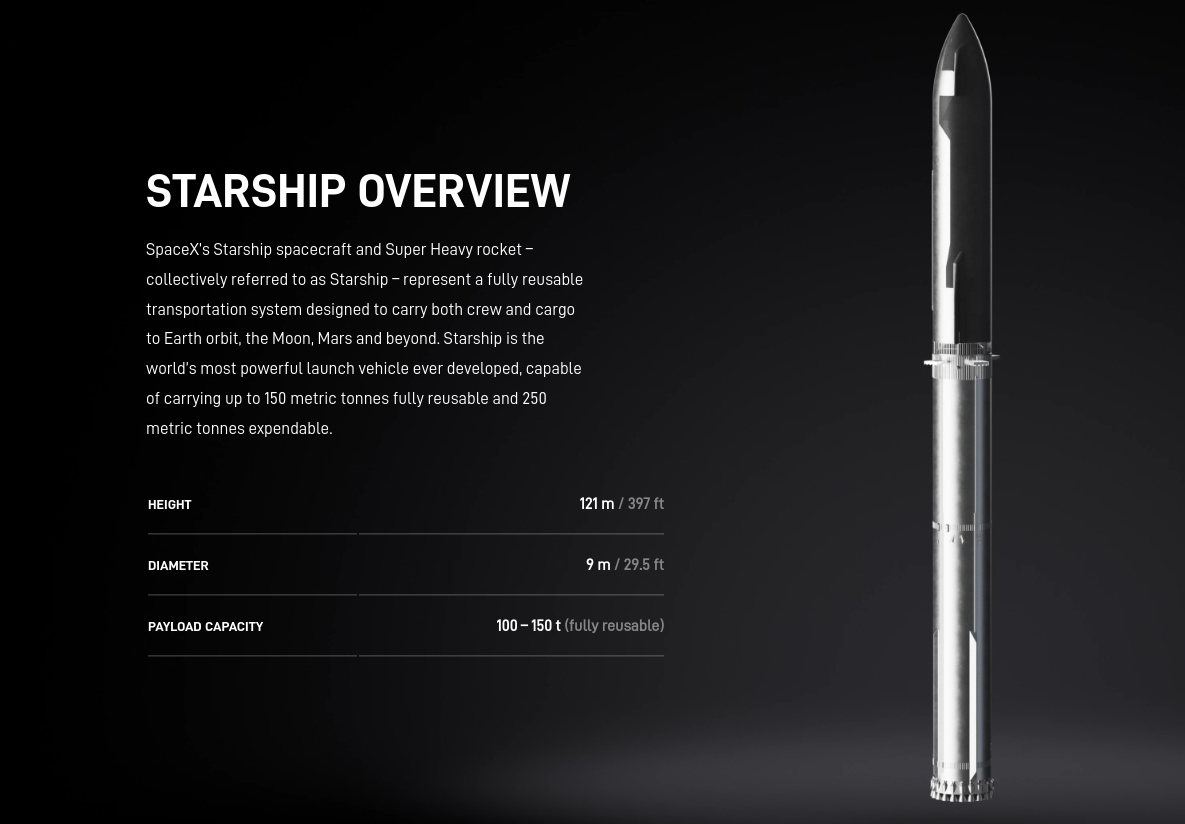
The Federal Aviation Administration has given SpaceX a green light to move forward with its next test of the Starship rocket. SpaceX may attempt the launch as soon as Saturday.
Let’s hope SpaceX can get back on track with its rocket. NASA is counting on the Starship as part of its Artemis III mission returning humans to the Moon, though recent delays have concerned all parties and may push off the Moon mission.
Image (Credit): View of the International Space Station from a Crew Dragon spacecraft. (NASA)
“Mistakes are mistakes. It is a shame for all of us. This is space exploration and everyone understands that. It is experience that we can use in the future.”
-Statement by Russia’s President Putin, as reported by Reuters, addressing the Luna-25 crash on the Moon in August. He added that the lunar missions will continue. He also said Russia also hopes to have its first segment of a new space station in operation by 2027, stating, “As the resources of the International Space Station run out, we need not just one segment, but the entire station to be brought into service.”
About 46 years after NASA’s Voyager 1 and Voyager 2 launched on an epic journey to explore space, the probes’ antique hardware continues to receive tweaks from afar. One update, a software fix, ought to tend to the corrupted data that Voyager 1 began transmitting last year, and another set aims to prevent gunk from building up in both spacecraft’s thrusters. Together, these updates intend to keep the spacecraft in contact with Earth for as long as possible.
NASA’s Lucy spacecraft is preparing for its first close-up look at an asteroid. On Nov. 1, it will fly by asteroid Dinkinesh and test its instruments in preparation for visits in the next decade to multiple Trojan asteroids that circle the Sun in the same orbit as Jupiter. Dinkinesh, less than half a mile, or 1 kilometer, wide, circles the Sun in the main belt of asteroids located between the orbits of Mars and Jupiter. Lucy has been visually tracking Dinkinesh since Sept. 3; it will be the first of 10 asteroids Lucy will visit on its 12-year voyage. To observe so many, Lucy will not stop or orbit the asteroids, instead it will collect data as it speeds past them in what is called a “flyby.”
A team of astronomers has found a new clue that a recently discovered near-Earth asteroid, Kamooalewa, might be a chunk of the moon. They hypothesized that the asteroid was ejected from the lunar surface during a meteorite strike–and they found that a rare pathway could have allowed Kamooalewa to get into orbit around the sun while remaining close to the orbits of the Earth and the Moon. The research team details their findings in the Oct. 23 issue of the journal Nature Communications Earth & Environment. Kamo`oalewa has been the object of several astronomy studies in recent years. As a result, a Chinese mission launching in 2025 is set to land on the asteroid and return samples to Earth.
Image (Credit): Apollo 17 commander Eugene Cernan approaching the Lunar Roving Vehicle. (NASA)
In addition to the asteroid Bennu sample, a lunar sample from 1972 is also grabbing headlines. It appears that the lunar sample collected by the Apollo 17 crew indicates the Moon may be about 40 million years older than previously believed.
The atomic spatial resolution analysis of individual mineral grains demonstrates the absence of nanoscale clustering of lead, which supports a 4.46 Ga ancient formation age for lunar zircon in sample 72255. This age pushes back the age of the first preserved lunar crust by ∼40 Myr and provides a minimum formation age for the Moon within 110 Myr after the formation of the solar system.
If you can forgive the title of the piece, it basically resets the understanding of the Moon’s formation and, thereby, the formation of the early Earth.
In a Reuters story, Cosmochemist Philipp Heck, senior director of research at the Field Museum in Chicago and senior author of the study, noted:
The giant impact that formed the moon was a cataclysmic event for Earth and changed Earth’s rotational speed. After that, the moon had an effect on stabilizing Earth’s rotational axis and slowing down Earth’s rotational speed…The formation date of the moon is important as only after that Earth became a habitable planet.
What will we still be learning about asteroid Bennu in 50 years (assuming we can get all of that soil out of the canister)?
Image (Credit): Logo of the Indian Space Research Organization. (ISRO)
After recently sending a rover to the Moon and a spaceship to the Sun, India announced plans to build its own space station by 2035 and also send its own astronaut to the Moon by 2040. It also wants to start work on missions to Venus and Mars. How is that for ambitious?
In a press release this week, India’s Prime Minister Shri Narendra Modi stated the following:
Building on the success of the Indian space initiatives, including the recent Chandrayan-3 and Aditya L1 Missions, Prime Minister directed that India should now aim for new and ambitious goals, including setting up ‘Bharatiya Antariksha Station’ (Indian Space Station) by 2035 and sending first Indian to the Moon by 2040.
To realize this Vision, the Department of Space will develop a roadmap for Moon exploration. This will encompass a series of Chandrayaan missions, the development of a Next Generation Launch Vehicle (NGLV), construction of a new launch pad, setting up human-centric Laboratories and associated technologies.
Prime Minister also called upon Indian scientists to work towards interplanetary missions that would include a Venus Orbiter Mission and a Mars Lander.
The space race continues with India showing itself as a strong player in space, potentially replacing Russia as one of the key space-faring nations. It benefits everyone to have more nations studying our solar system. It is unfortunate that Russia has concerned itself with less dignified matters back here on Earth. Maybe it will look to the stars again one day soon.



 Our Awesome Universe