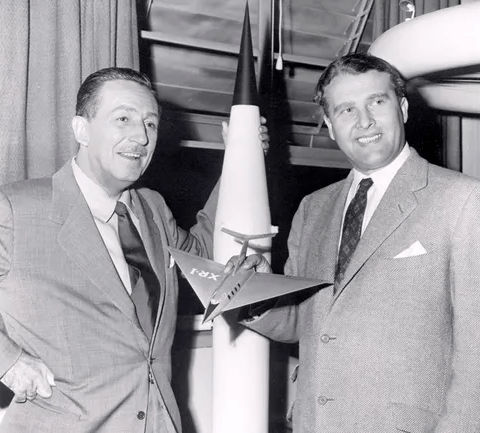
Image (Credit): Walt Disney (left) and Wernher von Braun. (NASA)
On this day in 1912, German-American aerospace engineer Wernher von Braun was born in Wyrzysk, which was part of Germany at the time and later became a Polish city. His full name was Wernher Magnus Maximilian, Freiherr von Braun.
Mr. Braun is best remembered for his part in the construction of Nazi Germany’s V-2 rockets as well as his later participation in development of the Saturn V rocket that became the workhorse of the U.S. Apollo space program.
In the above photo from 1954, you can see Walt Disney with Mr. Braun at the Guided Missile Development Operation Division at Army Ballistic Missile Agency in Redstone Arsenal, Alabama. Mr. Braun served as a technical consultant on a few Disney space films.
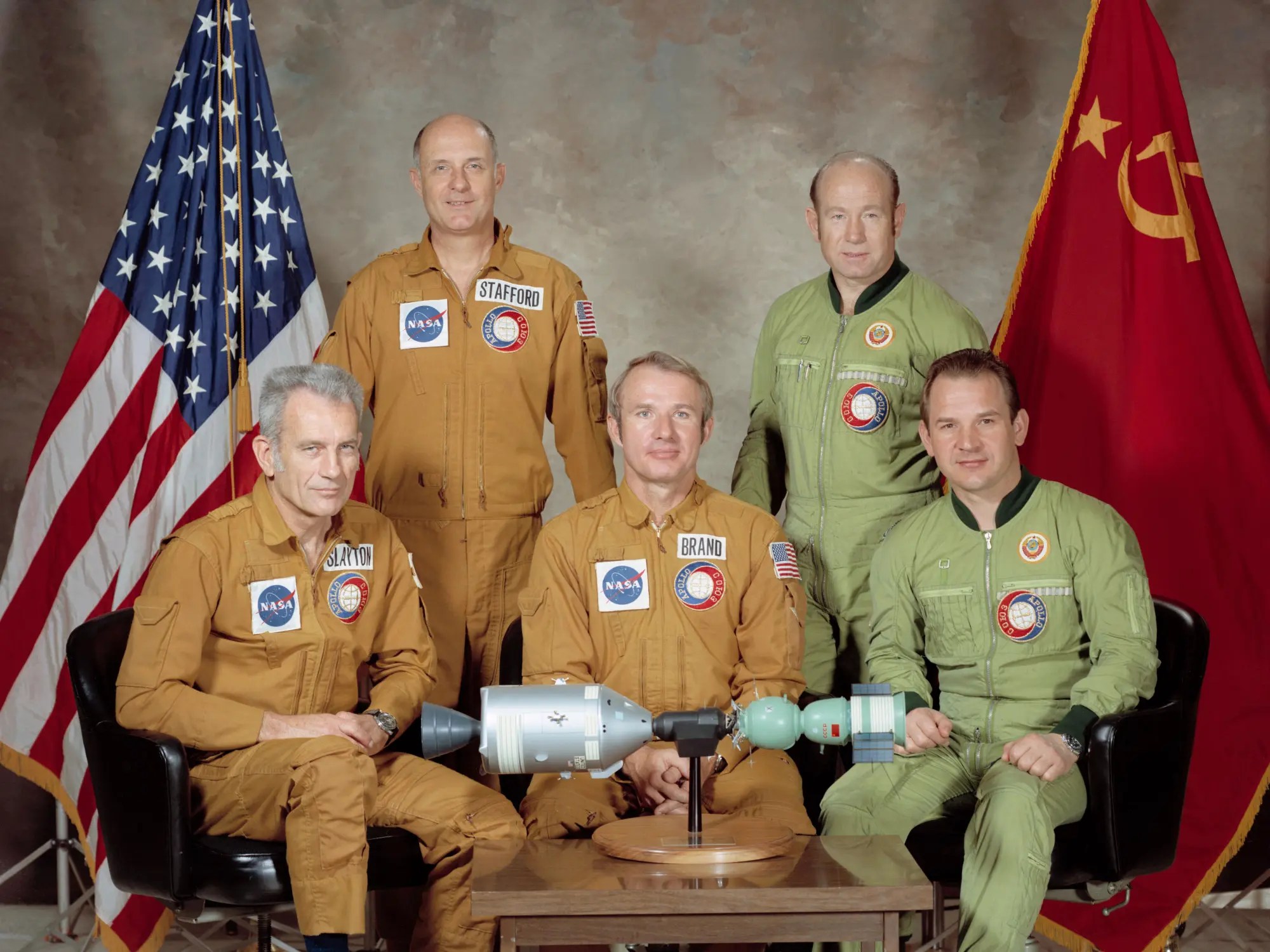
Image (Credit): The joint U.S.-USSR crew for the Apollo Soyuz Test Project. Astronaut Thomas P. Stafford (standing on left), commander of the American crew; Cosmonaut Aleksey A. Leonov (standing on right), commander of the Soviet crew; Astronaut Donald K. Slayton (seated on left), docking module pilot of the American crew; Astronaut Vance D. Brand (seated in center), command module pilot of the American crew; and Cosmonaut Valeriy N. Kubasov (seated on right), engineer on the Soviet crew. (NASA)
As we plan our return to the Moon, we cannot forget the Apollo astronauts who showed us the way last century. One of those astronauts, Thomas Stafford, died today at the age of 93.
Among his many achievements, including his Apollo 10 mission that prepared the way for the first Moon landing by Apollo 11, he may be most remembered for his 1975 space encounter with the U.S.S.R. cosmonauts.
The Apollo-Soyuz Test Project was the first international mission in space. It involved an Apollo spacecraft (crew of three) connecting with a Soyuz spacecraft (crew of two) in Earth orbit. The two days of joint activities created a precedent that was later followed by the International Space Station (ISS).
We were in the middle of the Cold War in 1975, so any cooperation with the U.S.S.R. was pretty amazing. It is just as surprising to witness SpaceX bringing cosmonauts to the ISS while the U.S. maintains severe sanctions on Russia.
Thomas Stafford died knowing that his early efforts to blaze a path to the Moon and cooperate with the Russians were still going strong today. That must have provided him with a little bit of peace in his final days.
You can watch a NASA video on Mr. Stafford’s accomplishments here.
You can also read more on Mr. Stafford’s life and career at these sites:
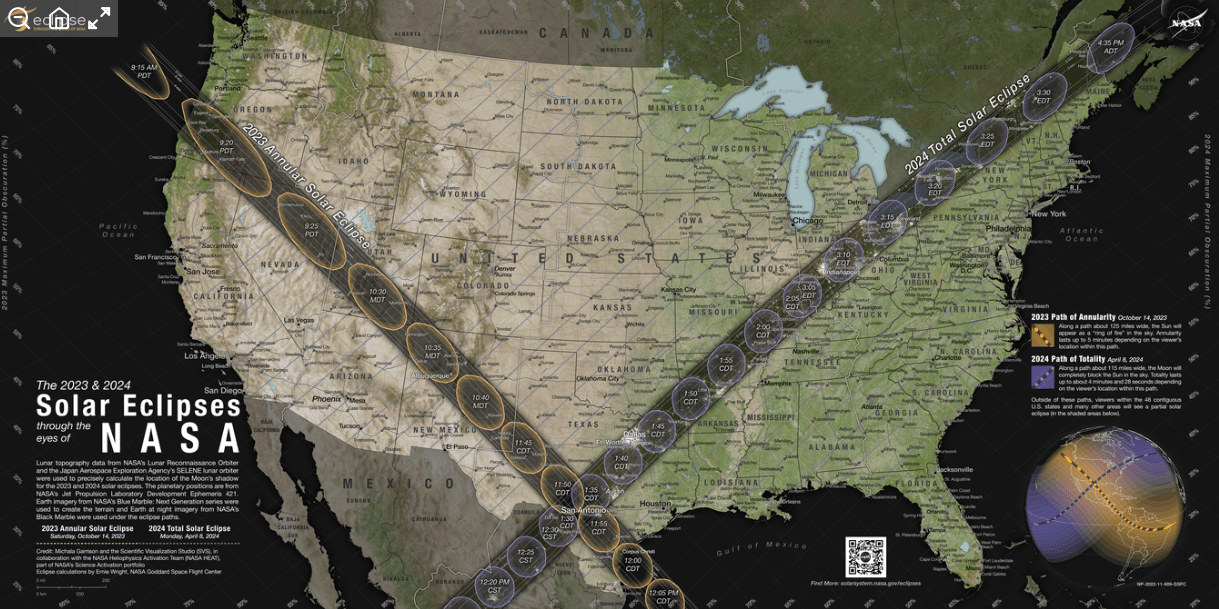
Image (Credit): A U.S. map showing the path of the Moon’s shadow during the 2023 annular solar eclipse (left side) and 2024 total solar eclipse (right side). (NASA)
If you are planning to get a good seat for the total solar eclipse on April 8, you may want to consult the NASA Solar Eclipses map (shown above) to figure our where you want to be. Hint for 2024 – California is not the place to be.
The 2024 solar eclipse map (shown below) from Scientific American magazine might also be helpful. It clearly highlights the cities that will have the best show.
Image (Credit): Map of the U.S. showing the path of the 2024 total solar eclipse on April 8. (Katie Peek/Scientific America, NASA)
Image (Credit): An artist’s rending of NASA’s VIPER at the Moon’s south pole. (NASA/Daniel Rutter)
You have until midnight today to submit your name to NASA and be part of the Agency’s first robotic Moon rover, called Volatiles Investigating Polar Exploration Rover (VIPER). Go to this link and provide your name and PIN code to ensure your name goes to the Moon (and you also get your boarding pass as a virtual souvenir).
VIPER is expected to head to the Moon in late 2024 as part of NASA’s Commercial Lunar Payload Services initiative. Once on the lunar surface, it will spend 100 days on the Moon’s south pole to sample the soil and locate frozen water.
If you missed the chance to have your name aboard the Europa Clipper, you still have a chance to be part of this local moon mission.
New research suggests there’s less oxygen on the icy surface of Jupiter’s moon Europa than thought — and that could affect what, if any, life might be lurking in the moon’s underground ocean. Even with little or no oxygen, microbes might still be bustling around in the ocean believed to exist miles beneath Europa’s frozen crust. As for what else, “who knows,” said NASA scientist Kevin Hand, who was not involved in the study published Monday in Nature Astronomy.
The best measurements from Hubble show the universe is now expanding faster than predicted based on observations of how it looked shortly after the big bang. These observations were made by the Planck satellite mapping of the cosmic microwave background radiation – sort of a blueprint for how the universe would evolve structure after it cooled down from the big bang. The simple solution to the dilemma is to say that maybe Hubble observations are wrong due to some creeping inaccuracy in its deep-space yardstick. Then along came the James Webb Space Telescope to crosscheck Hubble’s results. Webb’s sharp infrared views of Cepheids agreed with Hubble data. Webb confirmed that the Hubble telescope’s keen eye was right all along.
A trio of small rovers that will explore the Moon in sync with one another are rolling toward launch. Engineers at NASA’s Jet Propulsion Laboratory in Southern California recently finished assembling the robots, then subjected them to a punishing series of tests to ensure they’ll survive their jarring rocket ride into space and their travels in the unforgiving lunar environment.Part of a technology demonstration called CADRE (Cooperative Autonomous Distributed Robotic Exploration), each solar-powered rover is about the size of a carry-on suitcase.