Luna-25 Fails to Land (Properly) on the Moon

Image (Credit): Our Moon in all its glory. (NASA/JPL/USGS)

The message from Roscosmos was pretty bland:

During the operation, an abnormal situation occurred on board the automatic station, which did not allow the maneuver to be performed with the specified parameters.

Translated into normal speech, we learned that Luna-25 crashed during its attempted landing on the lunar surface.

This is a blow for Russia and Putin as well. The Soviet Union could threaten the world and run a terrific space program. The Russians are bogged down in Ukraine and unable to pick up a lunar program ceased about 50 years ago. It is sad to watch.

Roscosmos Director General Yury Borisov blamed the crash on Russia’s long absence from the Moon, stating,

The negative experience of interrupting the lunar program for almost 50 years is the main reason for the failures.

He may want to add corruption, economic sanctions, and horrible leadership to that list of reasons.

At least the Russian mission was able to share a few photos from orbit before it all ended.

The Moon’s south pole is still available for anyone who wants it. The Indian space program will give it a try this week. We can only wish them well as they fly over the Russian rubble.
A New View of the Moon

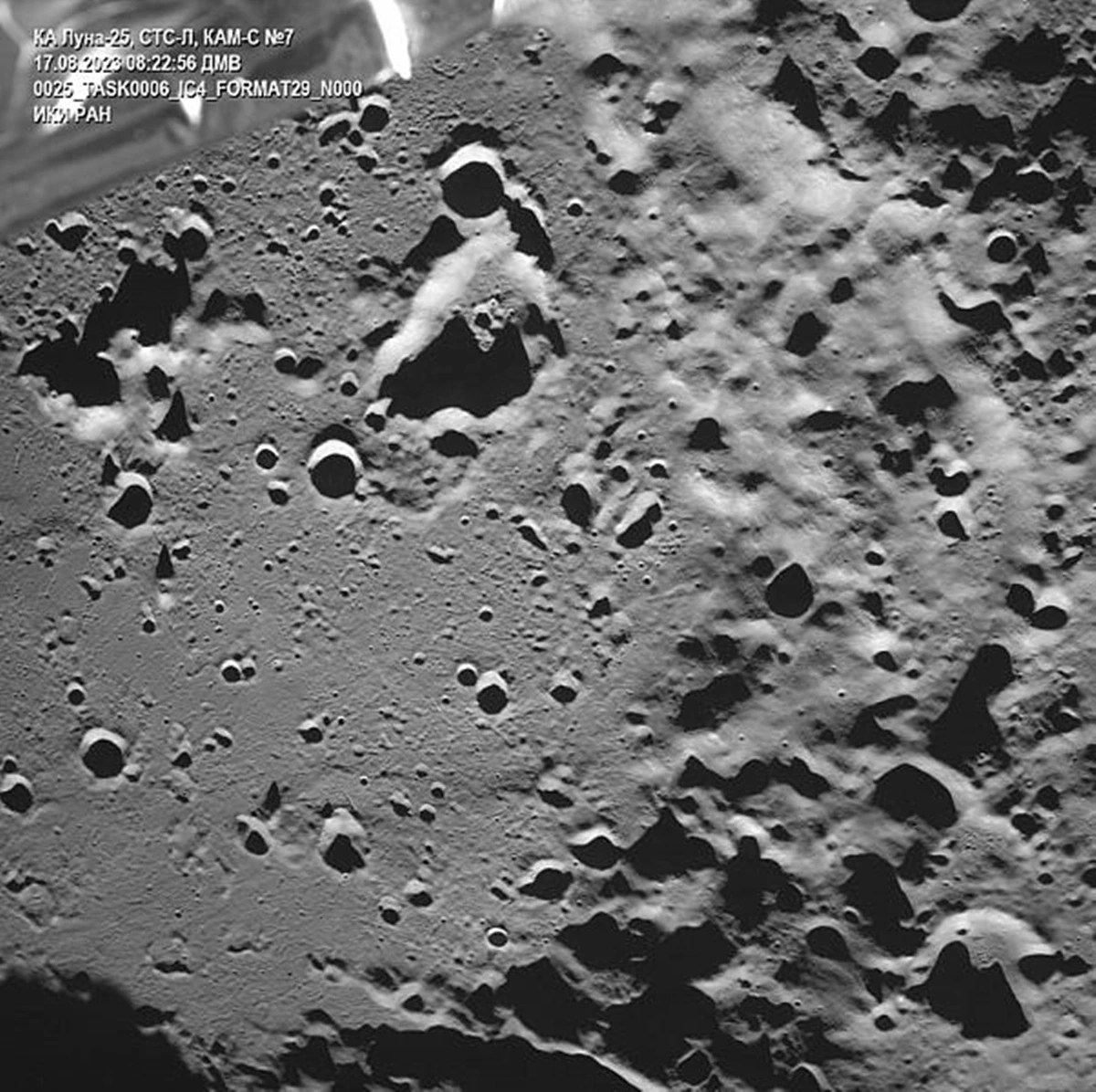
Image (Credit): The Zeeman crater as captured by Luna-25. (IKI RAS)

The first images from Russia’s Luna-25 mission have arrived. They show the far side of the Moon permanently hidden from those of us here on Earth.

The spacecraft is now orbiting the Moon, which was last done by the Russians back in 1976. The lander is expected to be on the lunar surface this Monday if all goes well.

For the sake of science (leaving politics out of it), let’s hope for a successful landing.

Pic of the Week: Cape Byron Lighthouse Moonrise

Image (Credit): “Cape Byron Lighthouse Moonrise” by Kevin Hennessey. (Australia Geographic)

The winners of the Australia Geographic astronomy photography contest have been named, and the photo above is one that won honorable mention in the Nightscapes Category, “Cape Byron Lighthouse Moonrise” by Kevin Hennessey.

Here is a little more about the impressive image:

The full moon rises behind the Cape Byron Lighthouse at the most easterly point of mainland Australia, silhouetting a group of spectators gathered at its base. Taken through a high-powered telescope from a distance of 5.1km away makes the moon appear extraordinarily large in this photo. The shooting location had to be accurate to within a couple of meters, determined with the help of the “Photopills” iPhone app, Google Earth and an aircraft-grade GPS.

Good Article: Looking Ahead in Astronomy

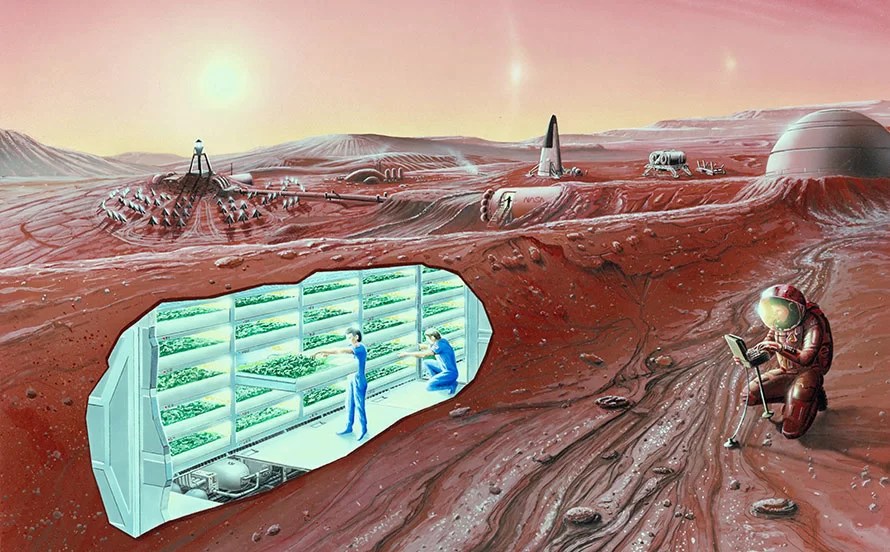
Image (Credit): An imagined Martian settlement. (NASA)

Astronomy magazine has a good article titled “Predictions for the Next 50 Years of Astronomy.” Five astronomers provide their ideas about what we might experience in the field of astronomy in the 2070s.

For instance, S. Alan Stern, a planetary scientist and member of the U.S. National Science Board, had this prediction:

By the ’70s, I expect we’ll have human exploration taking place on multiple worlds in the solar system, with Antarctic-like, semipermanent bases scattered around the globes of at least Luna and Mars. I also expect we may by then have much larger and more powerful launch vehicles, even fusion-based or high-power electric propulsion, making trip times an order of magnitude shorter than today. Just think: Mars in a few weeks, Pluto and the Kuiper Belt in a year!

I just want to see the Moon landing get underway before any predictions about the Kuiper Belt, but it is all exciting and in many ways unknowable given what has happened in the last 50 years. For instance, how many people 50 years ago believed that we would have a catalog of thousands of exoplanets, many similar to Earth?

Of course, predictions are tough. Here is what some scientists were saying in the 1970s about the fate of our little planet, as reported by the American Enterprise Institute:

  •  {Paul] Ehrlich sketched out his most alarmist scenario for the 1970 Earth Day issue of The Progressive, assuring readers that between 1980 and 1989, some 4 billion people, including 65 million Americans, would perish in the “Great Die-Off.”
  • Harrison Brown, a scientist at the National Academy of Sciences, published a chart in Scientific American that looked at metal reserves and estimated the humanity would totally run out of copper shortly after 2000. Lead, zinc, tin, gold, and silver would be gone before 1990.

We have our issues today, but I am very happy that these earlier scientists did not have the gift of prophesy.

Space Quote: What’s the Launch Date for Artemis III?

Credit: NASA

“We really are trying to get in the details of that schedule because when we come up with a date, December of 2025, or whatever that date might be, we want to have confidence for our teams, that we all have a realistic path to get there.” 

-Statement by Jim Free, NASA associate administrator of Exploration Systems Development, regarding the launch date of the Artemis III mission, as reported in Florida Today. The story highlights the potential delays related to SpaceX’s Starship and Axiom’s space suits.