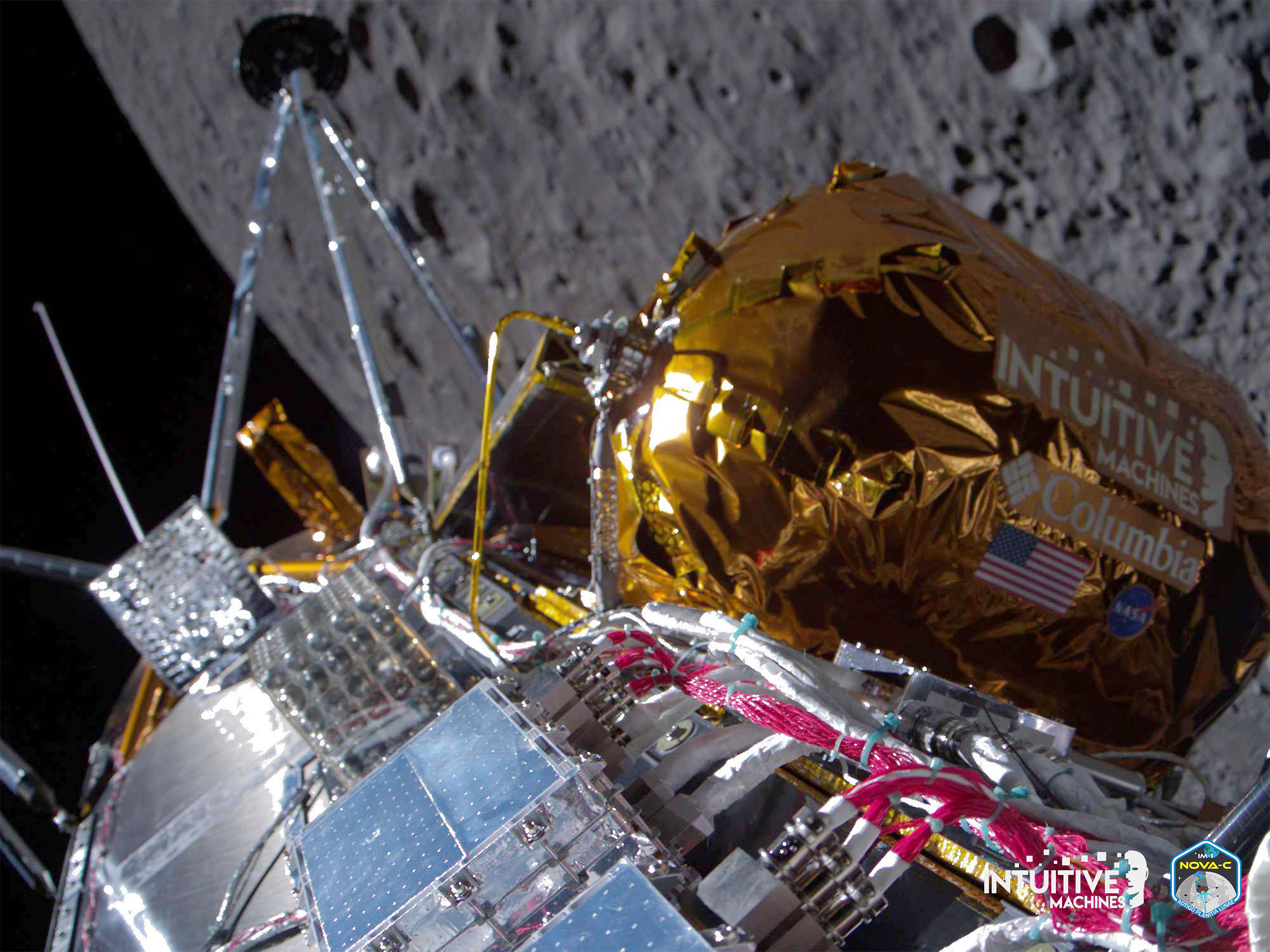
Image (Credit): A view of the Odysseus lunar lander as it flies over the near side of the moon on Wednesday. (Intuitive Machines/AP)
This week’s image come from Intuitive Machines and shows the Odysseus lunar lander orbiting the Moon just yesterday before its historic landing earlier today. After more than 50 years, the United States has returned to the Moon.
After troubleshooting communications, flight controllers have confirmed Odysseus is upright and starting to send data…Right now, we are working to downlink the first images from the lunar surface.
The Odysseus landed near the Malapert A crater, which is about 185 miles north of the Moon’s south pole.
The two-tonne ERS-2 spacecraft burnt up in the atmosphere over the Pacific. So far, there have been no eyewitness accounts of the mission’s demise or of any debris reaching Earth’s surface. ERS-2 was one of a pair of missions launched by the European Space Agency in the 1990s to study the atmosphere, the land and the oceans in novel ways. The duo monitored floods, measured continental and ocean-surface temperatures, traced the movement of ice fields, and sensed the ground buckle during earthquakes.
Houston-based Intuitive Machines is targeting 5:49 p.m. EST on Thursday, February 22, to put its Odysseus lunar lander on the surface of the moon—and it will be streamed live on NASA TV on YouTube. The first U.S. commercial moon lander, Odysseus—also known by its nickname “Odie”—will touchdown near a crater called Malapert A in the south pole region of the moon. If successful, this IM-1 mission—which is taking a scientific payload to the moon—will be the first spacecraft from the U.S. to land on the moon since Apollo 17 in December 1972.
There may be a lot more than we thought to the belt of icy debris that circles the outer Solar System. Data from the New Horizons probe as it sails serenely through the Kuiper Belt hints at unexpected levels of particles where dust ought to be thinning out, suggesting the donut-shaped field extends significantly farther from the Sun than previous estimates suggest.
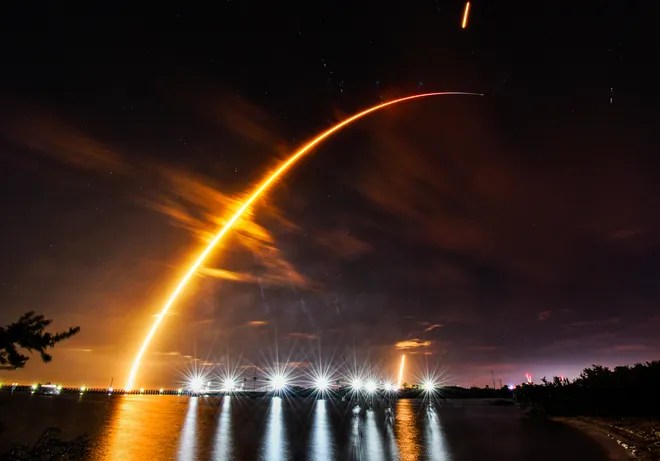
Image (Credit): Today’s launch of the Intuitive Machines IM-1 mission from the Kennedy Space Center. (Malcolm Denemark/Florida Today)
This week’s image shows the early morning launch of Intuitive Machines’ IM-1 mission via a SpaceX Falcon 9 rocket. The rocket carries the Nova-C robotic lander, also called “Odysseus,” that includes both NASA and commercial payloads. If all goes well, the lander will be on the surface of the moon next week.
This image from Florida Today is unique in that it is a time exposure showing both the launch from the Kennedy Space Center as well as the booster landing shortly afterward.
Image (Credit): Intuitive Machines IM-1 mission on the launch pad at NASA’s Kennedy Space Center in Florida. (SpaceX)
The second NASA-related commercial Moon mission was set to launch earlier today, but SpaceX called it off at the last moment due to a methane issue with its Falcon 9 rocket. SpaceX is expected to try the launch tomorrow.
The launch of the Intuitive Machines IM-1 mission is related to NASA’s Commercial Lunar Payload Services (CLPS) initiative, and will serve as one of the first lunar-based pieces of the Artemis program.
Intuitive Machines’ Nova-C lander is expected to land on the Moon Thursday, Feb. 22. Among the items on its lander, the IM-1 mission will carry NASA science and technology instruments focusing on plume-surface interactions, space weather/lunar surface interactions, radio astronomy, precision landing technologies, and a communication and navigation node for future autonomous navigation technologies.
The Moon mission that failed last month was also part of NASA’s CLPS initiative. This program is off to a slow start, but hopefully it can be relied on to be a key component of the lunar space program going forward.
If you are looking for some good news, I can report that Russia’s Progress MS-26 International Space Station resupply mission successfully launched earlier today.
Collins Aerospace, a private company hired to create spacesuits for use outside the International Space Station (ISS), has tested its suit aboard a commercial microgravity flight, passing a milestone that lets engineers move forward toward critical design review…During the test, the plane executed “roller-coaster-like maneuvers” to induce weightlessness and allow someone wearing a prototype to see if it actually lets someone move around in it under those conditions.
Water has been found on the surface of two asteroids for the first time, scientists said in a new paper. Two silicate-rich asteroids were detected by the retired Stratospheric Observatory for Infrared Astronomy (SOFIA) that were giving off a specific wavelength of light that indicated the presence of molecules of water, according to research published in The Planetary Science Journal.The discovery may have major implications for theories about how water initially made its way to our own planet. It could have been delivered via asteroid impact.
When China’s first lunar lander, Chang’e 3, touched down in Mare Imbrium on the Moon in 2013, it was the pinnacle of the country’s space endeavors. The robotic lander and its small Yutu rover companion were the first spacecraft to operate on the Moon since the 1970s, and provided new insights into our planet’s natural satellite…Since then, China’s space activities have exploded in range, frequency, and ambition. The country now rivals the U.S. for the most launches per year, with around 80 missions having been planned for 2023. The nation has its own modular space station, named Tiangong, which is expected to be continuously occupied by a rotating crew of three astronauts for at least a decade.