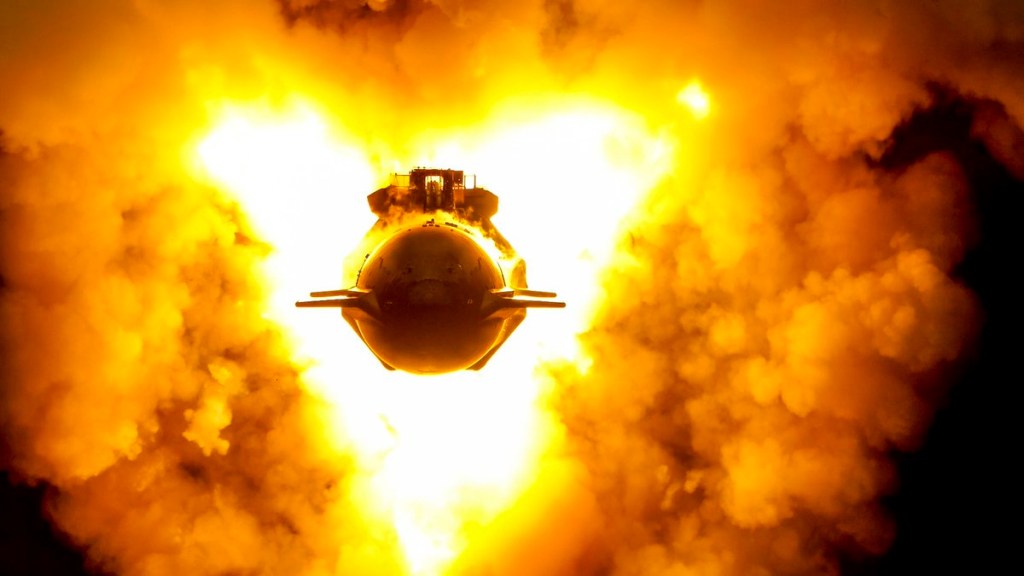
Image (Credit): June 26, 2023 Starship engine test viewed from above. (SpaceX)
The image above shows the SpaceX Ship 25 rocket from above as it tested it engines on June 26, 2023. Presumably, Elon Musk was tweeting out this and other such shots, but given the restrictions placed on Twitter these days, you may not be able to acquire this on your own without an account.
As far as the next Starship launch, the exact date has yet to be shared. However, NASA is already talking about delaying the Artemis III lunar mission, which will use the Starship, from 2025 to 2026.
Image (Credit): A Tardigrade, or water bear, which may have landed on the Moon thanks to an Israeli mission. (NASA)
If we had a real chance of being harmed by life on the lunar surface, Covid 19 would be child’s play. The New York Times has an article, “Cosmic Luck: NASA’s Apollo 11 Moon Quarantine Broke Down,” indicates we were not really ready for any potential contamination during the Apollo program. The newspaper cites a recent study on the quarantine process, which noted:
As NASA prepared to land astronauts on the Moon in the 1960s, scientists and federal officials came to fear that they could bring lunar microorganisms back to Earth, with potentially grave consequences for human, plant, and animal life. To prevent this“back contamination,”representatives from NASA and a network of federal departments and services developed a protocol to quarantine astronauts, equipment, samples, and spacecraft exposed to lunar dust. Yetalthough NASA assured policy makers and an anxious public that it had implemented impermeable safeguards against the escape of lunar microorganisms, it had in fact prioritized likely risks to astronauts over unlikely risks to American society. To a degree previously unknown, the Apollo quarantine protocol suffered from numerous containment breaches that would likely have exposed the terrestrial biosphere to contamination—had lunar microorganisms actually existed.
Of course, now that we have landed on the moon and sent up multiple missions, the risk today is that we have contaminated the lunar surface, as noted in this second story from Futurism, “NASA Says There May Be Life on the Moon After All.” For instance, an earlier Israeli mission that crashed on the lunar surface was carrying thousands of microscopic Tardigrades. The story also cites meteors as a possible source of life that could have found refuge on the Moon.
Efforts to insulate Artemis from possible cuts, delays and cancellation are facing a major test with the current budget fight on Capitol Hill. If NASA’s funding is stalled at the 2022 enacted level or reduced, agency administrator Bill Nelson has warned Artemis II and Artemis III could be delayed. The current launch dates are 2024 for Artemis II and 2025 for Artemis III.
A private rocket carrying the first Arab woman astronaut has blasted off on a mission to the International Space Station (ISS). Rayyanah Barnawi, a breast cancer researcher from Saudi Arabia, was joined on Sunday’s mission by fellow Saudi Ali al-Qarni, a fighter pilot.The pair are the first Saudi astronauts to voyage into space in decades.
ispace’s attempt to become the first private company to safely land a robot on the Moon left a mark: A NASA space telescope orbiting Earth’s nearest neighbor in space spotted the impact of the vehicle on the lunar surface…NASA’s Lunar Reconnaissance Orbiter (LRO) has been circling the Moon since 2009, carefully mapping its surface. Today, it released the first images of the impact site, which required scientists at the Goddard Space Flight Center and Arizona State University to carefully hunt for changes to the lunar surface.
Image (Credit): Artist’s rending of the Blue Origin lander on the Moon’s surface. (Blue Origin).
While SpaceX is building the lunar lander for the Artemis III mission, Blue Origin is back in the game building the next lunar lander for a follow-up human landing at the Moon’s southern polar region as part of Artemis V. The NASA contract with Blue Origin for this second mission is $3.4 billion.
Blue Origin’s partners in this venture include Lockheed Martin, Draper, Boeing, Astrobotic, and Honeybee Robotics. All of this is good news for the space program in that its expands the knowledge and risk related to a lunar landing among even more companies. Such redundancy will increase resilience.
NASA Administrator Bill Nelson welcomed Blue Origin to the team with this statement:
Today we are excited to announce Blue Origin will build a human landing system as NASA’s second provider to deliver Artemis astronauts to the lunar surface…We are in a golden age of human spaceflight, which is made possible by NASA’s commercial and international partnerships. Together, we are making an investment in the infrastructure that will pave the way to land the first astronauts on Mars.
Note: I am glad to hear that Mr. Bezos is still plugging away with his space company Blue Origin and not spending all of his money on play things, such as his $500 million yacht. The commercial space industry is party one run by billionaire playboys, which may not be the most stable foundation. Yet all the same, if part of their money is going to public projects, that is a good thing. Just as Andrew Carnegie invested in public libraries and Bill Gates fighting disease and poverty in Africa, we can all benefit from the money going into the space arena. Mind you, it is not charity, but it is starter funds for critical projects to keep the US in the space race.
NASA has pulled the plug on its Lunar Flashlight project, which was designed to look for sources of ice on our nearest neighbor. The agency spent the last few months trying, and failing, to get the craft to generate the necessary amount of thrust to get the small satellite to its intended destination. Officials say that the issue was likely caused by debris buildup in the fuel lines, which prevented the CubeSat from working to its full potential.
NASA’s Mars Perseverance rover has taken new images that reveal that some of the red planet’s ancient rivers were much wilder than scientists previously thought. “It’s the first time we’re seeing environments like this on Mars,” Katie Stack Morgan, Perseverance’s deputy project scientist, said in a NASA release. Scientists studying rock formations, features, and valleys on Mars, so far, have found evidence to suggest Mars was once covered by water.
Rocket Lab USA, Inc., a leading launch and space systems company, is preparing for the second of two dedicated Electron launches to deploy a constellation of storm monitoring satellites for NASA. The launch, called ‘Coming To A Storm Near You,’ is scheduled for lift-off no earlier than 17:30 on May 22nd NZST from Rocket Lab Launch Complex 1 on New Zealand’s Mahia Peninsula. The launch follows on from the successful ‘Rocket Like a Hurricane’ Electron launch on May 8th 2023, which deployed the first two CubeSats of NASA’s TROPICS constellation. The ‘Coming To A Storm Near You’ launch will deploy the final two TROPICS CubeSats, completing the constellation.