One of the Artemis Rocket Launches

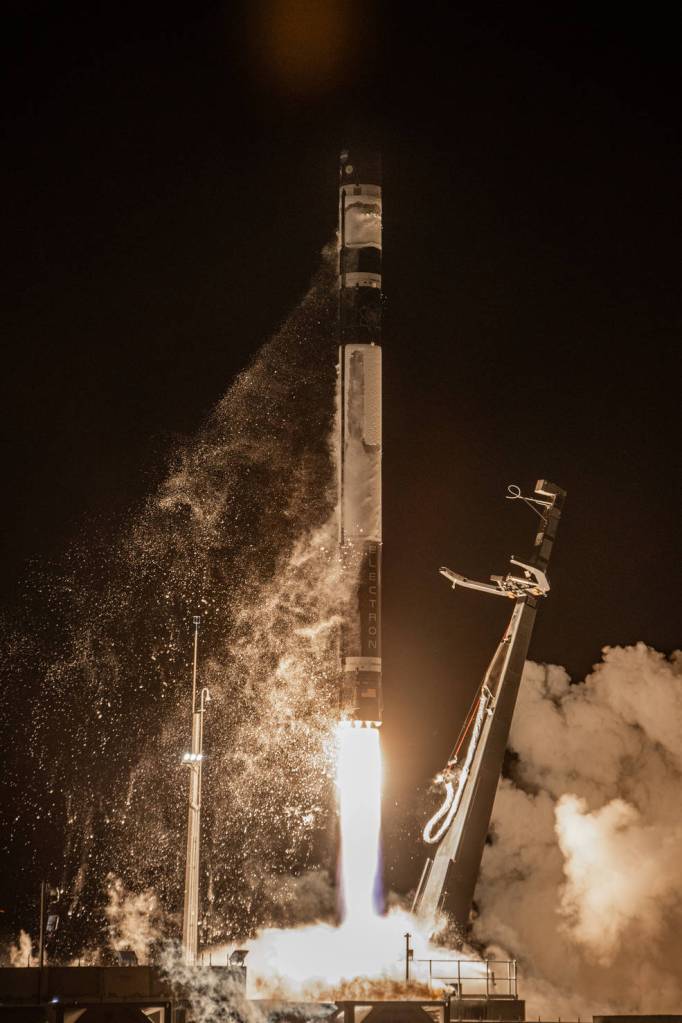
Image (Credit): June 28th launch of CAPSTONE aboard Rocket Lab’s Electron rocket from the Rocket Lab Launch Complex 1 on the Mahia Peninsula of New Zealand. (Rocket Lab)

While we are awaiting the launch of the uncrewed Artemis phase-one rocket later this summer to test the waters for a crewed mission, other related missions are ongoing. NASA’s Cislunar Autonomous Positioning System Technology Operations and Navigation Experiment (CAPSTONE) was launched earlier in the week from New Zealand and will take about four months before it orbits the Moon for another six months. The miniaturized satellite, or CubeSat, is designed to test the future lunar orbit of Gateway, a lunar space station being planned by NASA and its commercial and international partners to support NASA’s Artemis program, including astronaut missions.

Here are CAPSTONE’s mission objectives:

  • Verify the characteristics of a cis-lunar near rectilinear halo orbit for future spacecraft;
  • Demonstrate entering and maintaining this unique orbit that provides a highly-efficient path to the Moon’s surface and back;
  • Demonstrate spacecraft-to-spacecraft navigation services that allow future spacecraft to determine their location relative to the Moon without relying exclusively on tracking from Earth;
  • Lay a foundation for commercial support of future lunar operations; and
  • Gain experience with small dedicated launches of CubeSats beyond low-Earth orbit, to the Moon, and beyond.

In a press release, Elwood Agasid, project manager for CAPSTONE at NASA’s Ames Research Center in California’s Silicon Valley, stated:

CAPSTONE is a pathfinder in many ways, and it will demonstrate several technology capabilities during its mission timeframe while navigating a never-before-flown orbit around the Moon…CAPSTONE is laying a foundation for Artemis, Gateway, and commercial support for future lunar operations.

We forget about all of the smaller missions (literally, in this case) that make the full mission possible. CAPSTONE is a key mission to test some ideas and reduce risk for future astronauts.

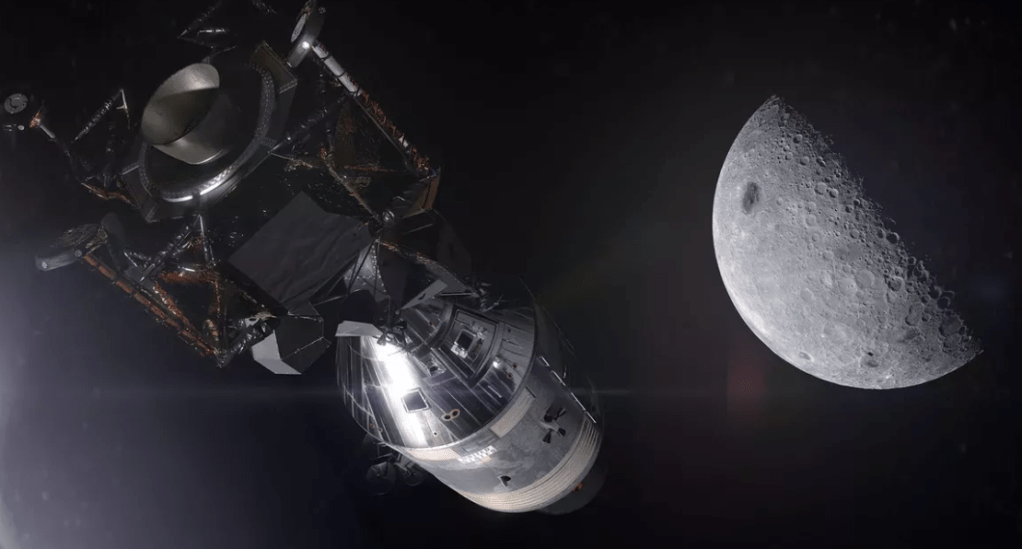
Image (Credit): Artist’s impression of CAPSTONE in orbit near the Moon. (Illustration by NASA/Daniel Rutter)

Television: The Earlier Moon Mission on PBS

Image (Credit): Artist’s impression of Apollo 11 approaching the Moon. (PBS)

If you really want something interesting to watch regarding the Moon, catch these two PBS programs (stations and times may vary). Yes, they aired earlier, but as noted earlier, I would rather rewatch the good stuff than waste my time on some of the new stuff.

American Experience: Chasing the Moon, July 2 at 7pm (6 hours):

“Chasing the Moon,” a film by Robert Stone, reimagines the race to the moon for a new generation, upending much of the conventional mythology surrounding the effort. The series recasts the Space Age as a fascinating stew of scientific innovation, political calculation, media spectacle, visionary impulses and personal drama. Utilizing a visual feast of previously overlooked and lost archival material — much of which has never before been seen by the public — the film features a diverse cast of characters who played key roles in these historic events. Among those included are astronauts Buzz Aldrin, Frank Borman and Bill Anders; Sergei Khrushchev, son of the former Soviet premier and a leading Soviet rocket engineer; Poppy Northcutt, a 25-year old “mathematics whiz” who gained worldwide attention as the first woman to serve in the all-male bastion of NASA’s Mission Control; and Ed Dwight, the Air Force pilot selected by the Kennedy administration to train as America’s first black astronaut.

8 Days: To the Moon and Back, July 9 at 8pm (1 hour 25 minutes)

Join Apollo 11 on its historic journey. The film seamlessly blends mission audio featuring conversations among Neil Armstrong, Buzz Aldrin and Michael Collins with new footage, NASA archive and stunning CGI to recreate the first moon landing.

Television: Moonhaven is Coming in July

Image (Source): Moonhaven’s Garden of Eden on the Moon. (AMC+)

While NASA is working on the first permanent base on the Moon, the AMC+ television series set 100 years in the future already has a Garden of Eden on the lunar surface. Here is the general story from AMC+ on the new series Moonhaven, which premieres on July 7th:

Moonhaven focuses on Bella Sway (Emma McDonald), a lunar cargo pilot and smuggler 100 years in the future who finds herself accused of a crime and marooned on Moonhaven, a utopian community set on a 500 square mile Garden of Eden built on the Moon to find solutions to the problems that will soon end civilization on Mother Earth. A skeptic in Paradise, Bella is sucked into a conspiracy to gain control of the artificial intelligence responsible for Moonhaven’s miracles and teams with a local detective to stop the forces that want to destroy Earth’s last hope before they are destroyed themselves.

Yes, the Earth is a toxic waste (again) and it is easier to build a future on the dead Moon than get our act together here on Earth. But even that is too easy, because the Moon colony appears to be a cult. Could it be a SpaceX colony based on the principles of Musk. I hope NASA did not pay for that.

I do not have any high hopes, but that may be it for this summer outside of Star Wars and Star Trek series. I may just go back and rewatch The Expanse this summer.

New Double Crater on the Moon

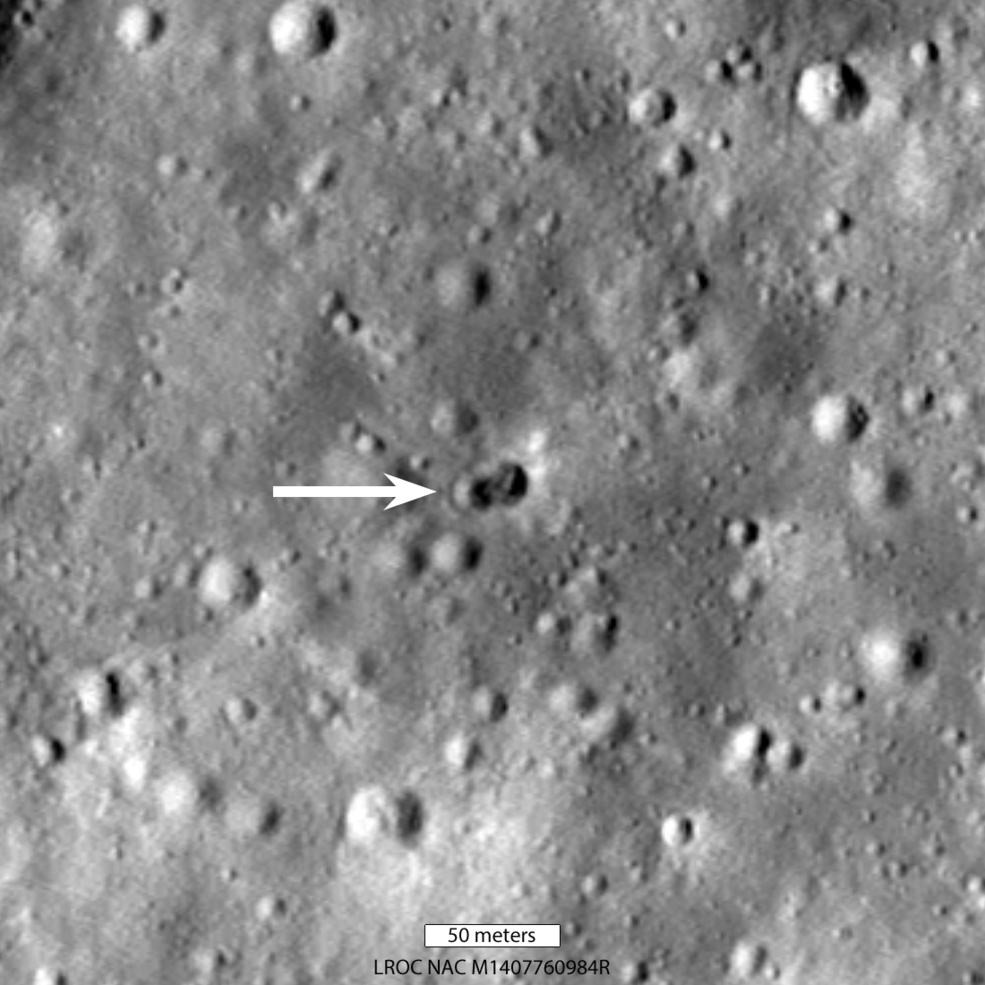
Image (Credit): Double crater from a rocket body that impacted the Moon on March 4, 2022, near Hertzsprung crater. (NASA/Goddard/Arizona State University)

Remember all of the chatter earlier this year about whether a SpaceX or Chinese rocket booster was about read to hit the Moon? Well, NASA’s Lunar Reconnaissance Orbiter recently located the crater created by this object – a strange double crater. NASA reported it found an eastern crater (18-meter diameter, about 19.5 yards) superimposed on a western crater (16-meter diameter, about 17.5 yards).

While NASA has not seen double craters when other booster rockets hit the Moon’s surface (yes, it does happen occasionally), it tried to explain this one:

The double crater was unexpected and may indicate that the rocket body had large masses at each end. Typically a spent rocket has mass concentrated at the motor end; the rest of the rocket stage mainly consists of an empty fuel tank. Since the origin of the rocket body remains uncertain, the double nature of the crater may indicate its identity.

Now we just need to go back to Space X and the Chinese and ask a few more questions about the rocket booster in question. It is still doubtful we have an Elon Musk crater on the Moon. Time will tell.

Artemis Rocket Launch Planned for August

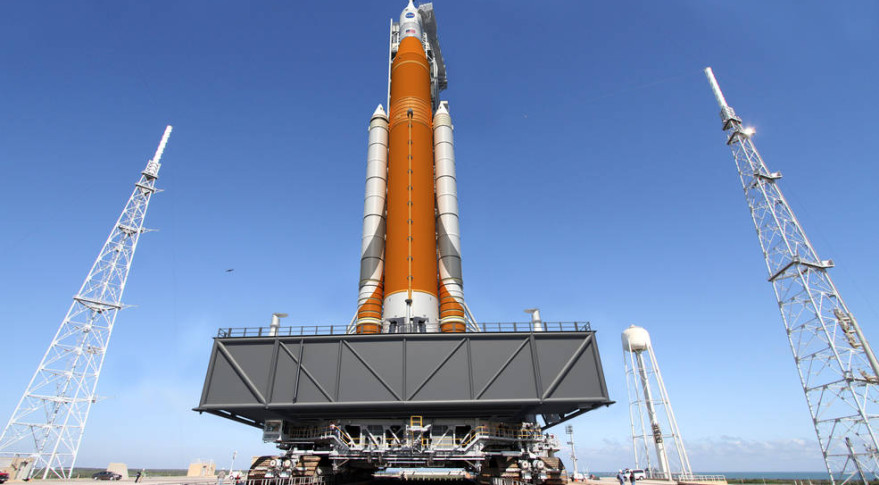
Image (Credit): NASA’s Space Launch System rocket. (NASA)

NASA said it is ready for a real test of the Space Launch System (SLS) and Orion capsule after multiple dry-runs. Of course, the tests were not perfect, but NASA said it is ready for the next phase. The latest test was on June 20th. Following that, Tom Whitmeyer, deputy associate administrator for common exploration systems at NASA Headquarters, stated:

During the wet dress rehearsal activities, we have incrementally added to our knowledge about how the rocket and the ground systems work together, and our teams have become proficient in launch procedures across multiple sites. We have completed the rehearsal phase, and everything we’ve learned will help improve our ability to lift off during the target launch window…The team is now ready to take the next step and prepare for launch.

The uncrewed launch itself could be as early as late August. Under this phase of the project, called Artemis 1, the rocket, capsule, and ground control will get a rigorous test. As NASA explains:

During this flight, the spacecraft will launch on the most powerful rocket in the world and fly farther than any spacecraft built for humans has ever flown. It will travel 280,000 miles from Earth, thousands of miles beyond the Moon over the course of about a four to six-week mission. Orion will stay in space longer than any ship for astronauts has done without docking to a space station and return home faster and hotter than ever before.

NASA has come a long way to get this this step. The various problems along the way is why you have such tests. And now the first phase is about ready. Fingers crossed…

Image (Credit): Artemis 1 mission map. (NASA)