“We look forward to Firefly providing this [Commercial Lunar Payload Services] delivery… This lunar landing should enable new scientific discoveries from the far side of the Moon during the lunar night. This particular group of payloads should not only generate new science but should be a pathfinder for future investigations exploiting this unique vantage point in our solar system.”
–Statement by Joel Kearns, Deputy Associate Administrator for exploration in NASA’s Science Mission Directorate, regarding the $112 million contract award to Firefly for a commercial lunar delivery targeted to launch in 2026 through NASA’s CLPS initiative that support the Agency’s Artemis program. NASA noted that the three payloads are (1) the Lunar Surface Electromagnetics Experiment-Night (LuSEE-Night), (2) Lunar Pathfinder, and (3) User Terminal. You can read more about the Firefly mission here. Firefly also issued its own press release.
Image (Credit): New Axiom Extravehicular Mobility Unit spacesuit. (NASA)
It is called the Axiom Extravehicular Mobility Unit, or AxEMU, but you can call it a lunar spacesuit. The newly designed spacesuit was on display today at the Space Center Houston’s Moon 2 Mars Festival. While the final suit will be in white, you get the idea with the prototype on display.
Since a spacesuit worn on the Moon must be white to reflect heat and protect astronauts from extreme high temperatures, a cover layer is currently being used for display purposes only to conceal the suit’s proprietary design. Axiom Space collaborated with costume designer Esther Marquis from the Apple TV+ series, “For All Mankind” to create this custom cover layer using the Axiom Space logo and brand colors.
It makes it sound like something being designed for Hollywood fans rather than a NASA-procurement contract. Is Axiom Space competing with Elon Musk on his design (see below)? Or maybe the company is trying to match the spacesuits from Lost in Space (also below)?
Whatever the case, NASA hopes to use these new suits for the lunar exploration under Artemis III. Moreover, NASA states these suits can fit “…at least 90 percent of the US male and female population.” I think they mean 90 percent of the population qualifying for such a mission. We cannot even fit the average American into train seats made for Europeans, so either the qualifying population is limited or these suits have a LOT of stretch-room.
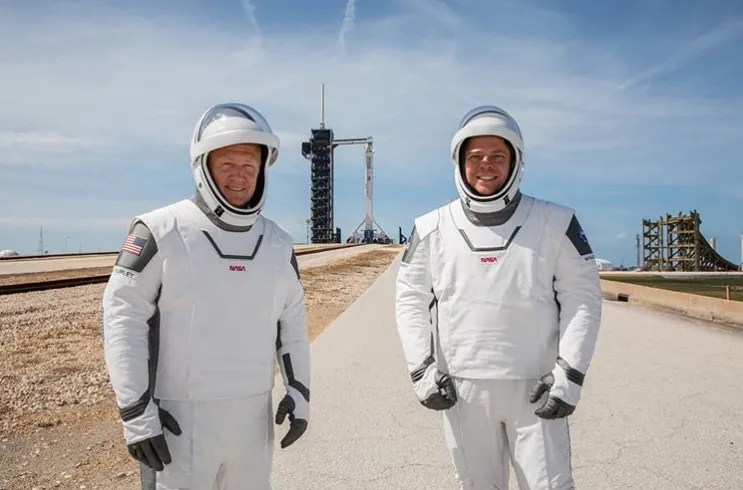
Image (Credit): SpaceX astronaut spacesuits for the Dragon capsule. (SpaceX)
Image (Credit): Spacesuits on Lost in Space. (Netflix)
NASA is projecting spending nearly $1 billion on a tug to deorbit the International Space Station at the end of the decade to provide redundancy for safely disposing of the station. NASA released additional details March 13 about its fiscal year 2024 budget proposal. An outline of the proposal, published by the White House March 9, requested $27.2 billion for the agency, a 7.1% increase from 2023 that roughly keeps pace with inflation.
Kazakh authorities have impounded the property of Russia’s main operator of spacecraft launching sites in Baikonur (Baiqonyr) in the Central Asian nation’s southern region of Qyzylorda…According to the media outlet, the decision was made due to the Russian state company’s debt of 13.5 billion tenges ($29.7 million) to the Baiterek Kazakh-Russian joint venture for work related to estimating ecological damage caused by Souyz-5 rockets.
NASA and the Department of Energy (DOE) are working together to develop a science instrument that will survive the harsh and unforgiving environment of the lunar surface at night on the far side of the Moon to attempt first-of-its-kind measurements of the Dark Ages of the Universe. The instrument, named the Lunar Surface Electromagnetics Experiment – Night (LuSEE-Night), is a collaboration between DOE’s Brookhaven National Laboratory, the DOE Office of Science, UC Berkeley’s Space Sciences Laboratory, and NASA’s Science Mission Directorate.
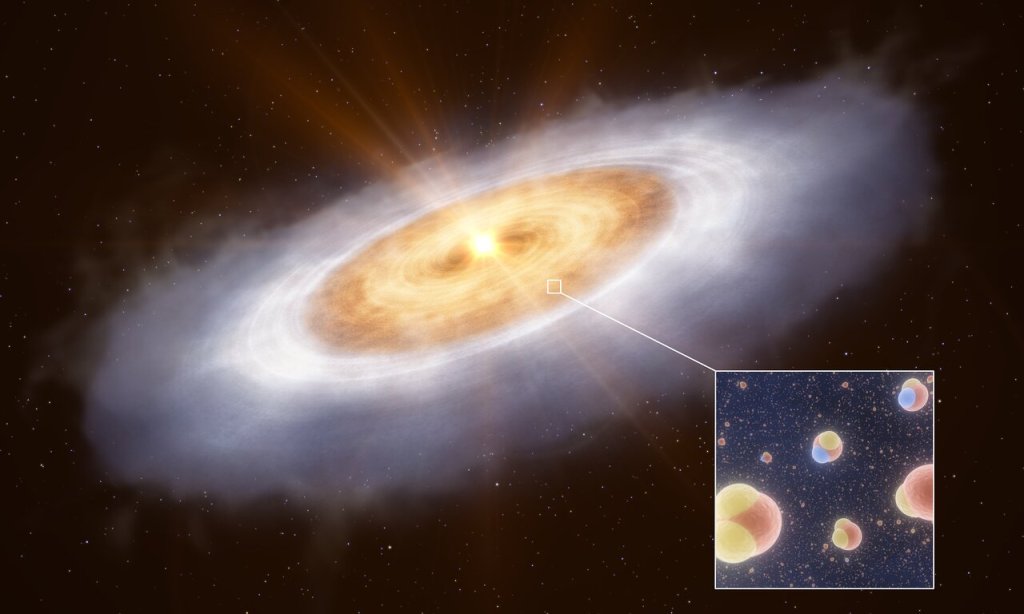
Using the Atacama Large Millimeter/submillimeter Array (ALMA), astronomers have detected gaseous water in the planet-forming disc around the star V883 Orionis. This water carries a chemical signature that explains the journey of water from star-forming gas clouds to planets, and supports the idea that water on Earth is even older than our Sun.
“We can now trace the origins of water in our Solar System to before the formation of the Sun,” says John J. Tobin, an astronomer at the National Radio Astronomy Observatory, USA and lead author of the study published today in Nature.
Astronomers have discovered the closest black hole to Earth, the first unambiguous detection of a dormant stellar-mass black hole in the Milky Way. Its close proximity to Earth, a mere 1,600 light-years away, offers an intriguing target of study to advance understanding of the evolution of binary systems.
What time is it on the moon? Since the dawn of the space age, the answer has been: It depends. For decades, lunar missions have operated on the time of the country that launched them. But with several lunar explorations heading for the launchpad, the European Space Agency has deemed the current system unsustainable. The solution, the agency said last week, is a lunar time zone.
The interview is with Peter Visscher, Director of Canadensys West, which is building the rover after receiving a contract from Canadian Space Agency’s Lunar Exploration Accelerator Program. Here is a little more about the rover and the partners on the mission:
The 30-kg lunar rover will be sent to the Moon’s south pole region as early as 2026. The rover will be carrying multiple science payloads from Canada and the US. Canadensys Aerospace is leading a broad team of partners, including NASA Ames Research Center, NGC Aerospace, Maya Heat Transfer Technologies, Nokia, Bubble Technology Industries, Waves in Space, Simon Fraser University, Western University, the University of Winnipeg, l’Université de Sherbrooke, Leap Biosystems, Surrey Satellite Technology, and RF Collins. The team’s scientific investigators are among the leading lunar researchers in Canada and the US and are affiliated with the core team organizations as well as Arizona State University, Planetary Science Institute, and University of Alberta.
The rover will explore the Moon’s South Pole as it searches for water ice. Such ice has already been detected from orbit, but this mission will test the soil in the area where the water was detected. Water on the lunar surface will be of great benefit to future missions on the Moon and elsewhere – it represents not only water itself, but oxygen for breathing and hydrogen for fuel.
The objectives of the mission were recently laid out by the Canadian government:
travel on the surface of the Moon to see how the various systems perform;
showcase the possible applications, feasibility and performance of a new technology;
make scientific measurements that will help determine the amount of hydrogen present in the Moon soil, which is one of the best indicators of water ice while defining at which temperatures it is detected;
analyze the lunar soil to better understand the geology of the site; and
assess lunar surface radiation to find out how much radiation future astronauts will be exposed to.
The interview in the podcast gives you more background on the project as well as potential plans to provide the rover with its own name.
NASA is working on another rover that it plans to send to the Moon’s surface by 2024 – Volatiles Investigating Polar Exploration Rover (VIPER). I can cover that mission and other lunar missions looking for water in a later post.