More Studies of the Moon – This Time Volcanoes

Image (Credit): The beautiful Gruithuisen Domes on the surface of the Moon. (NASA/GSFC/Arizona State University)

Earlier this month, NASA announced plans to to study volcanoes on the Moon as part of the Artemis Program. The mission, called the Lunar Vulkan Imaging and Spectroscopy Explorer (Lunar-VISE) investigation, will involve a stationary lander and mobile rover.

The mission will entail a 10-day survey of the summit of one of the Gruithuisen Domes to learn more about how these domes were formed without water or plate tectonics and how they evolved over time. The results will feed into future planning regarding robotic and human missions to the lunar surface.

Speaking of volcanoes on the Moon, you may have already read about the potential benefits of placing humans below the lunar surface in lava tubes. Such benefits include avoiding extreme temperature swings, radiation, and meteorite impacts. This NASA video, “Lava Tubes: Science Beneath the Surface of the Moon,” provides more background on NASA’s efforts to learn more about the Moon’s surface and the role of lava tubes.

This lava tube idea is also being pursued for a Martian habitat as well. I am not sure if people want to travel to a distant world only to hide underground, but given the dangers of surface habitation it seems this might be our best chance for long-term survival. Yes, a new race of extraterrestrial groundhogs.
Space Quote: NASA and ESA Cooperation

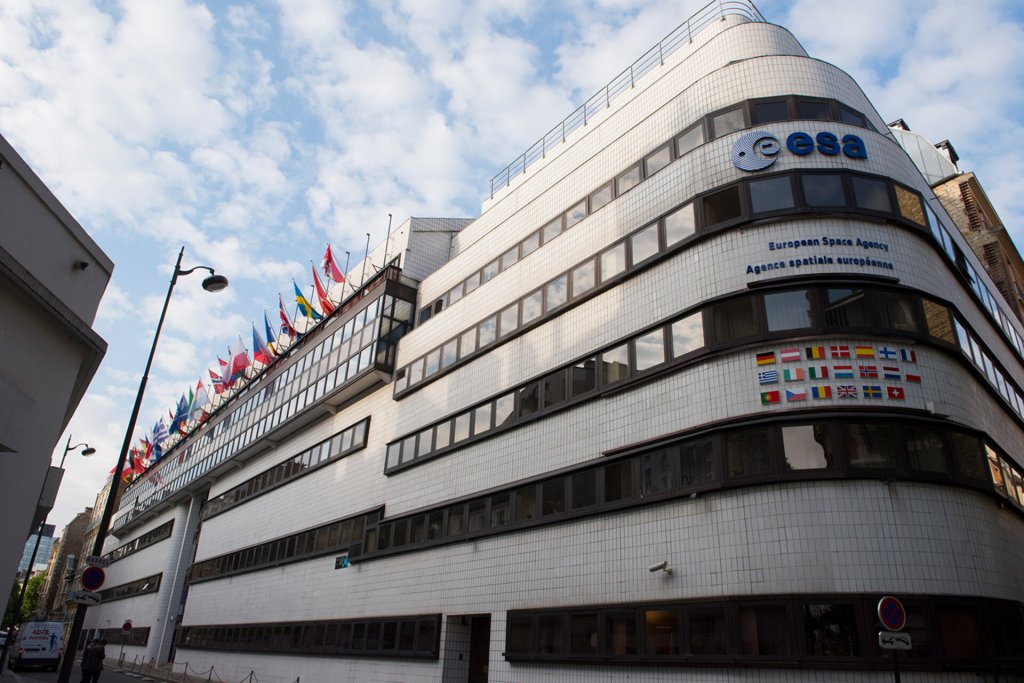
Image (Credit): European Space Agency (ESA) headquarters in Paris. (ESA)

“From understanding our changing planet to exploring Mars, I hugely value the cooperation we have with NASA…By contributing key European hardware and services to exciting programmes such as Artemis and Mars Sample Return, we are building Europe’s autonomy while also being a reliable partner.”

-Statement by ESA’s Director General Josef Aschbacher as part of the June 14-15 ESA Council meeting. See the press release, “N° 30–2022: From the Earth to the Moon and on to Mars – ESA and NASA take decisions and plan for the future.” for more on the meeting. The document also discusses plans to place a European astronaut on the Moon.

Chinese Map of the Moon

Image (Credit): Map of the Moon’s surface. (NSSDC Space Science Article Data Repository)

Earlier this month, China released a geological map of the Moon’s surface. It is to a scale of 1:2,500,000. Here is the accompanying description of the map:

Geologic maps of the Moon provide comprehensive information about the geologic strata, structural features, lithologies, and chronology of the lunar crustal surface, which reflect the evolution of the lunar crust under igneous processes, catastrophic impacts, and volcanic activities. The map in this repository is the first 1:2,500,000-scale lunar global geologic map, which incorporates the most comprehensive knowledge about the Moon by taking advantage of the latest exploration results and scientific findings. An updated lunar time scale is employed in this map to better reflect the dynamic evolution of the Moon. The map provides a state-of-the-art illustration of impact basins and craters of different periods, the distributions of 17 types of rocks and 14 types of structures.

With numerous countries considering lunar bases, greater details about the Moon’s surface could be very useful. I would have liked an overlay showing the various lunar mission remains already sitting on the Moon’s surface.

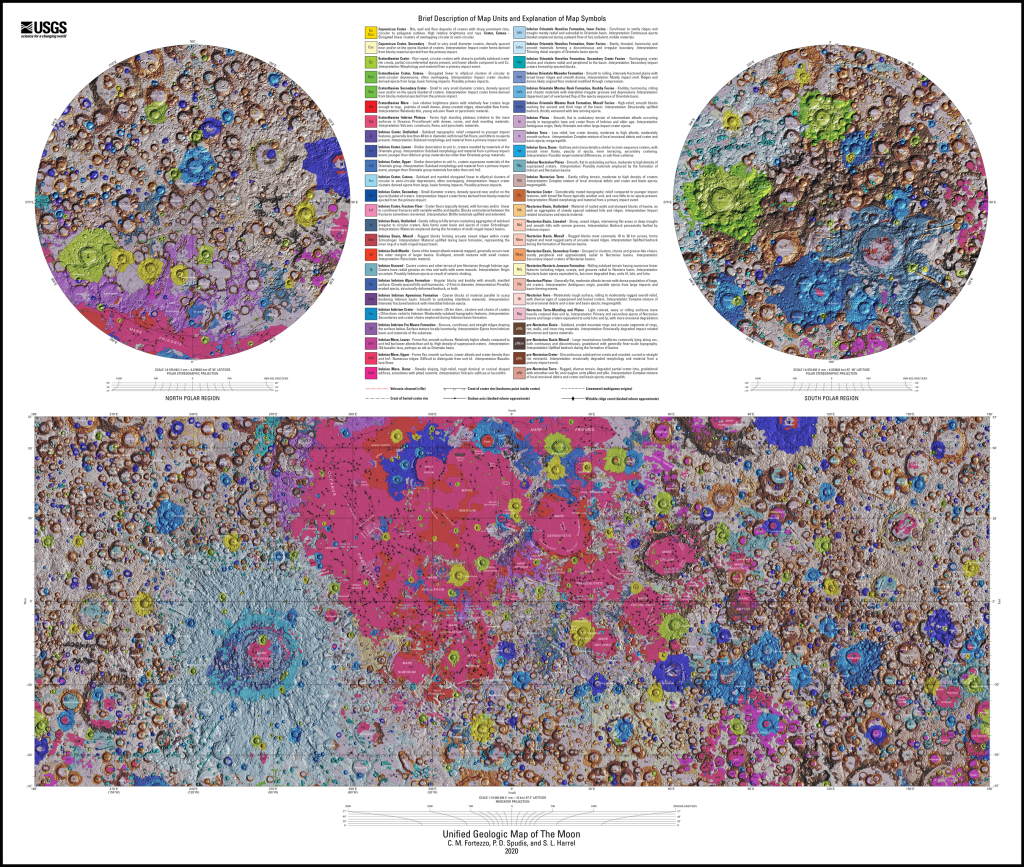
By the way, while the press is calling this the first comprehensive lunar map, there have been others, including the map below released two years ago by the U.S. Geological Survey’s (USGS) Astrogeology Science Center in Flagstaff, Arizona. I say the more maps the better for everyone.

Image (Credit): This new work represents a seamless, globally consistent, 1:5,000,000-scale geologic map derived from the six digitally renovated geologic maps. (USGS)

A New Suit for the Moon Mission

Image (Credit): Space suits in the television series Lost in Space. (Netflix)

U.S. companies Axiom Space and Collins Aerospace have been tasked to build new suits for NASA’s astronauts. The suits will be worn as part of the Artemis Program returning astronauts to the Moon. First, the new suits will be tested and used on the International Space Station (ISS).

While both companies are still in the early stages of developing the next space suite, the $3.5 billion Extravehicular Activity Services (xEVAS) Contract will support this development and production.

In a press release, Mark Kirasich, deputy associate administrator of NASA’s Artemis Campaign Development Division, stated:

Our commercial partnerships will help realize our human exploration goals…We look forward to using these services for NASA’s continued presence in low-Earth orbit and our upcoming achievement of returning American astronauts to the Moon’s surface. We are confident our collaboration with industry and leveraging NASA’s expertise gained through over 60 years of space exploration will enable us to achieve these goals together.

You may recognize the name Axiom Space. It was the company that worked with SpaceX to put private citizens on the ISS with its Axiom Mission 1 (Ax-1). It is also developing the world’s first commercial space station, the Axiom Station.

Collins Aerospace, part of Raytheon Technologies, has plenty of experience with space suits. The company designed the spacesuit used by the Apollo mission astronauts who landed on the moon. It also designed the space suits currently in use for missions outside the ISS.

NASA’s FY 2023 Budget Request

Credit: NASA

So what else did NASA Administrator Bill Nelson share with the Senate Committee on Appropriations last week (beyond his comments about the International Space Station)? In his prepared statement regarding NASA’s $26 billion budget request, he highlighted a number of priorities for his agency, including:

  • the Artemis Program to bring astronauts back to the Moon and related exploration costs – $7.5 billion;
  • continued support for the ISS – $4.3 billion;
  • the space technology research and development portfolio for the Moon, Mars, and other areas, such as sending the CAPSTONE CubeSat to the Moon as a pathfinder for the Artemis program – $1.44 billion;
  • greater science funding for projects such as exploring solutions for bringing the samples of Martian rock and soil collected by the Perseverance rover to Earth through the Mars Sample Return mission – $8 billion; and
  • supporting the civil aviation manufacturing sector with test flights on its Low Boom Flight Demonstrator, which will enable environmentally and socially acceptable supersonic passenger flights, as well as continued work on the X-57 Maxwell, an all-electric aircraft – $971 million.

NASA certainly has a lot on its place, and I did not even highlight the focus on Earth iteself, such as the planned Earth System Observatory, which is an array of satellites, instruments, and missions designed to generate a 3D, holistic view of the entire planet.

We just provided a $40 billion aid package to Ukraine so that it can defend itself and have a better future. This $26 billion will take us out of the realm of Earth-bound conflicts and allow us to find our future in the stars, or at least the solar system. It is money well spent.