Artemis I Launch: A Moving Target

Image (Credit): Status of Tropical Storm Nicole on Thursday morning. (The National Hurricane Center)

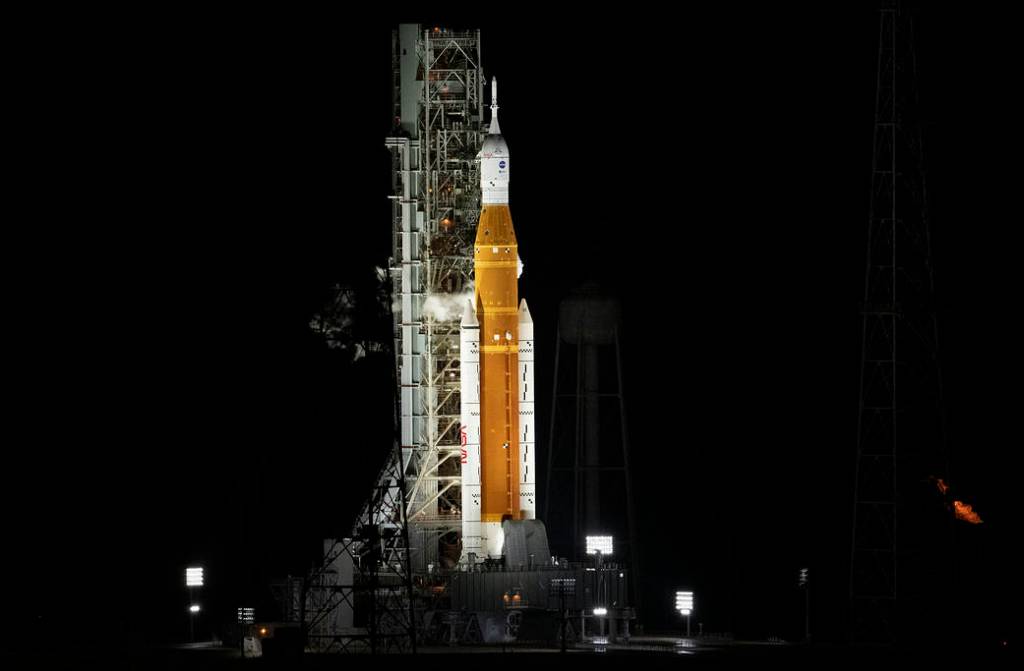
Florida does have its issues this time of year (and I don’t mean elections), making rocket launches more difficult. Now Tropical Storm Nicole is battering the state, leading to a delay in the upcoming Artemis I launch. The new launch date is November 16, as noted on NASA’s latest Artemis blog:

NASA is continuing to monitor Tropical Storm Nicole and has decided to re-target a launch for the Artemis I mission for Wednesday, Nov. 16, pending safe conditions for employees to return to work, as well as inspections after the storm has passed. Adjusting the target launch date will allow the workforce to tend to the needs of their families and homes, and provide sufficient logistical time to get back into launch status following the storm.

Gift Ideas: Lego Lunar Research Base

Image (Credit): Lego Lunar Research Base playset. (Lego)

While we await the Artemis III crew landing on the Moon and related lunar base, you might want to create your own mission with the Lego Lunar Research Base (shown above), which has “NASA-inspired” details. The playset has almost 800 Lego pieces, so you can build it yourself (to NASA specs, of course).

The playset comes with a “… lunar lander, VIPER rover and a domed accommodation module with laboratories, garage and air lock, plus 6 astronaut minifigures. I’m assuming the rocket that gets the astronaut minifigures to the Moon is sold separately.

And below is the Lego International Space Station is you are looking for something more traditional (and less expensive).

It’s great to see that Lego is allowing kids to build their own space missions at home.

Image (Credit): Lego International Space Station playset. (Lego)

Some of you may have played with Star Wars and Star Trek sets as kids, but at least these latest Lego set have a ring of credibility. Star Wars helped you destroy the galaxy, whereas Star Trek seemed more interest in exploration and at least had the veneer of Artemis CXXV.

I checked on whether Chinese and Russian kids with have their own space playsets and found the Russian Roscosmos Soyuz MS spacecraft (still a concept) and China’s Jiuquan Satellite Launch Center (made by a Lego copycat), both shown below.

Image (Credit): Lego version of the Russian Roscosmos Soyuz MS spacecraft. (Lego Ideas)
Image (Credit): Sembo Blocks version of the Jiuquan Satellite Launch Center. (http://www.whatsonweibo.com)

The Jiuquan Satellite Launch Center playset comes with a Long March 2F rocket and an authentic warning sign stating, “Those stealing secrets will be caught, once they’re caught they will be killed [decapitated].”

Maybe even reality is not always the best model for play.

Extra: You can find more Lego space models at the NASA gift shop.

RIP: Astronaut James A. McDivitt

Image (Credit): Astronaut James A. McDivitt. (HUM Images/Universal Images Group via Getty Images)

Back on October 13th we lost another Apollo astronaut. James McDivitt, age 93, passed away in his sleep.

Mr. McDivitt, a veteran fighter pilot from the Korean War, was a key part of the Gemini and Apollo missions. Part of NASA’s second class of astronauts, he was commander of the Gemini IV mission in June 1965, which conducted the first U.S. space walk, as well as the commander of Apollo 9, which set the stage for astronauts to land on the Moon.

As Andy Weir, author of The Martian, stated, “Astronauts are inherently insane. And really noble.” We should all remember the noble work of Mr. McDivitt and his peers in the early space program.

For more on Mr. McDivitt’s life, you can visit this NASA press release as well as this Washington Examiner obituary.

Space Stories: Approaching Lucy, Chinese Space Ambitions, and Conan the Bacterium

Image (Credit): Image from NASA’s Lucy spacecraft showing the Earth and Moon from 890,000 miles away (look closely – the moon on the left is a very pale dot). (NASA/Goddard/SwRI)

Here are some recent stories of interest.

NASA.gov: “NASA’s Lucy Spacecraft Captures Images of Earth, Moon Ahead of Gravity Assist

On October 13, 2022, NASA’s Lucy spacecraft captured [the above] image of the Earth and the Moon from a distance of 890,000 miles (1.4 million km). The image was taken as part of an instrument calibration sequence as the spacecraft approached Earth for its first of three Earth gravity assists. These Earth flybys provide Lucy with the speed required to reach the Trojan asteroids — small bodies that orbit the Sun at the same distance as Jupiter. On its 12 year journey, Lucy will fly by a record breaking number of asteroids and survey their diversity, looking for clues to better understand the formation of the solar system.

SpaceNews.com: “China Considering Mission to Ceres and Large Dark Matter Space Telescope

The Chinese Academy of Sciences is considering potential missions including a Ceres orbiter and a huge telescope to hunt for clues about the nature of dark matter. More than 20 candidates are vying for funding for further study under the Chinese Academy of Sciences Strategic Priority Program on Space Science, also known as the New Horizon Program, and are currently undergoing evaluation.

Space.com: “Extremophiles on Mars Could Survive for Hundreds of Millions of Years

One of Earth’s toughest microbes could survive on Mars, lying dormant beneath the surface, for 280 million years, new research has shown. The findings increase the probability that microbial life could still exist on the Red Planet. Deinococcus radiodurans, nicknamed “Conan the Bacterium,” is one of the world’s toughest microbes, capable of surviving in radiation strong enough to kill any other known life-form. Experiments have now shown that if Conan the Bacterium or a similar microbe existed on Mars, it could survive 33 feet (10 meters) beneath the surface, frozen and dried out, for 280 million years.

Study Findings: Fusible Mantle Cumulates Trigger Young Mare Volcanism on the Cooling Moon

Image (Credit): The Moon’s snakelike Schroeter’s Valley, believed to have been created by lava flowing over the surface. (NASA/Johnson)

Science Advances abstract:

[China’s] Chang’E-5 (CE5) mission has demonstrated that lunar volcanism was still active until two billion years ago, much younger than the previous isotopically dated lunar basalts. How the small Moon retained enough heat to drive such late volcanism is unknown, particularly as the CE5 mantle source was anhydrous and depleted in heat-producing elements. We conduct fractional crystallization and mantle melting simulations that show that mantle melting point depression by the presence of fusible, easily melted components could trigger young volcanism. Enriched in calcium oxide and titanium dioxide compared to older Apollo magmas, the young CE5 magma was, thus, sourced from the overturn of the late-stage fusible cumulates of the lunar magma ocean. Mantle melting point depression is the first mechanism to account for young volcanism on the Moon that is consistent with the newly returned CE5 basalts.

Citation: Su, B., Yuan, J., Chen, Y., et al. Fusible mantle cumulates trigger young mare volcanism on the cooling Moon. Science Advances (2022).
https://doi.org/10.1126/sciadv.abn2103

Study-related stories: