Bernie Sanders Has Questions About Private Space Companies

Image (Credit): Senator Bernie Sanders. (Rollcall)

In a recent The Guardian newspaper editorial, Bernie Sanders had some questions about the role of private companies, such as Blue Origin and SpaceX, in the future of space exploration or, as he sees it, space profiteering. In his editorial, “Jeff Bezos is worth $160bn – yet Congress might bail out his space company,” he noted the following:

At this moment, if you can believe it, Congress is considering legislation to provide a $10bn bailout to Jeff Bezos’s Blue Origin space company for a contract to build a lunar lander. This legislation is taking place after Blue Origin lost a competitive bid to SpaceX, Musk’s company. Bezos is worth some $180bn.

He then cites the costs of Jeff Bezos’ yacht and homes while pointing out the plight of those living paycheck to paycheck. Of course, the same could be said about Elon Musk, rumored to be the wealthiest man in the world and now in the papers for buying another company unrelated to space (or the car industry).

First, this battle between Bernie and Bezos has been going on for some time, but the “bailout” in question was debunked by Verifythis.com last year, which stated:

Although NASA recently chose SpaceX over Blue Origin and one other company to receive funding for development of a human lunar lander, NASA stated in its decision that it wanted to fund two companies but lacked the budget to even fund one without negotiating the price down. The Senate bill is in response to that, allocating NASA enough funding to award a second contract. Blue Origin is the likely frontrunner for that contract, but it’s not guaranteed. Even if Blue Origin does win the contract, the allocated $10 billion to NASA isn’t just for this contract and therefore wouldn’t all go to Blue Origin.

Of course, the editorial is really a lead in to the real issue – who owes the minerals in space? Mr. Sanders highlights the worth of a single asteroid, stating “Just a single 3,000ft asteroid may contain platinum worth over $5tn.” It is a good point as we consider the next great race for minerals. Of course, maybe Uncle Sam can get some of it back via taxes, but it is not hard to believe space companies would incorporate in the Bahamas or somewhere similar to avoid such taxation.

Mr. Sanders is calling for a “rational space policy,” and wants Congress to be part of the process. Given the number of nations heading to the Moon and Mars, it is much bigger than the U.S. Congress. The United Nations will need to play a role here via the Outer Space Treaty, which NASA is attempting to update via the Artemis Accords. In addition, maybe Congress needs to update the rescind the 2015 U.S. Commercial Space Launch Competitiveness Act, which states in § 51303:

A United States citizen engaged in commercial recovery of an asteroid resource or a space resource under this chapter shall be entitled to any asteroid resource or space resource obtained, including to possess, own, transport, use, and sell the asteroid resource or space resource obtained in accordance with applicable law, including the international obligations of the United States.

By the way, NASA has already issued a press release regarding more lunar lander opportunities. You can find the press release here.
Podcast: A Chat with Astronaut Chris Hadfield

Alan Alda recently interviewed Canadian astronaut Chris Hadfield to discuss his space work, singing career, and recent book. You can catch all of it on Mr. Alda’s podcast Clear+Vivid. For instance, Mr. Hadfield notes that he used duct tape on the International Space Station (ISS) to cover over bullet-sized holes in the station’s exterior handrails torn up by space debris. This is not exactly a high-tech solution, but it works and prevents the rough edges of the damaged rails from tearing into this space suit.

Mr. Hadfield also shares his story about the time he was blinded during an ISS space walk. Amazingly, he continued with the eight-hour space walk after a quick fix bled air from his suit and restored his vision.

You can also learn about the work that went into his now famous space-based version of David Bowie’s “Space Oddity” (see below). He notes that he had plenty of time on the ISS to write his own songs as well.

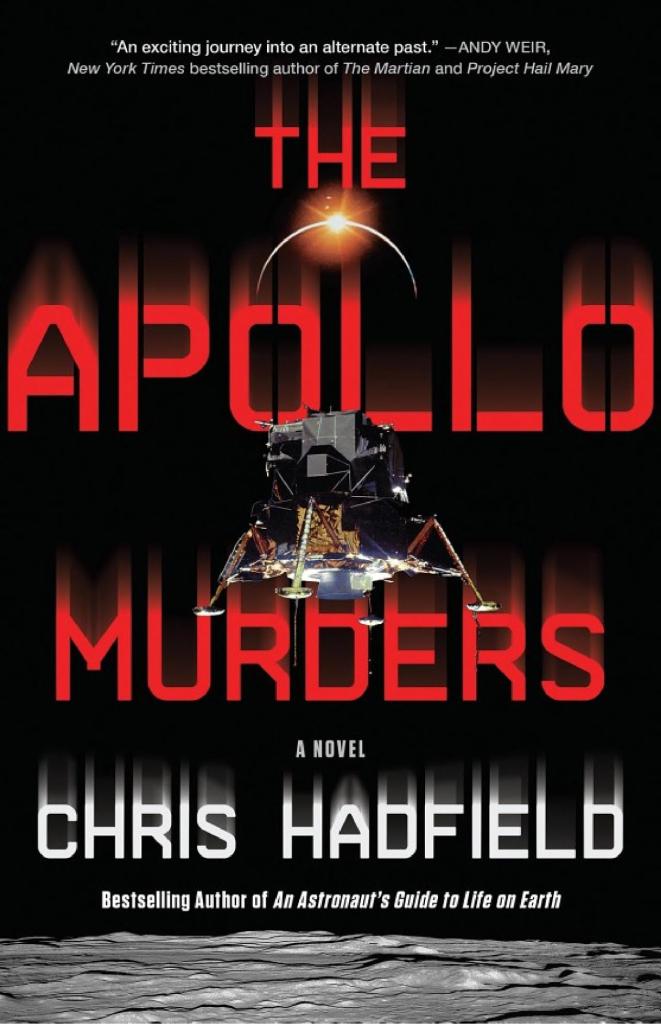
And should you be looking for a good adventure book, Mr. Hadfield book The Apollo Murders may solve that craving. It has enough real space stories intertwined within this thriller to keep it interesting. Here is the blurb for the book:

1973: a final, top-secret mission to the Moon. Three astronauts in a tiny spaceship, a quarter million miles from home. A quarter million miles from help.

NASA is about to launch Apollo 18. While the mission has been billed as a scientific one, flight controller Kazimieras “Kaz” Zemeckis knows there is a darker objective. Intelligence has discovered a secret Soviet space station spying on America, and Apollo 18 may be the only chance to stop it.

But even as Kaz races to keep the NASA crew one step ahead of their Russian rivals, a deadly accident reveals that not everyone involved is quite who they were thought to be. With political stakes stretched to the breaking point, the White House and the Kremlin can only watch as their astronauts collide on the lunar surface, far beyond the reach of law or rescue.

Full of the fascinating technical detail that fans of The Martian loved, and reminiscent of the thrilling claustrophobia, twists, and tension of The Hunt for Red October, The Apollo Murders is a high-stakes thriller unlike any other. Chris Hadfield captures the fierce G-forces of launch, the frozen loneliness of space, and the fear of holding on to the outside of a spacecraft orbiting the Earth at 17,000 miles per hour as only someone who has experienced all of these things in real life can.

Strap in and count down for the ride of a lifetime.

Alan Alda calls Mr. Hadfield a great communicator for space programs. Given all of his efforts and talents, it is hard to disagree.

Image (Credit): Chris Hadfield’s video singing “Space Oddity” on the ISS. (Canadian Space Agency)
Image (Credit): Chris Hadfield’s latest book. (Mulholland Books)

Movies: Apollo 10 1/2

Image (Credit): Scene from Netflix’s film Apollo 10 1/2. (Netflix)

Last week’s film was about young adults in space, but now we are hitting elementary school for the right stuff. This Nextflix film, Apollo 10 1/2: A Space Age Childhood, is a good weekend movie for the whole family if you are looking for something light. The basic story is that NASA flubbed its Apollo program and created a lunar spaceship that is too small for adult astronauts. Hence, instead of sending a dog into space like the Russians, NASA goes to elementary school for what it needs. Here is a clip of the film narrated by Stan, the astroboy, and directed by Richard Linklater (from other films such as Boyhood and Before Sunrise).

Rogerebert.com, which notes that the films does a pretty good job providing context on American life in the late 60s, gives the movie three stars (out of a possible four), stating:

Stan is a thoroughly likable storyteller, and there’s something to be said, in an era when Hollywood couldn’t care less about any idea not based on an pre-existing property, for intimate, personal films that don’t take you where you think you want to go.

It may be a silly plot, but given the state of the world at the moment it might also be a nice diversion. And don’t worry – it is my understanding that the Artemis lunar mission is being planned for full-sized adults.

Moon Craters and the Russians

Image (Credit): USSR’s Luna 2 spacecraft. (Worldhistoryproject.org)

So who owned the rocket stage that hit the Moon earlier this month? I had earlier noted the speculation pertaining to both SpaceX and then the Chinese rockets. Surprisingly, it is still is not clear who owned that rocket stage and maybe we will never know. That is not a good answer for the European Space Agency’s Space Safety Programme, which stated:

The upcoming lunar impact illustrates well the need for a comprehensive regulatory regime in space, not only for the economically crucial orbits around Earth but also applying to the Moon.

While that case has yet to be solved, we are pretty certain about the first Earth-launched rocked to hit the Moon. We can blame the Soviets for that strike back in 1959 with its Luna 2 (nicknamed the Lunik 2). At least the goal in that case was to hit the Moon.

Launched on September 12, 1959, it took 35 hours to travel the distance between the Earth and Moon. Luna 1, launched by the Soviets earlier that year, was supposed to hit the Moon but it missed by about 3,700 miles. You can see more about Luna 2 via this dated news clip.

Movies: A Romance Set on Mars

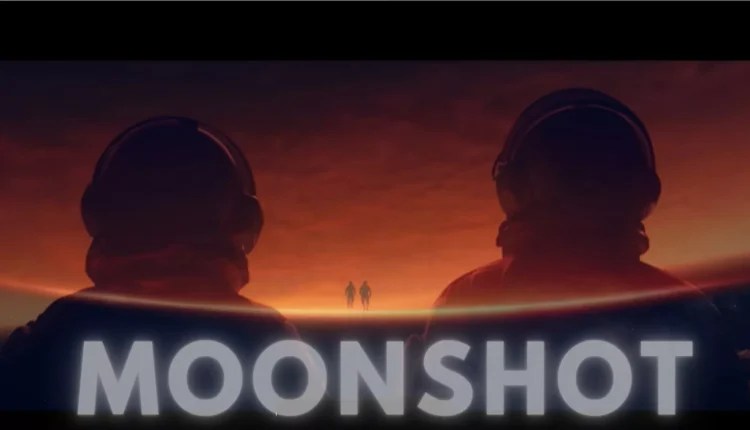
Image (Credit): Upcoming HBO movie Moonshot. (HBO)

On March 31st you can can watch another space-related movie, though this one has a misleading name. Called Moonshot, the setting is actually a space colony on Mars. You can watch a trailer of the HBO Max movie here.

While its just a platform for a young adult romantic comedy, it will be fun to see how the film portrays life on the Red Planet. Given that it includes a stowaway on the trip to Mars, you have to wonder what kind of space program these people are running when every pound of extra weight is critical.

Of course, Netflix already did the Mars mission stowaway story in last year’s film Stowaway.

So don’t think too hard. Just enjoy the spacecraft and scenery.