New Double Crater on the Moon

Image (Credit): Double crater from a rocket body that impacted the Moon on March 4, 2022, near Hertzsprung crater. (NASA/Goddard/Arizona State University)

Remember all of the chatter earlier this year about whether a SpaceX or Chinese rocket booster was about read to hit the Moon? Well, NASA’s Lunar Reconnaissance Orbiter recently located the crater created by this object – a strange double crater. NASA reported it found an eastern crater (18-meter diameter, about 19.5 yards) superimposed on a western crater (16-meter diameter, about 17.5 yards).

While NASA has not seen double craters when other booster rockets hit the Moon’s surface (yes, it does happen occasionally), it tried to explain this one:

The double crater was unexpected and may indicate that the rocket body had large masses at each end. Typically a spent rocket has mass concentrated at the motor end; the rest of the rocket stage mainly consists of an empty fuel tank. Since the origin of the rocket body remains uncertain, the double nature of the crater may indicate its identity.

Now we just need to go back to Space X and the Chinese and ask a few more questions about the rocket booster in question. It is still doubtful we have an Elon Musk crater on the Moon. Time will tell.

Artemis Rocket Launch Planned for August

Image (Credit): NASA’s Space Launch System rocket. (NASA)

NASA said it is ready for a real test of the Space Launch System (SLS) and Orion capsule after multiple dry-runs. Of course, the tests were not perfect, but NASA said it is ready for the next phase. The latest test was on June 20th. Following that, Tom Whitmeyer, deputy associate administrator for common exploration systems at NASA Headquarters, stated:

During the wet dress rehearsal activities, we have incrementally added to our knowledge about how the rocket and the ground systems work together, and our teams have become proficient in launch procedures across multiple sites. We have completed the rehearsal phase, and everything we’ve learned will help improve our ability to lift off during the target launch window…The team is now ready to take the next step and prepare for launch.

The uncrewed launch itself could be as early as late August. Under this phase of the project, called Artemis 1, the rocket, capsule, and ground control will get a rigorous test. As NASA explains:

During this flight, the spacecraft will launch on the most powerful rocket in the world and fly farther than any spacecraft built for humans has ever flown. It will travel 280,000 miles from Earth, thousands of miles beyond the Moon over the course of about a four to six-week mission. Orion will stay in space longer than any ship for astronauts has done without docking to a space station and return home faster and hotter than ever before.

NASA has come a long way to get this this step. The various problems along the way is why you have such tests. And now the first phase is about ready. Fingers crossed…

Image (Credit): Artemis 1 mission map. (NASA)

More Studies of the Moon – This Time Volcanoes

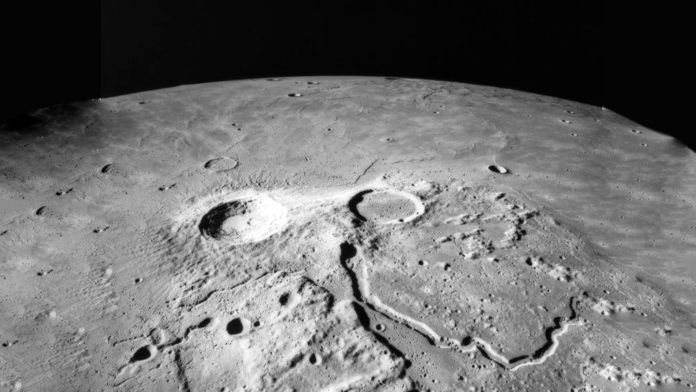
Image (Credit): The beautiful Gruithuisen Domes on the surface of the Moon. (NASA/GSFC/Arizona State University)

Earlier this month, NASA announced plans to to study volcanoes on the Moon as part of the Artemis Program. The mission, called the Lunar Vulkan Imaging and Spectroscopy Explorer (Lunar-VISE) investigation, will involve a stationary lander and mobile rover.

The mission will entail a 10-day survey of the summit of one of the Gruithuisen Domes to learn more about how these domes were formed without water or plate tectonics and how they evolved over time. The results will feed into future planning regarding robotic and human missions to the lunar surface.

Speaking of volcanoes on the Moon, you may have already read about the potential benefits of placing humans below the lunar surface in lava tubes. Such benefits include avoiding extreme temperature swings, radiation, and meteorite impacts. This NASA video, “Lava Tubes: Science Beneath the Surface of the Moon,” provides more background on NASA’s efforts to learn more about the Moon’s surface and the role of lava tubes.

This lava tube idea is also being pursued for a Martian habitat as well. I am not sure if people want to travel to a distant world only to hide underground, but given the dangers of surface habitation it seems this might be our best chance for long-term survival. Yes, a new race of extraterrestrial groundhogs.

Space Quote: NASA and ESA Cooperation

Image (Credit): European Space Agency (ESA) headquarters in Paris. (ESA)

“From understanding our changing planet to exploring Mars, I hugely value the cooperation we have with NASA…By contributing key European hardware and services to exciting programmes such as Artemis and Mars Sample Return, we are building Europe’s autonomy while also being a reliable partner.”

-Statement by ESA’s Director General Josef Aschbacher as part of the June 14-15 ESA Council meeting. See the press release, “N° 30–2022: From the Earth to the Moon and on to Mars – ESA and NASA take decisions and plan for the future.” for more on the meeting. The document also discusses plans to place a European astronaut on the Moon.

Chinese Map of the Moon

Image (Credit): Map of the Moon’s surface. (NSSDC Space Science Article Data Repository)

Earlier this month, China released a geological map of the Moon’s surface. It is to a scale of 1:2,500,000. Here is the accompanying description of the map:

Geologic maps of the Moon provide comprehensive information about the geologic strata, structural features, lithologies, and chronology of the lunar crustal surface, which reflect the evolution of the lunar crust under igneous processes, catastrophic impacts, and volcanic activities. The map in this repository is the first 1:2,500,000-scale lunar global geologic map, which incorporates the most comprehensive knowledge about the Moon by taking advantage of the latest exploration results and scientific findings. An updated lunar time scale is employed in this map to better reflect the dynamic evolution of the Moon. The map provides a state-of-the-art illustration of impact basins and craters of different periods, the distributions of 17 types of rocks and 14 types of structures.

With numerous countries considering lunar bases, greater details about the Moon’s surface could be very useful. I would have liked an overlay showing the various lunar mission remains already sitting on the Moon’s surface.

By the way, while the press is calling this the first comprehensive lunar map, there have been others, including the map below released two years ago by the U.S. Geological Survey’s (USGS) Astrogeology Science Center in Flagstaff, Arizona. I say the more maps the better for everyone.

Image (Credit): This new work represents a seamless, globally consistent, 1:5,000,000-scale geologic map derived from the six digitally renovated geologic maps. (USGS)