The Chairwoman of the UAE Space Agency and the Mission to Mars

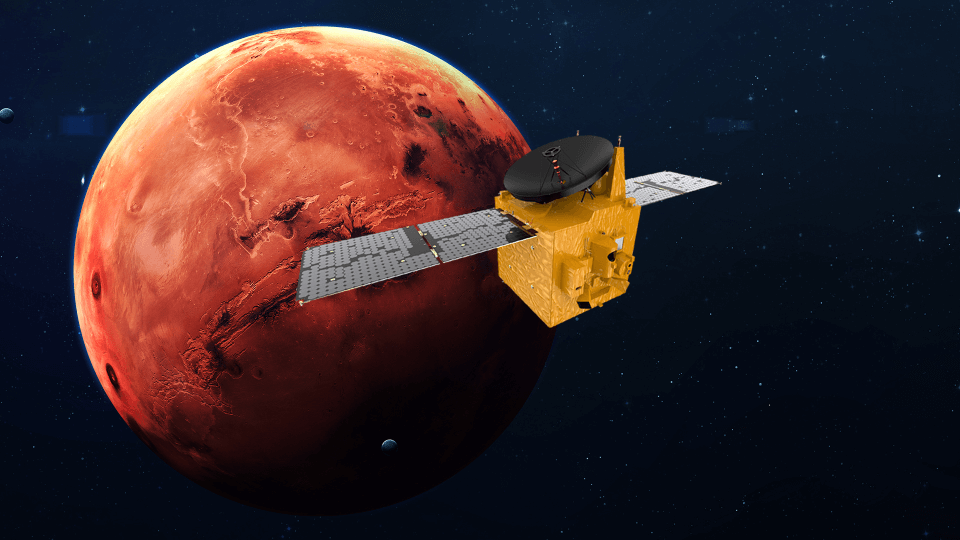
Image (Credit): Artist’s image of UAE’s Hope probe orbiting Mars. (UAE Space Agency)

You may want to visit Time magazine and view the article “The Woman Who Took the UAE to Mars.” It summarizes Sarah Al Amiri’s efforts related to the United Arab Emirates’ mission to Mars as well as her plans for the country’s space agency, which she now heads as Chairwoman.

Prior to becoming Chairwoman, Ms. Amiri was deputy project manager of a mission to map the Martian atmosphere. Her team, which was 80 percent female, developed the Hope probe to accomplish this goal. The probe was launched aboard a Japanese rocket in July 2020 and now orbits Mars. The data obtained from this mission is being shared openly to assist others studying the Martian atmosphere.

Another mission mentioned in the Time article by Chairwoman Amiri is a tour of seven asteroids as well as a flyby of Venus. A UAE space page defines the mission in this way:

The spacecraft will undertake a 3.6 billion-kilometre, five-year journey, which will see it perform gravity assist manoeuvres by orbiting first Venus, then Earth in order to build the velocity required in order to reach the main asteroid belt, located beyond Mars…The mission will study seven main belt asteroids…The mission will make its first close planetary approach orbiting Venus in mid-2028, followed by a close orbit of Earth in mid-2029. It will make its first fly-by of a main asteroid belt object in 2030, going on to observe a total of seven main belt asteroids before its final landing on an asteroid 560 million kilometres from Earth in 2033. This will make the Emirates the fourth nation to land a spacecraft on an asteroid.

What was not mentioned in the story but is available via another UAE government page is plans for several other space endeavors, including:

  • Sending a rover to the Moon in 2024. The rover’s name is Rashid, named in honor of the late Sheikh Rashid bin Saeed Al Maktoum, former Ruler of Dubai.
  • Establishing a settlement on Mars by 2117, and building a Mars Science City within the UAE to make this Martian mission possible.
The Future of the International Space Station

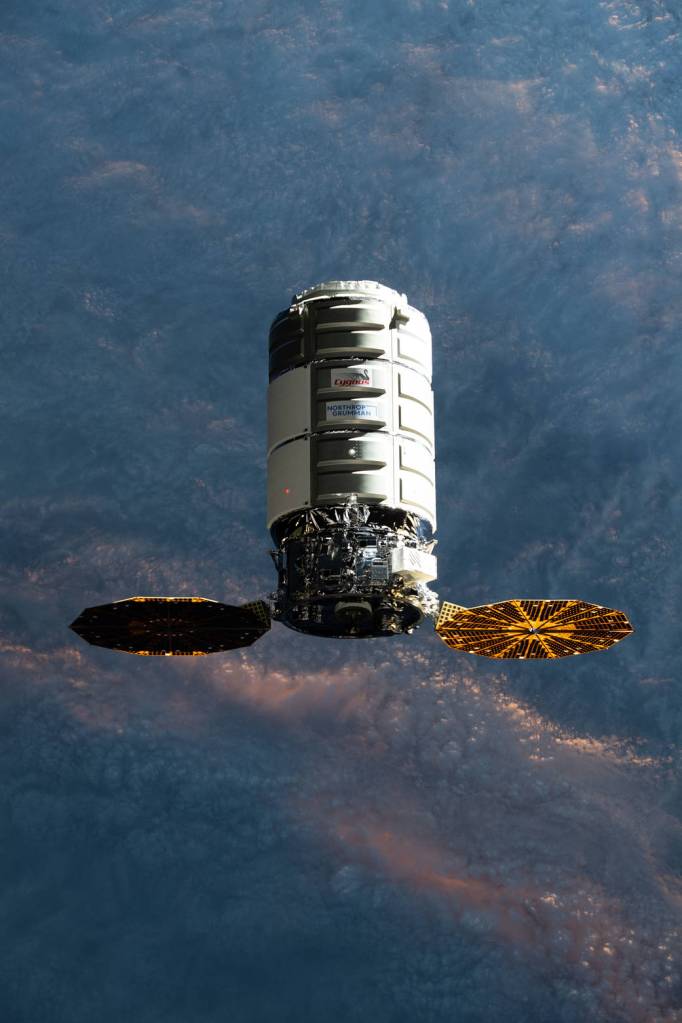
Image(Credit): Northrop Grumman’s Cygnus space freighter approaching the International Space Station (NASA).

Over the weekend, the Washington Post published an editorial by Homer Hickam, former NASA engineer and advisor to the National Space Council, titled, “Our space partnership with Russia can’t go on.” In the piece, Mr. Hickam argues that the International Space Station (ISS) has accomplished its goals and the US can now move onto other projects without the Russians:

With our flourishing commercial space companies, who are already cutting metal on their own future space stations, plus our federal government’s Artemis moon program, the United States is entering a new golden age of space exploration. The Russians, meanwhile, are stuck in the past with antiquated spacecraft and nowhere to go except the ISS.

Mr. Hickam appears to believe pushing out the Russians may mean the end of the ISS. Of course, this is just one man’s view, and whatever we do we need to do it in conjunction with our other ISS partners.

We could continue to maintain the ISS through 2030, as planned, and schedule more useful science even without the Russians as partners. This may make sense until we have another viable station that we can use, such as NASA’s planned lunar Gateway. Russia will not be part of the Gateway given that it is working with China on other lunar plans, so we do not need to worry about another breakup.

It would be better if Russia had focused on its space accomplishments rather than territorial ambitions as it prepares for the future. Joint space programs are a great way to use rockets for peaceful missions. I am not against a space race that pushes us even farther into space, yet I would prefer it be fueled by scientific achievement rather than nationalist angst.

Image(Credit): Artist rendering of the Artemis lunar Gateway (NASA).

A Day in Astronomy: The Discovery of Uranus

Source/Credit: Image of Uranus taken by Voyager 2 in 1986 (NASA).

On this day in 1781, astronomer Frederick William Herschel noticed a new object in the constellation of Gemini. With further study, he found he had discovered a new planet in our solar system – Uranus. Following his discovery, King George III appointed him Court Astronomer (yes, that King George who did not get many kind words from the embattled colonists on the other side of the pond).

While Frederick William Herschel is credited with numerous astronomical findings (including finding a number of moons, such as Saturn’s Enceladus, and discovering infrared radiation), he was also an accomplished musician. He played the oboe, violin, harpsichord and organ, and composed 24 symphonies as well as concertos, sonatas, and more. You can hear one of his symphonies here.

He was also a man with strong views about life beyond the Earth, including believing the Moon and the planets were populated with intelligent life (stating the surface of the Moon was similar to the English countryside) and speculating that the interior of the sun was heavy populated. Of course, he was a bit off the mark, but I expect he would be fascinated with the discovery of other planets and moons around the galaxy.

Extra: Frederick William Herschel’s sister Caroline assisted him with his work and also became an astronomer herself. For instance, she discovered a companion galaxy to the Andromeda Galaxy, M110 (NGC 205). She also discovered 14 nebulae and 8 comets. For her work cataloging stars, she was awarded the Gold Medal of the Royal Astronomical Society. She also became an Honorary Member of the Royal Astronomical Society in 1835.

Pic of the Week: Lunar Transit

Source/Credit: Thierry Legault

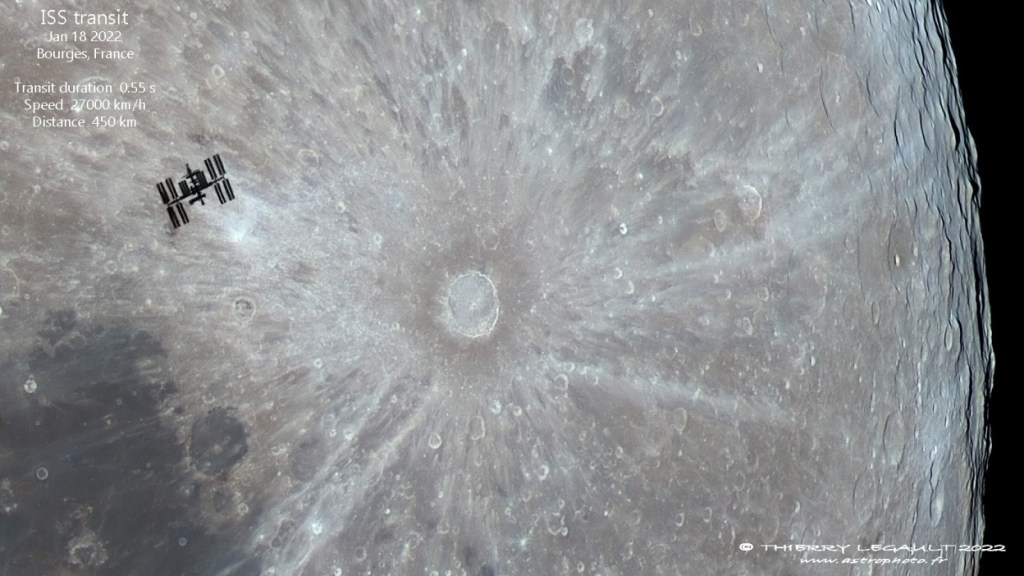
This week’s photo is a “lunar transit” of the International Space Station (ISS) taken on January 18, 2022. The details in the photo are impressive, including Tycho crater. The Mashable article accompanying this image states:

The silhouette of the space station is so clear, observers can make out a faint grid pattern on its solar panel arrays. The attached SpaceX Crew-3 spacecraft, which brought up NASA astronauts Raja Chari, Tom Marshburn, and Kayla Barron, as well as European Space Agency astronaut Matthias Maurer in November, is easily identifiable.

Is the U.S. Falling Behind in the Space Race?

Source/Credit: Yutu 2 rover on the dark side of the moon from the China National Space Administration.

As much as we talk about cooperation in space, it is always nice to be the first nation to pass a milestone, be it the first man on the Moon or the first probe of Pluto. The U.S. has plenty of great stories about space travel, as do the Russians, and now the Chinese are creating their own stories. For instance, China’s Yutu 2 rover was the first rover to explore the dark side of the Moon.

Now Politico magazine is worried about China taking the lead in some areas, as well as militarizing space. A recent article, “‘We’re falling behind’: 2022 seen as a pivotal lap in the space race with China,” discussed the race for the moon as well as delays in the U.S. spacecraft to get us there:

A linchpin of the NASA moon effort is the Space Launch System, the Boeing-built mega-rocket that has been beset by years of delay and cost overruns that is finally set to make its maiden test flight in 2022.

The U.S., Russia, and China all have designs on the moon:

The U.S. moon program has been enlisting international partners in the form of the Artemis Accords, which now includes more than a dozen countries. But Russia and China, which are pursuing a lunar research station, are also seeking partners.

We already know that the U.S. hopes to have astronauts on the Moon in 2024, so what are the Russian and Chinese schedules for their projects? It appears the two nations are working on a joint lunar research base scheduled for the 2030s. However, not everyone is convinced this will happen. A Foreign Policy article, “A Chinese-Russian Moon Base? Not So Fast,”voiced skepticism that the two nations can generate sufficient funding, technological know-how, and political unity to pull off such a mission, citing earlier joint attempts, including a Martian mission:

In 2007, China and Russia signed an agreement for “joint Chinese-Russian exploration of Mars,” culminating in a 2011 launch of a Mars orbiter and landing craft. However, the Russian rocket malfunctioned, causing Russian and Chinese spacecraft to come crashing back down to Earth, an embarrassing conclusion to both countries’ first attempt to reach the red planet.

The two nations seems to be even more unified against the U.S. since this Foreign Policy article was published, so anything is possible. However, the U.S. did pretty well in the 1960s and 1970s after initially trailing the Russians, so my money is still on the U.S. in this latest race.